
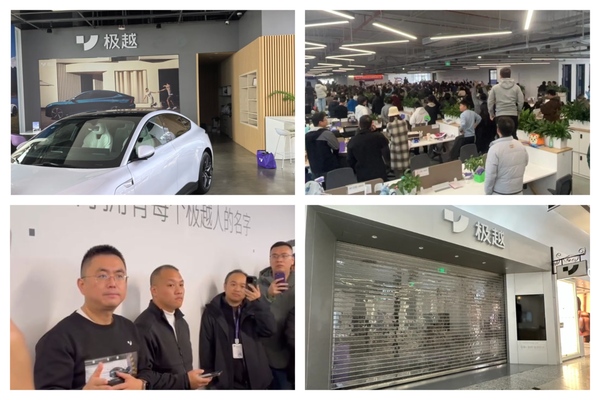
In the Chinese automotive industry, there is an overcapacity issue causing intense internal upheaval among car manufacturers. Price wars have resulted in the suspension of operations of 35 car companies, with over 190,000 new energy vehicles becoming “unfinished projects” due to difficulties in maintenance, inability to upgrade software, refusal of insurance companies to provide coverage, and other major issues. As the culling process in the Chinese automotive industry intensifies, the number of “unfinished” new energy vehicles will continue to grow.
According to data compiled by CarQuality.net, from 2020 to present, 35 car brands have officially exited the Chinese market through bankruptcies, closures, or reorganization. These include both traditional carmakers like Dongfeng Yulon, Lifan, Zotye, and Borgward, as well as emerging players in the industry such as Xiaopeng Motors, WM Motor, NextEV, Aiways, Enovate, Byton, Borgward, Youxia, Yunding, Iconiq, Redspace, Qiantu, Nio, Enovate, Hezhong, Singulato, and Xin Tech.
At the end of October 2023, Wang Du, assistant to the president of the China Automobile Dealers Association, stated that domestically, more than 160,000 existing car owners are affected by the bankruptcy or prolonged non-production of new energy car companies, with around 110,000 of them being WM Motor car owners.
Investigations by the Epoch Times revealed that among the new energy car companies that closed between October 2023 and the present include WM Motor and Enovate. WM Motor, which closed in December this year, had sold over 14,000 vehicles. Enovate, which went bankrupt and restructured in July, had a total sales volume of over 17,000 vehicles. It is evident that up to now, the aftermath of suspended new energy vehicle operations has affected over 190,000 car owners.
AC Automotive conducted an inventory and found that between 2020 and February 2024, 24 car companies have ceased operations, which conservatively estimated to impact approximately 6 million car owners. Noteworthy figures include 1.6 million vehicles from Zotye, 1 million from Lifan, and 950,000 from GAC FCA.
In October this year, Wei Jianjun, chairman of Great Wall Motors, openly remarked that while consumers may enjoy short-term benefits from purchasing at low prices, for those brands that have already closed, the resale value of their used cars has plummeted to nearly scrap metal levels. Additionally, finding repair services has become increasingly challenging.
Epoch Times reporters, after reviewing reports from mainland media and online car owner comments, identified five major issues with the sale of vehicles from failed new energy car companies.
Firstly, there is a significant depreciation in the value of used cars. For example, the WM EX5 model, priced at over 200,000 yuan, is now being offered at around 40,000-50,000 yuan on secondary car trading platforms. Some owners are attempting to sell nearly new Enovate 01 models on these platforms, bought at the end of September and with just 5,000 kilometers on them, for 140,000 yuan, compared to the original price of 249,000 yuan, resulting in a significant loss in just three months.
Secondly, the functionality of vehicles is limited. Following the bankruptcy of car manufacturers, software is not maintained, leading to the inability to use essential features such as autonomous driving, thus compromising both driving safety and experience. Post the shutdown of Xiaopeng Motors, some car owners reported online that the 4,999-yuan advanced autonomous driving feature can no longer function properly.
Thirdly, there are challenges in maintenance and repairs. With post-sales services suspended, car owners are forced to seek repairs at third-party workshops, incurring high costs and facing difficulties obtaining critical spare parts such as motors, batteries, and electronic control units. Most of these components were custom-made by manufacturers for the car companies; once the carmakers cease operations, there is no incentive for the suppliers to continue manufacturing these specialized components.
The Automobile Sales Management Measures issued by the Ministry of Commerce of the Communist Party of China stipulate that for discontinued or halted car models, car manufacturers should ensure the supply of spare parts for at least ten years, along with corresponding after-sales services. However, once a company closes down, these requirements become unenforceable.
If a manufacturing defect arises, there is no mechanism for recall. Recent reports from the Ministry of Industry and Information Technology of the CPC indicated that Skyline Motors, which has already applied for bankruptcy liquidation, has issues with energy consumption that do not meet standard requirements. However, Skyline Motors explicitly stated that due to the large number of affected products, they will not proactively implement a product recall unless there are new policy requirements.
Insurance companies are also refusing coverage. The Qilu Evening News reported that new energy vehicle owners are commonly denied insurance coverage by insurance companies, especially for discontinued models where parts supply issues remain unresolved. Some leading insurance companies are no longer providing coverage for car damage from vehicles manufactured by companies that are no longer in operation.
As for why these closed new energy vehicle manufacturers cannot be acquired to resolve the issue of “unfinished projects,” CarQuality.net points out that certain new brands emerged relying heavily on capital financing, without the backing of a major group, lacking the proper manufacturing qualifications, and even renting factories and production lines. Once they fail due to mismanagement or a lack of funds, it becomes nearly impossible to find enterprises willing to take over. These new brands have relatively short establishment histories and have not yet established brand influence and recognition. Hence, in the eyes of potential acquirers, they hold little to no market value and are seen as burdensome entities.
As the elimination competition in the Chinese automotive industry intensifies, the number of unfinished projects will continue to grow. Xiaopeng Motors CEO He Xiaopeng stated, “2024 marks the first year of a fierce competition for Chinese new energy vehicle brands; the first year of elimination competition.”
From the shutdown of Enovate Motors to multiple reports of mismanagement at NIO, and now Xiaopeng Motors’ sudden halt, the new energy vehicle market has shifted from price wars to elimination battles.
Li Xiang, CEO of Li Auto, believes that there will be a turning point in the Chinese new energy vehicle market in 2025. Li Auto aims to capture at least 20% market share to secure a ticket for the next phase of competition. This implies that at most five new energy car companies will have the opportunity to survive in the future.