
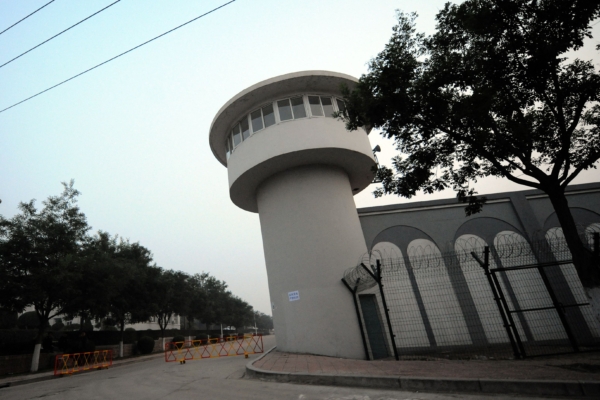
In recent years, the Chinese Communist Party (CCP) has launched massive anti-corruption campaigns under the guise of fighting corruption and has expanded the use of detention to target individuals in the public. According to investigations by foreign media, at least 218 new, renovated, or expanded detention centers have been built nationwide in the past seven years. The construction and expansion of prisons by the CCP have been exposed as related to its practice of creating a “corrupt official economy” amid financial difficulties.
In a report released on December 29 by the CCP Central Commission for Discipline Inspection, it was revealed that in 2024, 58 centrally managed cadres were under investigation. Compared to the previous year, a total of 45 centrally managed cadres were investigated in 2023, making it the year with the highest number of investigations since the 18th National Congress of the CCP in 2012. This year, the number has increased to 58.
The CCP’s state media stated that last year, the authorities cracked down on corruption in sectors such as finance, state-owned enterprises, energy, tobacco, pharmaceuticals, infrastructure projects, and bidding, intensifying efforts to combat bribery.
CNN reported on December 28 that the CCP continues to tighten control over various aspects of the country and society. Xi Jinping’s anti-corruption campaigns and crackdown on dissent have extended beyond the CCP to encompass the wider public sector. The authorities have not abolished secret detention, which has been a powerful tool in combating corruption and dissent.
The CCP’s disciplinary commission previously utilized unofficial measures called “shuanggui” (a process where the accused is investigated at a specified time and place) without legal basis. This practice was transformed after 2018 into the “liuzhi” system implemented by the Supervision Commission, which also allows for the solitary detention of suspects but lacks independent oversight. Liuzhi has a broader scope than shuanggui, targeting not only CCP members but anyone who wields public power – from officials, public servants, to managers in public schools, hospitals, sports organizations, cultural institutions, and state-owned enterprises. It can even detain ordinary citizens suspected of bribing officials under investigation.
According to a report by 21st Century Business Herald in October 2024, over the past three years, a total of 31 listed companies had their executives placed under detention. Most of these executives were heads of private companies, including vice general managers and financial officers, who had previously engaged in bribery activities with fallen corrupt officials.
Before 2018, the CCP never disclosed the number of individuals detained under “shuanggui.” However, after the introduction of the liuzhi system, the number of detainees sharply increased. According to official data released by Inner Mongolia in January 2019, the region implemented liuzhi measures on 377 individuals in 2018, 18 times more than the numbers under “shuanggui” during the same period in 2017. In 2023, the CCP announced a total of 26,000 individuals were placed under liuzhi nationwide.
CNN reported that the surge in arrest numbers prompted the authorities to construct numerous “detention centers” resembling prison camps across the country. Analysis of local government tender notices revealed that at least 218 detention centers were newly built, renovated, or expanded from 2017 to November this year, with the actual figure possibly much higher. Construction of these centers was temporarily halted during the COVID-19 pandemic, but the number of projects has been on the rise again since last year.
The recent enforcement actions by a public security agency called “Ocean Fishing” have raised widespread questions in society.
On September 25, 2024, Zhou Tianyong, Deputy Director of the International Strategic Research Institute at the Central Party School of the CCP and an economist, called for an urgent ban on and cessation of local practices where entrepreneurs are detained in exchange for monetary payments to boost financial revenue. He warned that allowing local disciplinary commissions to detain entrepreneurs and release them for a fee to generate revenue would lead to a disaster for the national economy. His article was subsequently censored domestically.
Recently, disciplinary commissions and supervision commissions across various regions in China have frequently issued recruitment notices, with an urgent need for additional positions such as detention caregivers. Applicants must meet criteria such as being a CCP member, having no family members overseas, and adhering to political regulations.
According to Radio Free Asia, Guo Min, former deputy director of a police station in Zhuzhou, Hunan, stated in an interview that due to financial difficulties faced by local governments, officials may be under pressure to arrest individuals in order to confiscate bribes and bolster the state treasury.
A whistleblower employed by the municipal government in Zhejiang recently disclosed exclusively to Dajiyuan that government employees are facing salary cuts and that the CCP is actively engaging in a “corrupt official economy,” preparing to carry out larger-scale arrests by constructing new prisons. The informant claimed, “The CCP is first targeting corrupt officials to undermine private entrepreneurs, then the disciplinary commissions will arrest these corrupt officials to extract money from them. It’s a chain of events.”