
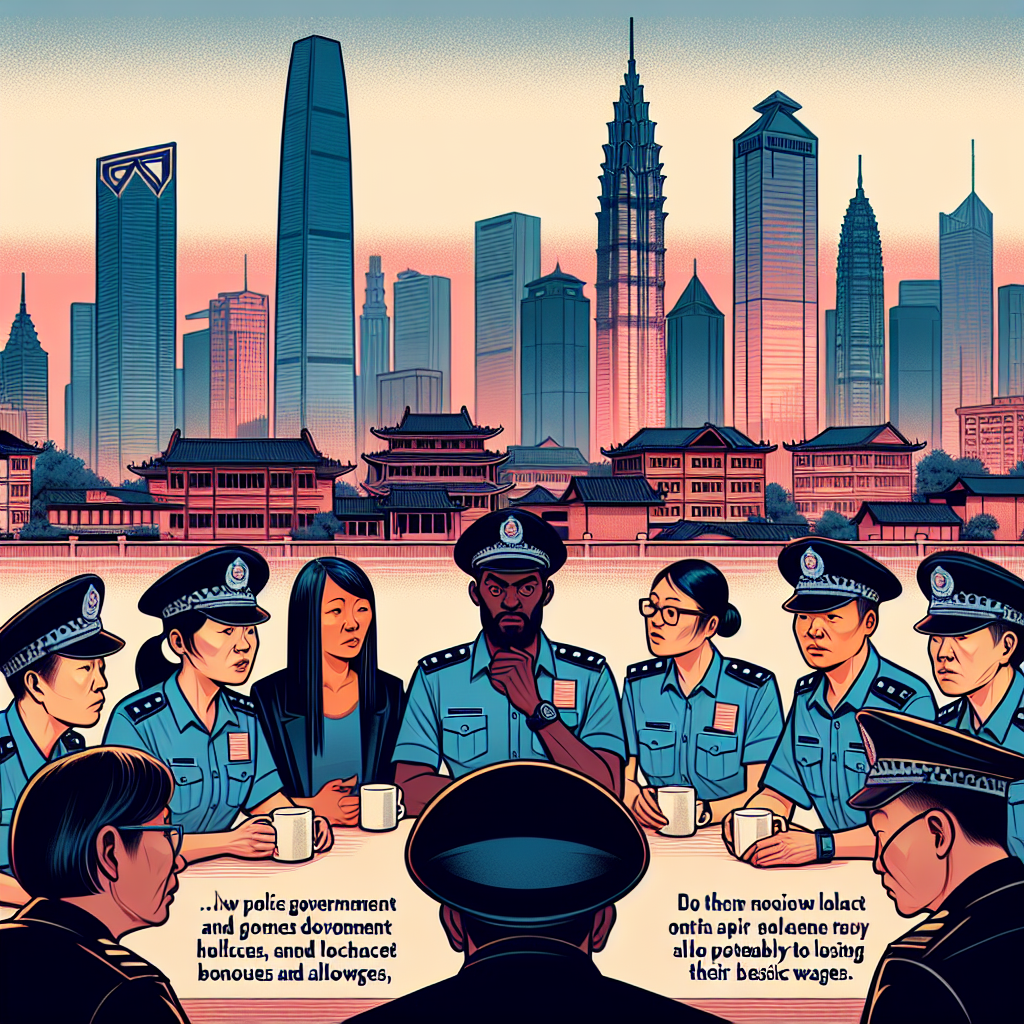
China’s economy is on the decline, putting immense financial pressure on local governments. A wave of salary cuts for civil servants is sweeping across the country, with bonuses and allowances being slashed or even the guarantee of basic wages is disappearing, including for police officers at local police stations.
Since 2022, a round of salary cuts for civil servants has been observed in China, initially affecting mainly economically developed coastal provinces in the southeast where significant reductions in bonuses and allowances were implemented.
As China’s economy continues to decline, some provinces in the central and western regions are struggling to pay their employees, including police officers at local police stations who are facing delays or non-payment of their salaries.
Mr. Chen from Hunan expressed to Dajiyuan that currently, local governments at all levels in the country are in debt, resulting in financial challenges to even pay basic wages.
The tightening of government budgets is evident, with Chen stating, “We interact with the police station, and the officers on duty even joke that we have more freedom than they do, as they have to work overtime at night. I told them that overtime should come with overtime pay, but they replied that they haven’t received their wages for several months. Moreover, they are not allowed to voice their grievances publicly, or even discuss it on WeChat. Once spoken out loud, they risk being dismissed for violating political discipline, so they try to keep it hidden.”
Mr. Luo, well-versed in mainland China’s political and economic affairs, informed Dajiyuan that the inability to pay police salaries at police stations is a growing concern. “I have a friend in Taizhou who mentioned that many units in the Taizhou government are currently unable to pay salaries, resulting in pay cuts and layoffs. Reports of auxiliary police officers not receiving their salaries and getting dismissed have been circulating, which is becoming increasingly common in the current situation in China.”
In Huizhou, Guangdong, Mr. Zeng mentioned to Dajiyuan that officially appointed police officers at police stations should be considered civil servants. Typically, a police station has only a few formal police officers, with the rest being auxiliary police or assistants.
Wu Shaoping, a rights lawyer living in the U.S., told Dajiyuan that due to the deteriorating financial situation of the Chinese Communist Party (CCP), many local civil servants nationwide are either facing pay cuts or delays in receiving their wages. He emphasized that nearly all provinces in China are experiencing negative financial revenues, with Hunan facing a higher possibility of police officers not being paid, as similar issues have already been reported in other regions.
Due to the lack of export processing industries and major pillar industries in western and central provinces in mainland China, the financial situations of some local counties and cities have been significantly impacted by the collapse of the real estate industry, leading to a fiscal crisis.
Since 2022, provinces in the western and central regions of mainland China, such as Shanxi, Qinghai, Inner Mongolia, and Hunan, have been implementing organizational reforms to streamline institutions under the so-called restructuring of small counties with low populations to alleviate fiscal crises.
Starting from March 2023, government bodies and institutions under the CCP have started to clear out various non-staff members, with the health and education sectors being the primary targets, which also include auxiliary police officers and urban management officers.
The last major scale restructuring and downsizing of government institutions under the CCP was in 1998. However, back then, the Western world was preparing to open up markets in China, prompting many personnel within the system to venture into business opportunities.
After 2014, salaries for public servants in China saw a significant increase, particularly for grassroots civil servants below the township level, with salary increments sometimes reaching up to 60-70% every one or two years.
In 2016 and 2018, civil servants received timely salary increases, but by 2020, this trend came to a halt, leading to the onset of salary cuts across the board.
Even economically prosperous provinces like Guangdong now face the pressure of salary reductions.
Ms. Bai, residing overseas, mentioned earlier this year to Dajiyuan that she knew a deputy chief at a police station in a coastal city who informed her that all police officers had their salaries cut.
Mr. Zeng explained that in Meizhou, a relatively remote city in Guangdong, an internal document was circulated guaranteeing the payment of salaries for six months, striving to stretch it to eight months for civil servants.
Institutions in Guangdong have mostly eliminated performance bonuses, as Mr. Zeng pointed out, stating, “I know someone who mentioned that monthly wages that were usually paid in a lump sum are now sometimes split into three payments throughout the month.”
Mr. Zeng further elaborated, explaining that government employees considered internal staff have job security, whereas those in the institutional and corporate sectors have lower positions. Temporary and contract workers earn much less, with public servants earning around ten thousand yuan per month in their region, and significantly more in cities like Shenzhen. Meanwhile, institutional and corporate workers earn around five to six thousand yuan, and temporary workers who only receive basic social security benefits estimate around three thousand yuan.
Mr. Zeng mentioned that various industries are currently struggling as sales are down, affecting businesses such as restaurants and wholesale and retail sectors, resulting in financial losses.
He noted a decline in private projects, citing the lack of work for small contractors who used to build houses, as they are now struggling to find work. Even truck drivers who used to transport bricks, sand, and building materials for private projects are facing a scarcity of work opportunities due to payment uncertainties.
To increase local government revenue, reports of police setting up checkpoints to enforce fines on drivers and street vendors with hefty penalties have become more prevalent.
According to the financial news outlet “First Financial,” fines and confiscation revenues in 2023 increased substantially in seven out of sixteen provinces, with Chongqing and Beijing reporting a growth of 22.4% and 21.9%, respectively. Many local governments have ceased publicizing fine records.
Mr. Fan from Henan relayed to Dajiyuan that currently, they are extracting money from health insurance, with yearly escalating costs. Individuals are now compelled to pay for health insurance, failing which their children are denied admission to schools. Many are opting out of the system, believing minor illnesses can be self-treated, and major ailments are beyond their means to afford treatment. However, parents with school-going children are obliged to pay to ensure their children’s education, as not paying results in exclusion from schools. Those who dare not pay are usually those whose children are not of school-going age.
Mr. Fan mentioned that police cars are frequently mobilized to generate income for the government, engaging in revenue collection from the public. Minor offenders who would have been detained in the past are now more likely to face criminal charges, with even minor offenses leading to months of incarceration, resulting in an increase in public discontent and unrest.
He observed a rising number of detainees in recent years, indicating a trend of police officers targeting individuals for monetary rewards, regardless of the scale of the offense. During the interrogation process, detainees are often asked to produce money, with families required to provide bail fees before their release on a temporary basis, subsequently leading to an extended detention period without the prospect of release until sentencing procedures are completed.
Mr. Fan highlighted the financial distress within the government, leading to intensified revenue collection efforts such as evasion tactics, resulting in increased financial stresses across various regions and cases.
He provided an example of the situation, mentioning an incident involving a woman from Puer, Yunnan province, whose boyfriend engaged in business activities in Myanmar and used her identification to facilitate transactions, attracting police attention due to suspicions of illegal money dealings. Subsequently, the woman from Yunnan was apprehended by police from Hebei, and later the authorities in Henan also intervened, sparking a jurisdictional battle over the case. Ultimately, the woman from Yunnan was transferred to Henan, while her boyfriend remained detained in Hebei.
Additionally, he shared another instance where vocational school students who had signed working contracts with several loan companies and debt collection agencies while still in school were targeted by authorities post-employment, resulting in allegations of involvement in fraudulent activities. Their wages were seized as proceeds of crime, financial penalties were imposed, effectively rendering their work futile.
Such cases are becoming more prevalent as inexperienced students are entrapped without understanding the complexities involved. Families, in a bid to prevent their children from enduring hardships, resort to seeking assistance from intermediaries to secure their release on bail. However, once out on bail, they are often re-arrested and excluded from the quota of individuals who can be spared.
Mr. Fan expressed that those at the lower rungs of society are falling prey to exploitation, exacerbating the conflict between officials and the public. As violent incidents escalate, the desperation among the populace further fuels the resistance, creating a scenario where officials are targeted for retribution, as survival becomes increasingly untenable.
“People have begun expressing sentiments that they’d rather go to war, leading to the destruction of the world. My neighbor frequently makes such remarks, suggesting dropping a few bombs whenever a plane flies overhead, advocating for complete annihilation,” Mr. Fan added.
Wu Shaoping emphasized that even law enforcement personnel such as the police need to sustain themselves, and the inability to pay their wages could have dual repercussions. On one hand, these individuals might become less motivated to perform their duties diligently; on the other hand, local governments might resort to tasking them with revenue-generating activities to address the wage issue, potentially leading to an increase in arbitrary fines and fees.
“In another scenario, there might be a reduction in spending on maintaining stability and control. For citizens seeking rights protections, persecution and illegal interception incidents may decrease. Should more grassroots personnel under the CCP face delayed or unpaid salaries, the regime’s instability will undoubtedly escalate,” Wu concluded.