
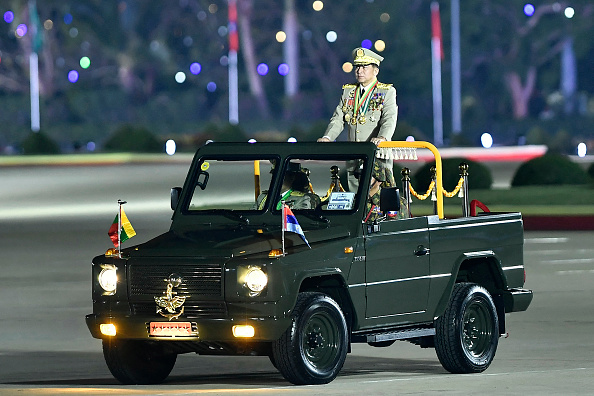
On November 27th, 2024, the International Criminal Court (ICC) Chief Prosecutor requested judges to issue an arrest warrant for Min Aung Hlaing, the head of the military government in Myanmar, accusing him of committing crimes against the Rohingya Muslim minority group.
Min Aung Hlaing, a general, is charged with crimes against humanity for the expulsion and persecution of the Rohingya people. Nearly one million Rohingya have been forced to flee to neighboring Bangladesh. The actions of the Myanmar military government have been described as “ethnic cleansing,” involving widespread rape, killing, and arson.
International Criminal Court Chief Prosecutor Karim Khan, while at a refugee camp in Bangladesh, stated that he plans to soon request additional arrest warrants for Myanmar leaders.
He said, “The Rohingya have not been forgotten. They, like all people in the world, are entitled to legal protection.”
Khan met with displaced Rohingya in Bangladesh. Approximately one million Rohingya, mostly Muslims, are currently refugees in Bangladesh, with around 740,000 fleeing in 2017.
The events began in October 2016 when several border police camps at the Myanmar-Bangladesh border were attacked, with armed personnel killing police officers and seizing weapons and ammunition. A group named the Arakan Rohingya Salvation Army claimed responsibility. Subsequently, six similar groups emerged.
The Myanmar government alleged these organizations aimed to establish an Islamic state in Myanmar and launched “counter-terrorism” military operations. By August 2017, the crackdown escalated into a “clearance operation” against the Rohingya.
Around one million Rohingya fled, with the vast majority heading to neighboring Bangladesh. UN investigators described this action as textbook ethnic cleansing.
UN investigators accused Myanmar soldiers, police, and Buddhist residents in the remote western Rakhine State of burning down hundreds of villages, torturing fleeing residents, engaging in large-scale massacres, and collective rape.
Myanmar denied these allegations, claiming its security forces were legitimately acting against armed attackers targeting police outposts.
The Rohingya are primarily Muslims and have been denied recognition and citizenship rights by the Myanmar government due to religious, cultural, and racial differences. Myanmar has sought to forcibly repatriate them to Bangladesh, labeling them as Bangladeshis and implying their homeland is in Bangladesh, making their presence in Myanmar illegal. Bangladesh is a Muslim-majority country, and most Rohingya originally hail from there.
Human rights organizations have welcomed the decision to seek arrest warrants. With conflicts in Ukraine and Gaza dominating headlines, attention to the dire situation of the Rohingya has diminished.
Maria Elena Vignoli, Senior International Justice Counsel at Human Rights Watch, said: “The International Criminal Court prosecutor’s request for arrest warrants against senior military leader Min Aung Hlaing comes as a new round of atrocities against Rohingya civilians unfolds, reminiscent of what occurred seven years ago. The ICC’s action is a crucial step in breaking the cycle of abuse and impunity.”
Zin Mar Aung, Foreign Minister of Myanmar’s National Unity Government, stated that the ICC’s action represents “a key moment in Myanmar’s history,” urging judges to “swiftly issue arrest warrants,” and governments to “take action and enforce said warrants to uphold justice and international law.” The government is composed of elected officials who were banned from taking office in 2021.
Myanmar’s ruling military, in a statement to Reuters, stated that the country is not a member of the court and does not recognize its assertions.
Khan’s request has been submitted to a panel of three judges who will evaluate the evidence provided and decide whether to issue the arrest warrant. There is no set deadline for this decision.
In 2023, an arrest warrant request against Russian President Vladimir Putin was approved in less than three weeks, but it took six months for judges to issue controversial warrants against Israeli Prime Minister Benjamin Netanyahu and his former Defense Minister after Khan’s request.
Myanmar is not under the jurisdiction of the International Criminal Court, but Bangladesh is a member state. In 2018, court judges ruled that prosecutors can investigate crimes committed on member states’ territories, such as forced deportation.
In 2019, former ICC Chief Prosecutor Fatou Bensouda formally requested an investigation into the situation, with judges approving an investigation into “any crime, including those that could occur in the future,” at least partially related to the Rohingya and occurring in Bangladesh or other member states. This paved the way for Khan’s actions.
Min Aung Hlaing’s military seized power from Aung San Suu Kyi’s government in February 2021, exacerbating conflicts with armed ethnic minority groups in Myanmar’s border regions.
Min Aung Hlaing visited China earlier this month and met with Chinese Premier Li Keqiang.
In 2022, the International Court of Justice, the UN’s highest judicial body, advanced a lawsuit filed by West African nation Gambia against Myanmar, accusing the country of committing genocide against the Rohingya. Five European countries and Canada have requested the court to support Gambia in the case. Gambia is also a Muslim-majority nation.
(This article drew references from reports by Reuters and The Associated Press)