
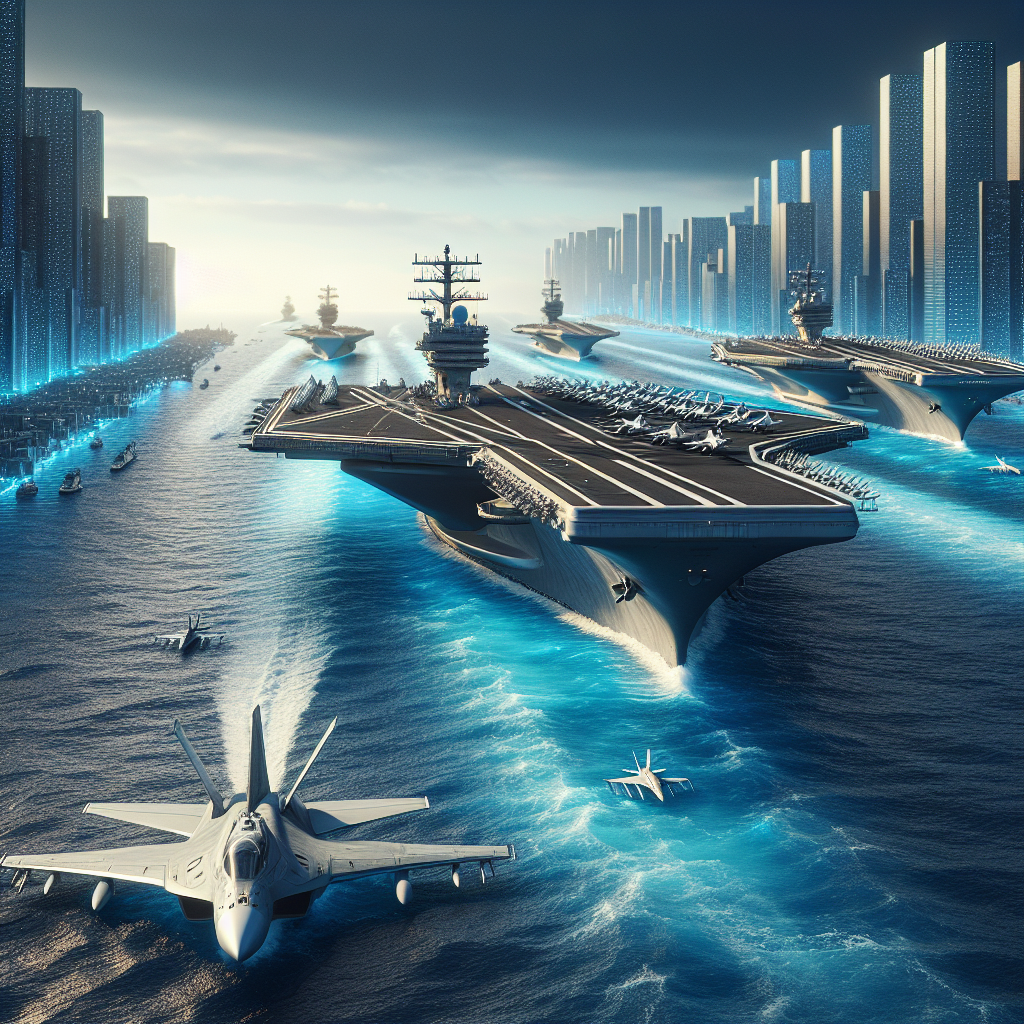
The United States has deployed three aircraft carriers in the Asia-Pacific region to address any potential threats posed by the Chinese Communist Party before President Trump’s inauguration. According to Nikkei Asia, one of the aircraft carriers has already arrived in Japan, with two more on the way.
The USS George Washington, a nuclear-powered aircraft carrier carrying 2,702 crew members, arrived at the US Seventh Fleet’s base in Yokosuka, Japan, on Friday, November 22. It is set to carry out patrol missions in the waters near China. This marks the first return of the Washington to the port in nine years for deployment tasks.
The USS Carl Vinson, another nuclear-powered aircraft carrier, has set sail from San Diego and is expected to be deployed to the Asia-Pacific region. Ship spotters observed the carrier leaving its homeport at Naval Air Station North Island in California a day before its departure was confirmed by a US Navy spokesperson on November 19.
Meanwhile, the USS Abraham Lincoln, currently in the Indian Ocean and passing through the South China Sea, is expected to return to San Diego after departing from the Middle East.
According to Katie Koenig, a spokesperson for the US Pacific Fleet, the presence of aircraft carriers in the region allows for rapid responses by maritime and joint forces, maximizing the combat power and operational capacity of the most capable vessels.
She stated that this also demonstrates the collective determination to ensure the safety and stability of the region.
Commander Fred Kacher of the US Seventh Fleet, based in Yokosuka, emphasized the advanced maritime capabilities represented by the US aircraft carriers. He stated that this deployment signifies the most advanced investment the US can make in security for Japan and the Western Pacific.
The Seventh Fleet’s area of operations covers the Western Pacific and parts of the Indian Ocean, including several potential conflict zones near China such as the East China Sea, South China Sea, Taiwan Strait, and the Korean Peninsula.
Kacher further added that the return of the Washington aircraft carrier with modern cutting-edge technology represents the US commitment to deterrence and security in the region.
Since the departure of the Ronald Reagan aircraft carrier from Yokosuka in mid-May, the US did not have any forward-deployed aircraft carriers in Asia. Other carriers were redirected to the Middle East to address escalating conflicts in that region.
According to analysts cited by Nikkei Asia, the increased US military presence in the Pacific region aims to counter any threats from the Chinese Communist Party before Trump’s inauguration on January 20. This summer witnessed the reassignment of multiple aircraft carriers from the Pacific to the Middle East, with a reduction in deployments in the Middle East now.
Brent Sadler, a former US Navy veteran and senior researcher at the Heritage Foundation, emphasized the need for reinforced carrier deployments amidst a period where the Communist Party of China is testing US resolve.
Sadler stated that China is clearly the top threat and following recent missile attacks by Iran on Israel and subsequent retaliatory strikes, the Biden administration may shift focus away from the Middle East.
Jacob Stokes, Deputy Director of the Indo-Pacific Security Program at the Center for a New American Security, highlighted that China will likely test the incoming Biden administration early, perhaps around Taiwan or South China Sea issues, or a combination of both.
Stokes stated that leaders at the US Indo-Pacific Command hope to reset the baseline and be prepared for military asset deployment and strategies in January next year.
Sadler noted that the absence of carriers in the Western Pacific in recent months has led to provocations by China in the South China Sea and around Taiwan. While additional carrier strike group deployments do not guarantee the prevention of such provocations, having carriers deployed provides the President with more options to express dissatisfaction with China in ways that they can understand.