
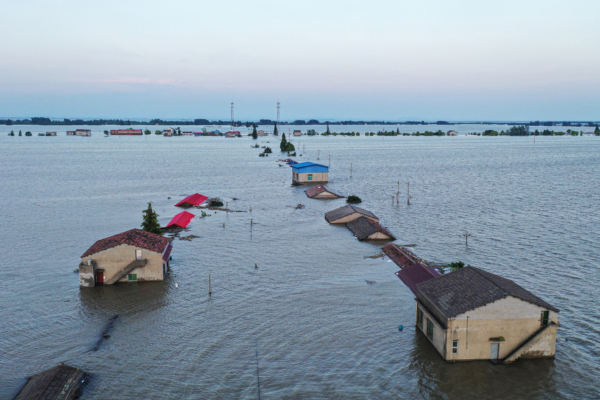
In a few months ago, there was a flood in the Yangtze River basin in China, with the Dongting Lake water system experiencing a flood exceeding the warning level. The breach of the Dongting Lake embankment led to frequent flood discharge in the area, exacerbating the disaster. However, in recent months, the Yangtze River basin has transitioned from floods to droughts, entering a low water period with upstream water inflow decreasing by about 40% to 60%. In September and October, the water inflow was still 12% and 27% lower compared to the extremely dry year of 2022.
According to the latest information from the Chinese Ministry of Water Resources, the natural water inflow in the upper reaches of the Yangtze River in August to October were 19,900 cubic meters per second, 12,900 cubic meters per second, and 11,300 cubic meters per second respectively, which were 23%, 45%, and 31% lower than the historical average for the same period. The water inflow in September and October was still 12% and 27% lower than the extremely dry year of 2022, ranking second and sixth from the bottom since records began in 1881. As of 8:00 on November 1st, the water levels at major control stations in the middle and lower reaches of the Yangtze River were 2.5 to 5.4 meters lower than the historical average.
The Ministry of Water Resources pointed out that in recent months, the Yangtze River basin has experienced a rapid shift from floods to droughts. From June to July this year, the precipitation in the Yangtze River basin was slightly above average by one to two percent. The main stream of the Yangtze River experienced three numbered floods, and several tributaries also saw varying degrees of rising water levels. In addition to the Lishui River, the Zi River, Yuan River, and Xiang River in the Dongting Lake water system all experienced floods exceeding the warning level.
On July 5th, a dangerous situation occurred at the Tuanzhou Embankment in Huarong County, Yueyang, Hunan, where emergency efforts failed to seal off the embankment, leading to its collapse. However, starting from August, the Yangtze River basin experienced a rapid change from floods to droughts.
From August to October, the precipitation in the Yangtze River basin was about 30% lower than the average for the same period in previous years, ranking the second lowest since complete historical data was available in 1961.
According to the flood situation brief released by the Changjiang River Water Resources Commission in September, the water inflow in the Yangtze River basin was significantly lower than historical averages, with the main stream at Cizhutan station receiving over 40% less water than usual, and the water inflow at downstream Hanshui station and Datong station decreasing by almost 60%. In October, the water inflow in the Yangtze River basin continued to be insufficient, with Cizhutan station receiving nearly 50% less water than usual, Hanshui station receiving over 60% less, and Datong station nearly 60% less, ranking the lowest in historical records.
The main tributaries in the upper reaches of the Yangtze River including the Minjiang Gaocang station received nearly 30% less water than historical averages, while Beipei station in the Jialing River received nearly 70% less water, and Wulong station in the Wu River received over 60% less. The Baihe station in the upper reaches of the Han River received over 80% less water, while Xinglong station in the middle and lower reaches received nearly 70% less.
Meanwhile, in September, temperatures in many areas reached record highs. Statistics from China’s National Climate Center showed that the average national temperature in September 2024 was 18.8 degrees Celsius, 1.7 degrees higher than the historical average for the same period, the highest since 1961. The Sichuan Basin and the middle and lower reaches of the Yangtze River continued to experience high temperatures after entering September.
In the middle and lower reaches of the Yangtze River, Poyang Lake experienced a rapid decline in water levels in September. Records from the Jiangxi Provincial Hydrological Monitoring Center showed that on October 9th at 7:00 p.m., the water level at Xingzi Station on Poyang Lake dropped to 7.99 meters, falling below the extreme low water level (8 meters) for the second earliest time on record.
According to the website of the government of Honghu City, Hubei Province, since the middle of September this year, due to the continuous decrease in water levels in the Yangtze River, a section of the Yangtze River from Luoshan Fuliangzhou to Yejiamen Pier in Honghu City, nearly 7 kilometers in length, has severely dried up. The Lingyuan Water Plant and Laozha Water Plant’s water intake points were surrounded by sediment and debris, leading to a disruption in water supply as the channels were cut off from the main navigational channel of the Yangtze River – making water intake for the two plants difficult.