
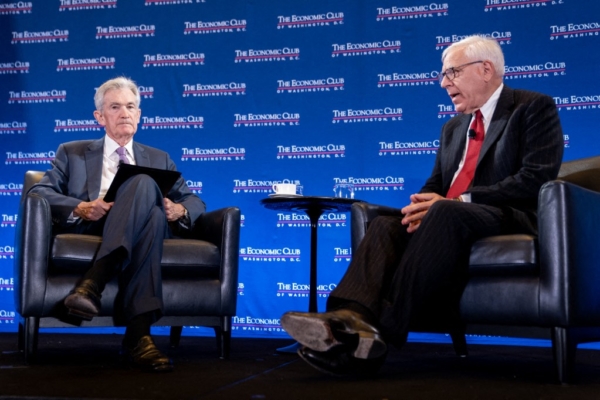
As the US inflation continues to slow down, the issue of interest rate cuts is attracting more attention. Federal Reserve Chairman Jerome Powell said on Monday (July 15) that the Fed will not wait for inflation to reach 2% before cutting interest rates. Powell emphasized that the inflation reading for the second quarter has “indeed to some extent” boosted policymakers’ confidence that the inflation rate is gradually moving towards the 2% target in a sustainable manner.
Powell engaged in a conversation with David Rubenstein, the Chairman of the Economic Club of Washington D.C., on Monday.
“In fact, in the second quarter, we did make more progress in containing inflation. We have three better (inflation) readings, which, when averaged, are quite good,” he said.
He reiterated that the labor market is currently in a better balance, and if the labor market unexpectedly softens, it could also be a reason to adjust interest rates.
Powell refused to make predictions about the timing of interest rate cuts. However, he explained why the Fed would not wait until inflation drops to 2% before starting the rate cuts. He emphasized that the impact of monetary policy has a lag effect. If the Fed continues to wait until inflation falls to 2%, it may already be too late, as the tightening policies currently in place, or the degree of tightening, are still exerting an influence that could push inflation below 2%.
He also stated that better inflation data would give policymakers more confidence that inflation will return to the 2% level. “Recently, we have received some data like this,” he said.
According to the records of the Federal Reserve’s interest rate meeting held on June 11th and 12th, participants believe that more favorable data is needed to give them confidence that the inflation rate is sustainably heading towards 2%. Lowering rates before seeing this data is deemed inappropriate.
Powell reiterated these views on Monday.
“We have been waiting for this moment to arrive. What I want to say is that we did not gain any additional confidence in the first quarter, but the three readings in the second quarter, including last week’s reading, did indeed increase confidence to some extent,” he said.
The next Federal Reserve interest rate meeting will take place on July 30th and 31st. The market expects that this meeting will announce keeping the benchmark interest rate unchanged. The Fed may start cutting rates in September, possibly lowering rates twice or even more times this year.
Powell also mentioned on Monday that he does not believe the US economy is heading for a hard landing.
Reuters cited Thomas Simons, an economist at Jefferies, saying, “Pretty much as expected. I think his (Powell’s) position is gradually shifting towards the possibility of rate cuts.”