
California’s City of Industry, one of the least populated cities in the state, has recently stirred up tensions with its neighboring Chinese communities due to plans to construct a battery plant. The Puente Hills Community Preservation Association (PHCPA) has filed a lawsuit demanding that the project undergo environmental review in accordance with legal procedures.
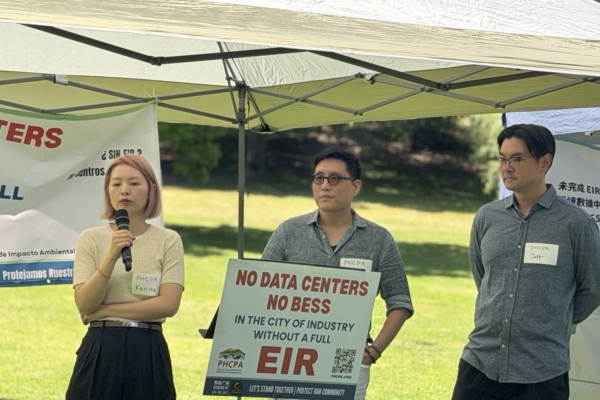
This Wednesday, several community organizations held a press conference at the Peter F. Schabarum Regional Park in Hacienda Heights to update the public on the controversial City of Industry Battery Energy Storage System (BESS) project and the proposed establishment of a data center that have been hot topics in the community recently.
According to a project notification issued by the City of Industry last year for the “Marici Battery Energy Storage System Project”, the city plans to build battery energy storage facilities at three locations with an annual total capacity of over 580,000 kilowatt-hours, including redevelopment of a 9.2-acre site. The project was approved by the City Council in mid-February this year.
The controversy surrounding these proposed projects is closely related to the unique geographical location of the City of Industry: the city is situated in a narrow strip east of Interstate 605 and north of Highway 60, connecting multiple communities; with over 3,000 businesses employing more than 68,000 workers, while the residential population of the city is only around 250 people.
Nearby communities are concerned that the battery plant and data center projects could worsen noise and environmental pollution, impose significant strains on water resources, electricity supply, and impact their quality of life.
PHCPA, founded by several Chinese-American youths, has raised concerns similar to those that arose in Monterey Park a couple of months ago. During that time, hundreds of residents rallied against the city council, ultimately forcing the city to abandon its plans for a data center. Drawing comparisons between the City of Industry and Monterey Park, Jeff pointed out that the surrounding residents in the City of Industry are primarily non-native English speakers, and the lack of significant opposition may lead decision-makers to believe that residents either do not care about the project or feel powerless to resist.
Jeff mentioned that their plans include lobbying, community engagement, on-site protests, and attending every event to pressurize decision-makers.
Andrew, a resident living near the proposed projects, expressed disappointment and deep concern within his community, stating that communication channels with the City of Industry seem to have been closed off. He hopes for effective communication with the city through the media and appreciates the new actions taken by PHCPA, aiming for better dialogue with the City of Industry to completely halt the project.
Karina, a resident of the Puente Hills community and a member of PHCPA, highlighted that the battery plant project is just a street away from the nearest residential area, with the closest point being less than 100 feet from homes. Many community members were unaware of the scale and impact of the project until their investigation revealed worrisome environmental and safety hazards. This led to questioning whether the information provided by the decision-making authorities is clear and transparent enough and if community members truly understand the substance of the project.
PHCPA, the Puente Hills Community Preservation Association, aims to unite community forces to empower residents to voice their concerns, be informed, and actively participate. The TACF (Community Safety Foundation), an organization active in the Chinese community, also sent members to show support.
“We are not a large organization; we are regular people living and working here who will be affected by these decisions every day,” Karina said. These projects will shape the community’s future for decades, so it is crucial to prioritize the environmental impact and the quality of life of local residents.
PHCPA has filed a legal lawsuit under the California Environmental Quality Act. This Saturday, from 10 am to 1 pm, they will gather again at Schabarum Park, hoping to inform more residents about the relevant information.