
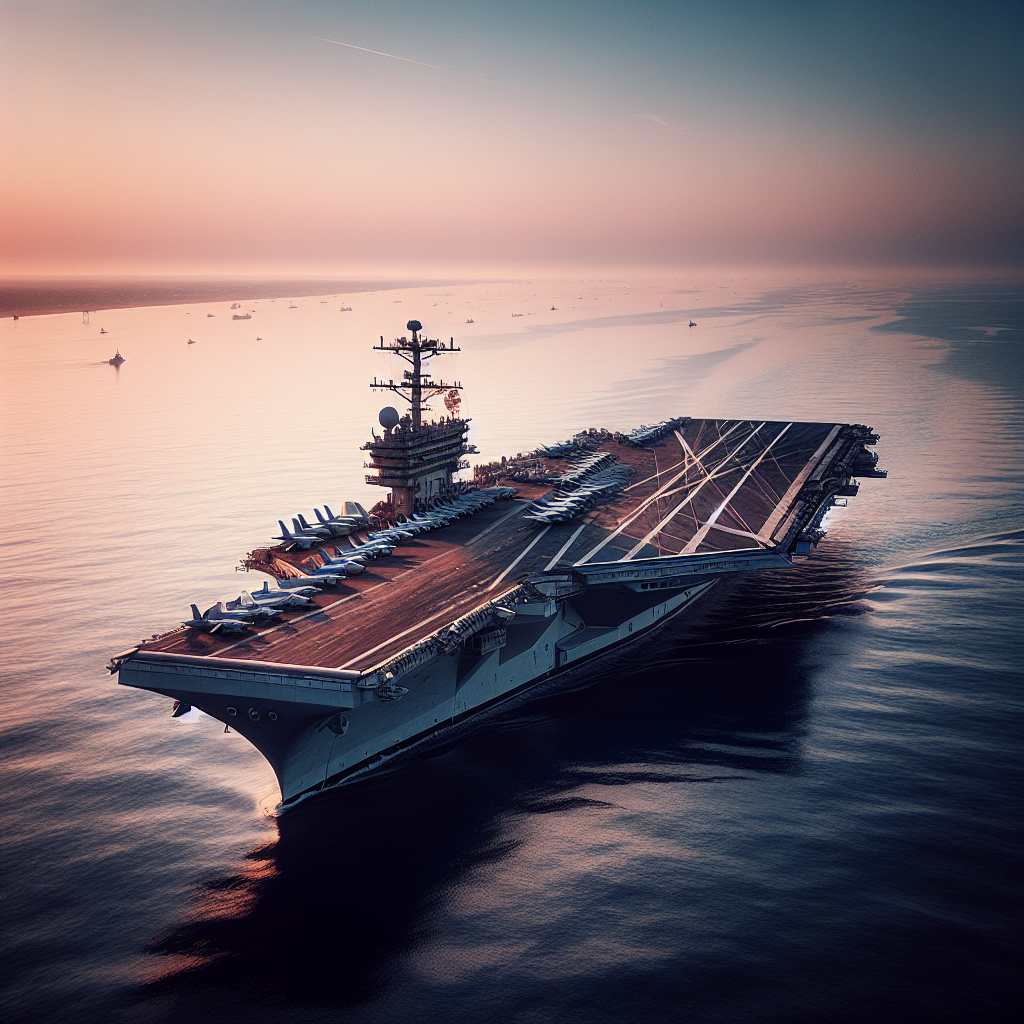
On Wednesday, April 29, a U.S. official told The Epoch Times that the USS Gerald R. Ford aircraft carrier, an American Navy vessel, is set to return to the United States after a deployment of approximately 10 months. The USS Gerald R. Ford is one of three American aircraft carriers currently deployed in the Middle East region, marking the first time since the 2003 Iraq War that the U.S. Navy has had three carrier strike groups in the area simultaneously. The other two carriers are the USS Abraham Lincoln and the USS George H.W. Bush.
Last week, the USS George H.W. Bush arrived in the Arabian Sea to join the USS Abraham Lincoln in enforcing the U.S. military blockade of Iranian ports. The USS Gerald R. Ford is a new class of aircraft carrier in the U.S. Navy, known as the Ford-class, boasting a larger deck space compared to the older Nimitz-class carriers, equipped with an electromagnetic aircraft launch system for quicker plane take-offs and landings.
Currently, the USS Gerald R. Ford carries over 4,000 sailors and is on the longest deployment for a U.S. aircraft carrier since the Vietnam War. The carrier set sail from its homeport in Norfolk, Virginia, on June 24, 2025, and has been at sea for 309 days as of April 29, approximately 10 months.
According to data from the U.S. Naval Institute’s news website, on the 295th day of its deployment, the USS Gerald R. Ford broke the 50-year record for the longest deployment of an aircraft carrier. Prior to this, the USS Abraham Lincoln had been at sea for 294 days during the COVID-19 pandemic in 2020. The longest deployment record for a carrier in history is held by the retired USS Midway, which served for 332 days during the Cold War from 1972 to 1973.
Although the exact departure date of the USS Gerald R. Ford from the Middle East is not clear, officials informed The Epoch Times that the carrier is expected to return to its homeport in Norfolk around mid-May for extensive maintenance and upkeep. The prolonged deployment of the USS Gerald R. Ford has raised concerns, affecting not only the service members separated from their homes for an extended period but also putting significant strain on the vessel’s equipment. The carrier has also undergone repairs due to a fire incident during its deployment.
During a congressional hearing on Wednesday, several lawmakers questioned the extended deployment of the USS Gerald R. Ford. They queried War Secretary Peter Hegseth about the necessity of keeping the carrier at sea for a prolonged period, as it could impact its future availability and readiness, as well as that of other naval vessels.
Hegseth responded that this decision was made after consulting with the Navy, and naval officials indeed discussed the balance between readiness and maintenance. He added that “due to multiple operational demands, both in the Southern Command (responsible for Latin American affairs) and the Central Command (responsible for Middle Eastern affairs), immediate additional military power is needed, and after a difficult decision-making process, this ultimately led to the extension.”
During its deployment, the USS Gerald R. Ford was summoned to support U.S. military gatherings in the Caribbean Sea, and in early January, it participated in the operation to capture former Venezuelan president Maduro. In February, the aircraft carrier was ordered to the eastern Mediterranean to support Operation Epic Fury, aimed at countering the regime of Iran’s leader, Hassan Rouhani.
In mid-March, the USS Gerald R. Ford had to withdraw from operations against Iran due to a laundry room fire on board, first relocating to Greece and later to Croatia for repair. By mid-April, the aircraft carrier returned to the Middle East region, as the U.S.-Iran negotiations for a two-week ceasefire were set to conclude on April 22. However, the ceasefire was extended by President Trump, and the carrier is currently deployed at the northern end of the Red Sea, providing real-time surveillance and deterrence against Iran.