
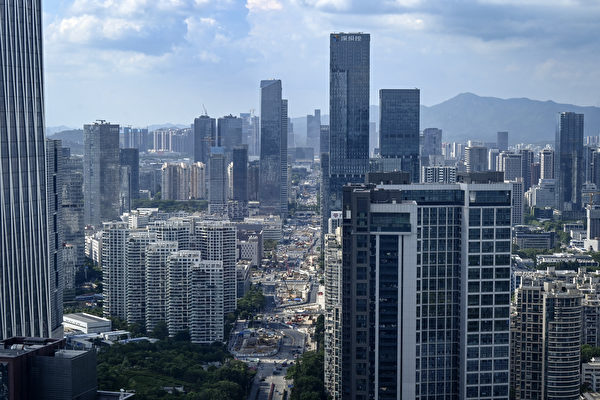
In recent years, the vacancy rate in office buildings in major cities in China has continued to rise, exceeding 20% in many areas and even surpassing 30% in some cities. According to data from several institutions, in the first quarter of 2026, the vacancy level in key cities across the country remained high, with rents generally decreasing. The market is gradually shifting towards being tenant-led, with some commercial office buildings in Shanghai even offering zero deposit leases.
Recently, real estate agencies in Shanghai and other areas have revealed on social media that rents in certain office buildings in the Hongqiao Business District of Shanghai have fallen back to 2010 levels. For example, a Grade A office space of around 188 square meters is now being rented for less than 20,000 yuan per month, with some even offering “zero deposit” rentals. Additionally, in the Minhang District’s Xinzhuang Business District, a 130-square-meter office space is renting for about 8,000 yuan per month. Videos from Guangzhou, Wuhan, and Hangzhou also show significant declines in office rents.
Peng Hai, a financial scholar in Shanghai, stated that Shanghai is the economic powerhouse of China, and office rents have always been seen as a direct indicator of economic activity. He explained, “It’s not just a simple decline in rent now, but rather a disappearance of demand. Foreign capital is withdrawing in large numbers, with many of the offices being the headquarters of American, Japanese, and South Korean companies in China, which are now relocating. Domestic companies in China are also moving out of Shanghai due to difficult business conditions.”
Peng Hai further elaborated, “Areas like Lujiazui and Hongqiao used to be hubs for foreign investment, financial institutions, and large corporations, and office spaces were never an issue to rent out. But now, even financial institutions are downsizing, and some private enterprises are transferring their headquarters functions to lower-cost cities.”
Market data from the first quarter of 2026 indicates that amidst high vacancy rates, office building landlords are generally lowering rents, extending rent-free periods, and providing renovation subsidies to attract tenants. Some projects are even delivered with renovations as a common condition.
According to a report by international real estate consultancy firm Cushman & Wakefield for the first quarter of 2026, the vacancy rate for Grade A office buildings in Shenzhen is around 29.8%, Guangzhou approximately 22.1%, and Beijing about 15.79%. Concurrent data from Savills shows that Shanghai’s vacancy rate is around 23.4%. The indicators in major first-tier cities have remained at high levels in recent years, indicating a continuing imbalance between supply and demand.
Beijing real estate researcher Zhu Fei stated that compared to last year, Grade A office rents in Beijing have experienced a larger decline: “They have dropped by about 20%, with some areas seeing even larger declines. It’s now a tenant-led market, and companies can continuously negotiate for lower prices. In the five major core business districts, the rent is around 200 yuan per square meter per month, but actual transaction prices are even lower, continuously pulling down the overall market rents.”
The downward trend in the office market is even more pronounced in many second-tier cities in mainland China. Data from the first quarter of 2026 shows that the vacancy rates in some emerging business districts have exceeded 30%, with certain regions approaching 40%, highlighting a significant mismatch between office building supply and actual occupancy demand.
Hubei scholar Zhang Chunhua expressed to reporters that in recent years, both the commercial office and residential real estate markets have been on a downward trajectory. Many new areas were developed based on land bidding, where office buildings were constructed first, followed by residential buildings. However, these spaces remain unrented and unsold, leading to high vacancy rates.
Zhang Chunhua said, “These projects were not initially based on market demand, but rather driven by local governments to sell land and achieve political achievements. After the land was sold and developers brought in, banks couldn’t recover their loans, developers’ funding chains broke, and they simply absconded. This is not an isolated phenomenon.”
For a long time, local Chinese government relied on the cycle of “selling land – building – attracting investment” to drive GDP growth. Now, with the vacancy rate of Grade A office buildings in first-tier cities close to 30%, this expansion model driven by administrative will and detached from actual demand has completely failed. Economic experts openly acknowledge that the office market in China is experiencing a sharp decline, stripping away the final veil of the traditional model of promoting urban development through industrial activities.
Commentators believe that the concrete structures left by the blind expansion of local governments are now transforming into difficult-to-digest non-performing assets and debt burdens. The continuous decline in rents and the comprehensive shrinkage in demand are mutually reinforcing, indicating a deep pessimism in future business prospects. When even the core commercial districts of first-tier cities are unable to withstand the impact of economic downturn, the Chinese economy is facing a systemic reshaping from asset prices to market confidence, with new pillars yet to take shape, while risks continue to accumulate.