
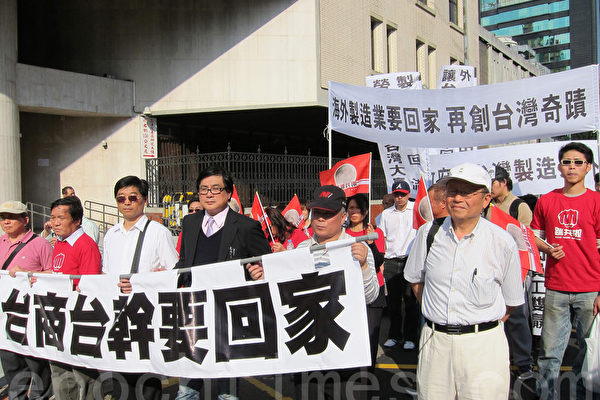
【Epoch Times News, April 30, 2026】On April 10, 2026, during the “Zheng-Xi Meeting,” many people noticed that there were no Taiwanese businesspeople accompanying the delegation led by Kuomintang Chairwoman Zheng Liwen. However, during the Nationalist Party-Communist Party “Hu-Lien Meeting” in 2005, there were many Taiwanese businesspeople participating in the delegation.
In the program “News Decoded” on New Tang Dynasty Television, Honorary Professor Ming Juzheng from the Department of Political Science at National Taiwan University pointed out that ten or almost twenty years ago, China’s GDP growth was said to be in double digits annually, which was quite remarkable. However, it should not be forgotten that Taiwan also experienced a period of double-digit growth for a considerable amount of time, known as the “Taiwan Miracle.”
Regarding the rapid economic growth of mainland China after the reform and opening up, Ming Juzheng believed that it was due to many Taiwanese and Hong Kong businessmen who expanded and promoted their decades-long experience to the mainland. The contribution of Taiwanese and Hong Kong businessmen to the economic development of the mainland was significant.
Ming Juzheng further remarked that the economic development of the mainland had a problem, which is being affected by political factors. Zhao Ziyang stated in the mid-1980s when discussing economic reforms that without breaking through politically, economic development would not advance. This is the situation today, as Ming Juzheng asserted.
Various factors, including the policies of the Chinese Communist Party, limit the economic development of China, according to Ming Juzheng. He pointed out that the CCP made four mistakes: engaging in a trade war with the United States, forcefully taking over Hong Kong, promoting nationalization over privatization, and implementing strict controls. Any one of these four major events could hinder China’s economic progress, let alone all four happening simultaneously. Simply by examining the official announcements from the mainland, one can see that there are economic issues in China.
Ming Juzheng mentioned that a professional friend pointed out that Taiwanese businesspeople are very sensitive; once they sense something is not right, they begin to withdraw. When Taiwanese businesspeople go to the mainland, due to cultural and linguistic similarities, they can quickly grasp the trends in economic development by observing daily life and the landscape. Subsequently, they leave. Some Taiwanese businesses start from coastal areas, then gradually move to central provinces and remote regions before departing. Why? Because the dividends have been exhausted, and resources like land, population, and utilities have been depleted. When the trade war began, Taiwanese businesspeople had even clearer insights.
In 2022, the U.S.-based think tank Center for Strategic and International Studies (CSIS) released a report on October 4, 2022. The report surveyed 525 senior executives from Taiwanese companies from July 25 to August 1, 2022. Over 60% of the surveyed Taiwanese companies had ongoing operations in mainland China, with approximately a quarter generating over 25% of their revenues from the Chinese market. The report indicated that 25.7% of the surveyed Taiwanese companies had partially shifted production or procurement operations outside of mainland China, while 33.2% were considering but had not taken action yet. At that time, more than half of Taiwanese businesses —roughly 58%— had left, were preparing to leave or had already begun the process.
By the first two months of the year, in February, direct investment from Taiwanese businesses to the mainland had decreased by 16.2% annually, marking 14 consecutive months or 1 year and 2 months of negative growth. The proportion of Taiwanese investment in mainland China peaked in January 2014, and by 2026, it had dropped by 81% compared to 2014, representing an 80% decrease and leaving only 20%. During this period, over 200 billion yuan from divesting mainland assets by listed companies and investments from over 300 companies returning to Taiwan added up to 1.4 trillion yuan, leading to a thriving stock market and real estate market in Taiwan.
Ming Juzheng indicated that in recent years, foreign investors also began to feel the impact of measures like the “Counter-espionage Law” and “Data Security Law.” After several protests yielded no results, they, too, started withdrawing gradually. As of 2025, the withdrawal rates of Korean, American, Australian, European, and Japanese businessmen from China were 32%, 30%, 28%, 21%, and 14% respectively. The lower withdrawal rate of Japanese businessmen at 14% was due to many already leaving in previous years, hence the relatively lower proportion now.
Not only Taiwanese and foreign businesses were fleeing, but Chinese enterprises within China were also starting to flee abroad, as pointed out by Ming Juzheng, evident from the declining investments of private Chinese enterprises in fixed assets. According to Ming Juzheng, investment in fixed assets by private Chinese enterprises decreased by 2.6% annually, suggesting a lack of interest and confidence in domestic operations. However, their foreign investment increased during the same period for six consecutive months. This signals that private investors are pessimistic about the domestic market but optimistic about opportunities abroad.
Moreover, Ming Juzheng added that some state-owned enterprises in China were also looking to flee, but the government was beginning to restrain their departures. The exodus isn’t limited just to businesses; reports have shown that Chinese billionaires have been the largest group of emigrants from China. When these factors are combined, along with the departures of foreign and Taiwanese enterprises and even Chinese state-owned enterprises, it paints a picture of a mass exodus occurring in China.
Ming Juzheng stated that mainland China is aware of its economic challenges, especially the severe funding shortage during the “15th Five-Year Plan.” As a result, it is seeking ways to fill this gap, turning to Taiwan among other solutions. The crucial question is whether Taiwan will fall for this. He emphasized that if China is experiencing a mass exodus and proposes a second Western Development Campaign at such a time, it demonstrates a lack of understanding of the mainland’s economic and international situation.
Reference Video: [News Decoded] Global Funds Fleeing China! Chinese Enterprises Eager to Leave Too!