
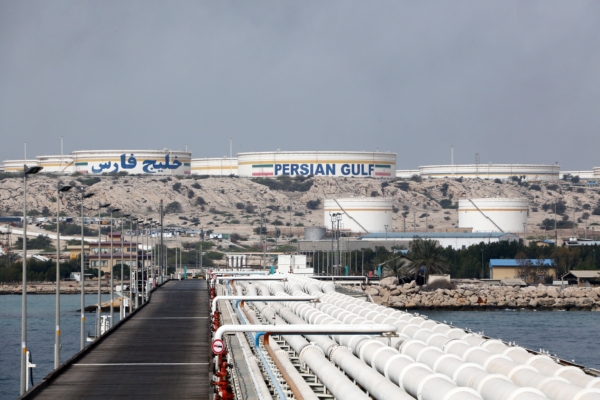
According to the latest maritime intelligence report, a group of oil tankers sanctioned by the United States are using “digital camouflage” technology to try to evade U.S. monitoring by secretly loading around 8 million barrels of crude oil, valued at up to $800 million at current market prices.
The maritime intelligence company Windward AI, in its update on Wednesday, identified at least 10 sanctioned oil tankers manipulating the Automatic Identification System (AIS) signals to falsify their geographic locations.
While these vessels appear to be anchored in Basrah, Iraq on digital maps, they are actually sailing towards Iranian ports to load the sanctioned crude oil.
“These vessels are creating a ‘digital alibi’ by manipulating signals,” Windward AI told Fox News. “By sending false destination messages to Iraqi ports, these tankers seem to be in Iraqi waters, but are actually heading towards Iran.”
“Once loading is completed, the vessels will reappear in the AIS system, making the cargo appear to originate from legitimate Iraqi sources.”
Since April 13, the U.S. Navy has been enforcing a strict maritime blockade against Iran to compel them back to the negotiating table and abandon their nuclear program. Windward stated that this maritime standoff has reduced Iran’s crude loading and export volumes by over half.
Currently, Iran is utilizing oil tankers as floating storage to delay saturation of onshore storage facilities. If the blockade continues for several weeks, Iran may be forced to shut down some oil wells, leading to long-term production losses. Analysts at the vessel tracking firm Kpler assessed on Monday that Iran’s unused idle oil storage capacity could last at most 22 days.
To prevent shutdowns of some oil fields, Iran has begun implementing emergency measures, including using containers in the southern oil towns of Ahvaz and Asaluyeh, as well as storing crude oil in deteriorating and decommissioned old storage tanks.
Among the evasive behaviors monitored on Wednesday, four Very Large Crude Carriers (VLCCs) stood out, namely Alicia, RHN, Star Forest, and Aqua.
Windward stated, “Each of these four VLCCs can carry approximately 2 million barrels of crude oil, totaling 8 million barrels; valued at around $800 million when calculated at $100 per barrel.”
These vessels were found using false vessel registrations from locations such as Curacao and Malawi to conceal their true identities.
Currently, the U.S. blockade actions have significantly squeezed Iran’s economic lifeline, but the “cat and mouse” game unfolding in the Persian Gulf continues. As U.S. enforcement pressure mounts, Iranian vessels are attempting to shift some high-risk activities to areas with weaker surveillance by falsifying vessel positions.
Windward noted that Chabahar in eastern Iran has become a new gathering point, with five oil tankers turning off their AIS signals and estimated to carry a total volume of 7 to 8 million barrels.