
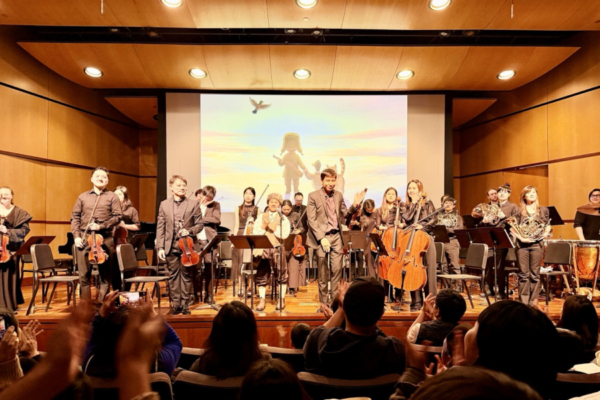
Virtuosi San Jose held two children’s music concerts, “Peter and the Wolf,” at the Santa Clara University Music Hall on the evening of April 25th. Through live narration, animated visuals, and orchestral performances, they led parent-child audiences into the fantastical symphonic fairy tale world. Both concerts were sold out in advance, attracting over 500 audience members, with enthusiastic applause after each program.
“Peter and the Wolf” is a children’s symphonic fairy tale created by Russian composer Sergei Prokofiev in 1936, using storytelling and orchestral music to help children recognize the sounds of different instruments. The story tells of Peter playing in the forest one winter morning, encountering a bird, a duck, and a cat. Soon, a wolf appears, swallowing the duck and eyeing the bird and cat. Brave Peter manages to trap the wolf with a rope and, with the help of a hunter, sends the wolf to the zoo.
Each of the two performances that evening lasted nearly 90 minutes, with over 30 musicians participating in the orchestral performance of “Peter and the Wolf.” Each character was represented by a different instrument: the bird played by the flute, the duck represented by the oboe, the cat presented by the clarinet, the grandfather performed on the bassoon, the wolf played by the French horn, and Peter expressed through the strings. Children listened to the story, identifying the sounds of the instruments, getting to know the orchestra in an enjoyable way.
Founder of Virtuosi San Jose and violinist Ernest Yen stated that the orchestra, established in 2022, primarily focuses on conductorless chamber music concerts. The performance of “Peter and the Wolf” marks the orchestra’s first attempt at a more complex children’s music program, incorporating various wind instruments and storytelling in addition to strings. Golden State Youth Orchestra’s music director, Yun Song Tay, was invited to conduct and assist in integrating the performance.
Yen expressed that the purpose of hosting children’s music concerts is to cultivate children’s interest in classical music from a young age. “Cultural aspects need to be nurtured from childhood,” he said. Through suitable stories and musical forms for children, he believes they can be guided into the world of classical music.
Tay highlighted the need for conducting assistance due to the larger ensemble and more complex repertoire. He described the unique feature of “Peter and the Wolf” using different instruments to represent story characters, allowing children to understand the characters and plot through music. He also mentioned his long-standing relationship with Yen for over 30 years, with many of his students learning the violin in Yen’s student orchestra, making him delighted to collaborate on this occasion.
Thirteen-year-old narrator Lin Danni shared that she spent about a month preparing for the performance, mainly practicing by listening to music and audio files at home, getting familiar with melodies and rhythms, and coordinating with cues from the script for her timing. She emphasized that narration involves more than delivering lines – understanding the music’s rhythm is crucial for accurately connecting with the orchestra’s performance.
French horn player Jeffrey Lee, originally from Taiwan and currently an exchange student at Stanford, has been playing the French horn for about 15 years. Invited by Yen for the first time to perform with Virtuosi San Jose, he took on one of the roles as the “Big Bad Wolf” in “Peter and the Wolf.” Lee expressed that the presence of many lovely children at the event created a more relaxed atmosphere compared to typical classical music concerts, easing the tension during the performance.
Aside from “Peter and the Wolf,” the program also included children’s string ensemble “Variations on Twinkle, Twinkle Little Star,” piano performance of Mozart’s “Ah, vous dirai-je, Maman” variations, a violin and piano rendition of an operatic march adapted by Heifetz, and Beethoven’s Symphony No. 5 in C Minor, fourth movement, among diverse and rich contents.
Taiwanese parent Stanley Chen, accompanied by two children, one of whom performed on stage while the ten-year-old Ryan watched from the audience, praised the concert for its blend of entertainment and educational value. He noted that through storytelling, animation, and live orchestral performances, children could learn about different instruments and the makeup of an orchestra, serving as a helpful primer for children’s music.
Chen commended the organizers for their dedicated promotion of children’s music education, bridging the gap between classical music’s typically adult-targeted appreciation and its accessibility to young children, a commendable initiative deserving wider recognition.
Young Ryan described the music concert as “very fun,” with vibrant narration, captivating orchestral performances, and engaging visuals. Having studied the piano and violin for about four years, Ryan showed a keen interest in music, appreciating the lively atmosphere at the concert. ◇