
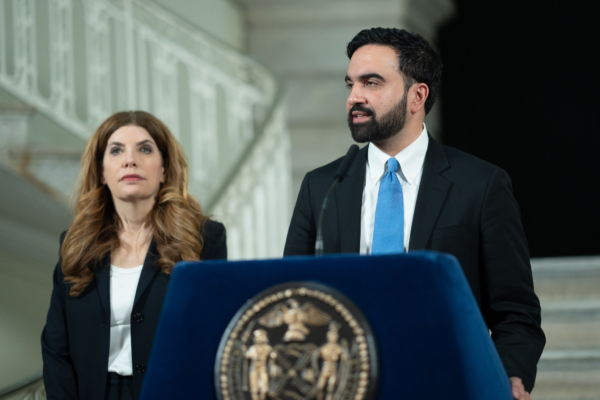
New York Mayor Mamdani faced with a multi-billion dollar fiscal deficit in the city’s budget, held a joint press conference with City Council Speaker Manning on Tuesday (April 28), urging New York Governor Hochu to adjust a major tax exemption system that primarily benefits high-income groups to increase the city’s revenue sources. However, Governor Hochu immediately expressed opposition on Tuesday, emphasizing that New York City should prioritize solving its financial problems through expenditure cuts.
The mayor and the city council speaker held a press conference at City Hall, stating that New York City is facing severe financial pressure with a budget deficit of about $5.4 billion. The mayor pointed out that the deficit stems from long-term budget imbalances and issues with the fiscal distribution structure between the city and the state, stating that “cost-cutting alone cannot fill the gap, we must increase revenue.”
Mamdani stated that reducing the pass-through entity tax exemption rate from the current 100% to 75%, known as PTET, is expected to increase New York City’s annual revenue by about $1 billion, to be used for basic services such as public transportation, education, and public facilities. The mayor mentioned that the tax exemption mechanism primarily benefits high-income groups, with over 95% of the beneficiaries earning over $1 million annually, and over 80% earning over $5 million.
City Council Speaker Manning also noted that this move would align New York’s tax rates more closely with other states such as Massachusetts and Connecticut, and suggested implementing it as a short-term measure to address current financial pressures.
The pass-through entity tax was originally designed to help businesses circumvent the federal limit on state and local tax deductions (SALT). With this system, business partners or owners can convert state and local tax payments into entity-level payments for federal tax purposes, allowing full deductions when filing federal taxes. Bloomberg analysis indicates that if the proposal is approved, it will significantly increase the tax burden on thousands of business owners, including retailers, restaurants, large law firms, financial companies, healthcare firms, while publicly traded corporations and other entities will remain unaffected.
Any modifications to tax exemption policies must be proposed by state legislators and signed into law by the governor. However, Governor Hochu swiftly rejected the proposal in another press conference on Tuesday, stating that the state government will not alter the PTET system, and suggesting that the city should review its own spending structure. She mentioned that the state government has already provided support to New York City through various measures, including approximately $1.5 billion in grants to help reduce the deficit, $12 billion over two years for childcare programs, and an estimated annual revenue of around $500 million from the pied-à-terre tax.
Nevertheless, the city government emphasized that despite some support, the overall financial pressure has not been relieved, and New York City continues to bear disproportionate fiscal burdens. The mayor and city council speaker pointed out that New York City contributes about 55% of state tax revenue but only receives about 42% of funds in return, requesting the state government to reassess the fiscal distribution mechanism.
As budget negotiations between the state government and state legislature have not been finalized, the mayor and city council speaker announced an extension of the deadline for submitting the executive budget from May 1 to May 12. Without clarity on the state budget, the city government will find it difficult to finalize its financial planning. According to the law, New York City must complete the final version of the budget by June 30.
In addition to tax adjustments, the mayor stated that they are simultaneously seeking to cut expenses, including reviewing cost efficiency and restructuring some financial frameworks, while emphasizing that they will not reduce basic public services or shift the burden to middle and low-income groups.
In response to criticism from the business community and some fiscal groups, the city government did not directly address individual criticisms but reiterated that the policy goal is to make high-income earners bear more responsibility to sustain city operations. The fiscal oversight organization, the Citizens Budget Commission (CBC), pointed out that increasing the tax burden could weaken New York’s economic competitiveness. The New York State Business Council stated that the PTET system is functioning well and should not be weakened in its effect.
The joint press conference by the mayor and city council speaker is seen as a signal of unity between the city government and the council on budget issues. Previously, there were disagreements between the two sides on cost-cutting and revenue-raising strategies. The city council speaker stated that adjusting the PTET exemption has long been included in the council’s budget recommendations and is not a policy shift but one of many fiscal tools.