
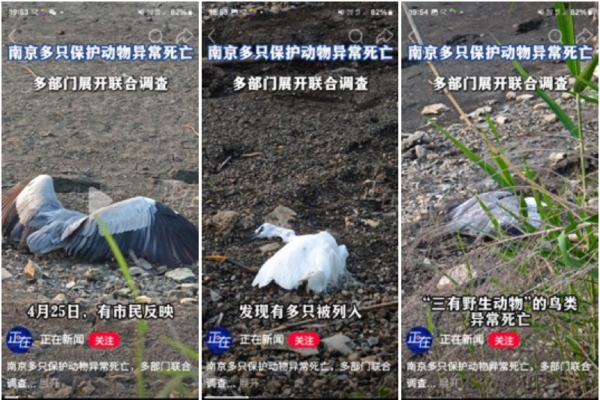
In recent days, in a certain area of Nanjing, at least twenty wild protected animals (such as egrets) have died abnormally, sparking attention and discussions on the internet. Local authorities have stated that a joint investigation involving multiple departments was conducted on the bodies, with over a hundred common toxicology tests carried out, revealing no presence of toxic substances. Initial investigations have ruled out human factors and avian influenza, leading to skepticism from netizens who are questioning if the authorities are concealing something.
According to an official account from Qingdao Radio and Television Station’s program “In the News” on the 27th, on April 26, Nanjing citizens discovered numerous bird species classified as “wild animals of significant ecological, scientific, and social value” dead abnormally in fishponds near Yongning Street and Qingshan Fishing Village.
Per the Mainland Wildlife Protection Law, animals of significant ecological value, scientific research value, and social value are known as significant wildlife animals.
Photographs taken by citizens show one egret collapsing while vomiting, with several other egrets already deceased nearby.
Officials from the agricultural and rural department of Pukou District, responsible for wildlife protection in Qingshan Fishing Village, told “In the News” that local public security, ecological environment bureau, and their unit’s animal husbandry and aquatic products station are jointly investigating the scene with no conclusive results as of now.
However, this news has caused concern and speculation among many Nanjing residents. Some speculate on water source pollution, while others analyze that if it were water pollution, there should have been mass deaths, not just a fraction.
Some residents suspect poisoning to profit from selling them, yet some netizens believe the deaths do not resemble poisoning. One netizen commented, “Looking at the images captured by citizens, it seems the species that died abnormally are relatively uniform (egrets, nightingales), which appears more akin to a disease.”
Another netizen mentioned that before the issue gained attention online, the procuratorate had already started an investigation, testing soil and body samples, finding no signs of poisoning, with the specific cause of death still under investigation.
The first person to discover the dead birds was a bird-watching enthusiast who posted the latest official update online on the 28th afternoon, stating, “Human factors have been preliminarily ruled out. Samples sent for testing have shown no abnormalities. Water samples tested normal. Over a hundred common toxicology tests were conducted on the bodies, revealing no toxic substances present.” Additionally, avian influenza was denied.
The enthusiast apologized for inciting public opinion online due to their initial statement of “mass bird deaths,” clarifying that a dozen birds were relatively insignificant compared to the entire population.
Despite this, many netizens in the comments section supported the enthusiast, thankful for promptly reporting their discovery to the relevant authorities, prompting official attention and coordinating swift investigations with multiple organizations. The enthusiast noted that the area has already undergone “mass culling.”
Some netizens mocked the local authorities, saying, “It seems like they said a lot, but didn’t really say anything at all.”
Local residents expressed to reporters, “Just conducting over a hundred tests in these few days feels more like lying. There must be reasons that the authorities cannot disclose, and trust is slowly eroded in this way.”