
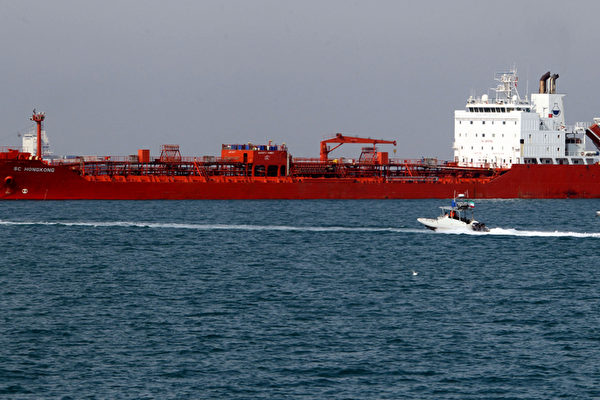
The United States military intercepting Iranian oil tankers expands globally. The US Department of War stated on the X platform that the US will continue to conduct maritime law enforcement operations globally, combating illegal networks and intercepting vessels providing material support to Iran, regardless of their location.
TankerTrackers, a oil tanker tracking website, reported on April 26th that satellite images confirmed that since the US began blocking Iranian ports on April 13th, prohibiting oil tankers from entering or leaving, a total of 38 vessels carrying approximately $1.05 billion worth of crude oil were promptly intercepted by the US Navy and forced to return to Iranian ports.
On April 23rd, the Pentagon announced that the US military intercepted a sanctioned stateless oil tanker named “Majestic X” in the Indian Ocean and boarded the vessel for inspection. The tanker was transporting oil from Iran and headed towards Zhoushan, Zhejiang. Previously, the US Navy also intercepted and boarded another stateless vessel named “M/T Tifani” in the Indian Ocean, at least 10 times bound for Chinese ports since late 2022.
Financial expert and current affairs commentator Qin Peng, speaking on the New Tang Dynasty TV show “News Discussion,” mentioned that one of the cost advantages of China’s manufacturing industry comes from the cheap oil supply from shadow fleets. Iran has a fleet of oil tankers filled with oil floating at sea, known as shadow fleets or ghost fleets. Qin Peng, who has extensive experience observing China’s economy, technology, and current affairs, also worked as a business information consultant for over a decade and is a commentator for various Chinese and English media outlets.
Shadow fleets, also known as ghost fleets, primarily transport oil and oil products from sanctioned countries such as Russia and Iran. They consist of old, poorly maintained large oil tankers with opaque ownership, utilizing frequent flag changes or forgeries, shutting down or interfering with vessel signals to hide their true location and navigation path. They often engage in ship-to-ship transfers at high seas to obscure the origin of the oil.
Qin Peng estimated that there are around five of these Iranian fleets constantly navigating the seas to transport Iranian oil. The US previously estimated that there is approximately 140 million barrels of oil, worth over $10 billion, mainly sold to China. These fleets primarily function by transferring oil in places like Malaysia’s territorial waters, where Chinese vessels pick up the oil. Despite the lack of official data from China, oil imports from Malaysia and Indonesia show inconsistency where China’s imports from these countries surpass their total output, thanks to the shadow fleets.
Qin Peng pointed out that obtaining low-priced oil from Iran, along with previously receiving large quantities of discounted oil from Russia, Venezuela, has enabled China’s manufacturing industry to maintain a cost advantage, ensuring China’s continued dumping of goods on the global market.
As the US and Iran engage in conflict, causing oil prices to soar, the current blockades and global economic actions seizing Iranian oil tankers, sanctioning individuals, companies, and financial institutions aiding Iran in illicit dealings, have significantly impacted China’s economy.
Admiral Bradley Cooper from the US Central Command announced on April 11th that the US military is conducting mine sweeping operations. The Pentagon informed Congress that it could take up to six months to completely remove mines laid by Iran in the Strait of Hormuz, as per the Washington Post.
Professor Yu Weixiong from the UCLA Anderson Economic Forecasting Center expressed concerns to the New Tang Dynasty TV, stating that while it may not necessarily take six months, any disruption in Middle East oil exports would have a substantial impact on the global economy.
Yu Weixiong added that East Asia, especially China, heavily reliant on Middle Eastern oil, would be significantly impacted. China currently requires around 15 million barrels of crude oil daily, importing approximately 13 million barrels due to domestic production shortages, with over 5 million barrels coming from the Middle East, including Iran. Beijing’s current resilience stems from strategic oil reserves and the ability to procure oil from shadow fleets at sea.
Given the current situation, Beijing and other East Asian countries are more anxious compared to the US. Veteran media figure Li Subu suggested that around 13% to 17% of China’s oil comes from Iranian shadow fleets, which are notably inexpensive. This scenario could severely affect China’s economy and pose challenges for Beijing. With the unfolding US blockades, both Iran and China may find it unsustainable in the long run. Li Subu concluded that whether Iran or China, the need to consider their own interests might lead to Iran’s compromise.
In summary, the US-Iran conflict, coupled with the blockades and sanctions, is likely to have a significant impact on global economies, particularly on China and other East Asian nations heavily reliant on Middle Eastern oil supplies.