
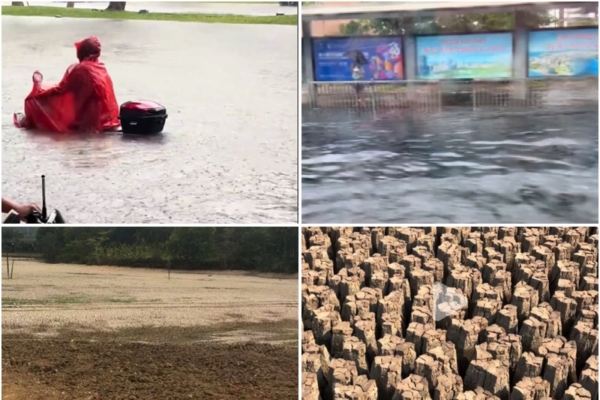
Recent extreme weather events have been hitting various parts of mainland China, with Hainan province experiencing a dramatic shift from drought to flooding. Some areas have been hit by exceptionally heavy rainfall, reaching levels classified as severe rainstorms. In some cities, the rainfall within just two to three hours has been so intense that it has led to a “see-the-sea” scenario, with some issuing red alerts for heavy rain.
On April 24th at 10:30 a.m., local official media “Haikou Net” issued an orange alert for heavy rain, stating that the rainfall in Haikou city reached 120 millimeters within three hours.
Local residents have reported that the flooding is severe enough to allow for swimming, causing transportation disruptions. Some areas have seen water levels rising so high that there are no longer sidewalks, and even bus stops have been submerged.
In Qionghai city, Hainan, just two hours of rainfall directly led to urban flooding. According to a video introduction by a Hainan science popularization blogger known as the “Disaster Tracker,” several road sections in the urban area were severely flooded with water levels exceeding one meter, causing transportation disruptions. In other areas, houses have been flooded, trapping residents and impacting daily life.
The Hainan Meteorological Service Center’s official account “Hainan Weather” reported that the island recorded its highest precipitation from 08:00 on April 24 to 08:00 on April 25 at 253.1 millimeters. The following day, from 08:00 on April 25 to the same time on April 26, the highest precipitation recorded was 187.3 millimeters.
According to Chinese meteorological standards, heavy rain ranges from 100 to 250 millimeters, while over 250 millimeters is classified as severe rainstorm.
Due to the lack of significant rainfall in Hainan for the past six months, many reservoirs have dried up almost completely. Local residents expressed confusion, saying, “It’s hard to understand. We haven’t had rain for so long, the ground is cracking, how could a heavy rain cause this in such a short time?”
Investigation revealed that the simultaneous occurrence of artificial rainfall operations in the region was related to the situation.
For instance, in Wenchang, it was reported by “Wenchang Integrated Media” that artificial rain enhancement was carried out in response to the recent prolonged high temperatures and drought conditions. After over 40 days of monitoring and analysis, artificial rainfall was implemented in Wencheng Town and Huiwen Town on April 24, significantly alleviating the drought situation.
The significant impact of this was evident as the Wenchang Meteorological Observatory changed the orange alert for heavy rain to a red alert at 1:13 p.m. on April 24, with local rainfall reaching 243 millimeters, classified as severe rainstorm.
Regarding the artificial rainfall in Wenchang, some residents believed that the Central Meteorological Observatory had already forecasted heavy rain on the 24th, and conducting artificial rainfall under existing rain conditions could lead to disasters like this.
A local teacher in Wenchang mentioned that the heavy rain had flooded the school playground, expressing sorrow over the damage.
Apart from Wenchang, official information stated that timely artificial rain operations were carried out in Tunchang, Chengmai, Baisha, and Anding, with visible positive effects.
Six days prior, a betel nut farmer in Hainan revealed that if it didn’t rain soon, the reservoir directly facing his betel nut plantation would completely dry up. He emphasized, “If there’s no water where I am, then most of Hainan will also be parched.”
A picture of a local reservoir provided by a netizen from Letong, Hainan, highlighted the precarious situation facing the reservoir near Qianjia Town in Letong Li Autonomous County, with water levels reaching a critical low.
In contrast, Hunan province had been experiencing persistent rainfall for several months, leading to the loss of crops. One farmer expressed dismay over the situation, while another confirmed that the rainfall in Changsha, Hunan, had been incessant.
Netizens lamented that mainland China is now facing extremes of drought and flooding.
The mainland has been grappling with severe extreme weather conditions recently. A week ago, Guizhou was hit by epic hailstorms, strong winds, and heavy rain, and on the 24th of April, Yunnan experienced another wave of epic hailstorms.
Yunnan’s Kunming was suddenly struck by severe hailstorms, leading internet users to liken the scene to a disaster movie.
Furthermore, Yunnan has forecasted continued severe convective weather with thunderstorms, accompanied by heavy rainfall, strong winds, and hail from April 27th to the 29th.
In the Daxing’an Mountains of Heilongjiang, a farmer pleaded to the heavens on April 24th, lamenting the unseasonal snowfall following the recent snow melt and questioning how to cultivate the land with such conditions. His video drew attention and discussion among farmers on mainland Chinese social media platforms. Responses from farmers from different regions described the adverse effects of the extreme weather on agriculture and crop yields.
According to the National Meteorological Center of mainland China, El Niño conditions are expected to occur in May, with a moderate to strong El Niño event forming during the summer and autumn seasons, lasting at least until the end of the year.
A brief explanation by the Heilongjiang Meteorological Service Center’s official science popularization account “Longjiang Weather” described El Niño as a phenomenon where the tropical oceanic regions of the central and eastern Pacific experience sustained warming, disrupting the balance between the ocean and atmosphere, thereby affecting global climate patterns.
The impacts of El Niño in China, as outlined by the Ministry of Agriculture of the People’s Republic of China, include southern flooding and northern drought, extreme high temperatures, and aggravated pest infestations.