
Following the cleanup of industry associations, the Chinese Communist Party (CCP) has introduced strengthened control measures targeting the “new employment group” involving over 80 million people, urging them to “follow the Party.” Experts believe that the CCP fears potential rebellion from this group, leading them to enhance control measures preemptively, which may result in greater public discontent and backlash.
On April 27, 2026, the CCP Central Office and State Council Office issued the “Opinions on Strengthening Service Management for the New Employment Group,” emphasizing the guidance of “Xi Jinping Thought” and the importance of “adhering to and strengthening the Party’s overall leadership.” It stresses “strengthening ideological and political guidance,” as well as mentioning the need to “provide cohesive services, safeguard legitimate rights and interests in accordance with the law,” claiming to guide the new employment group to “listen to the Party and follow the Party.”
On the same day, official media released the corresponding Q&A from the CCP Central Social Work Department.
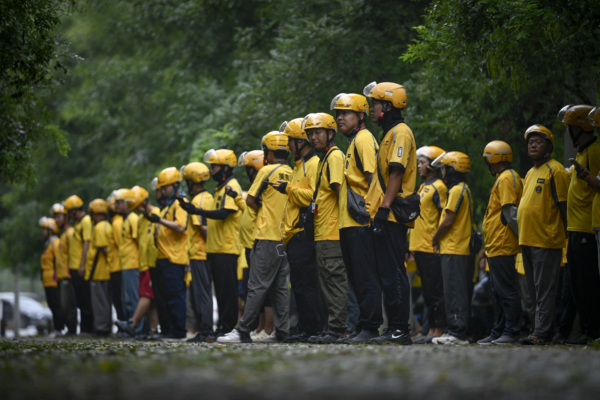
In China, the so-called “new employment group” officially refers to individuals engaged in more loosely structured employment through internet platforms. This group mainly includes delivery personnel, food delivery riders, online ride-hailing drivers, e-commerce practitioners, online streamers, and other emerging field workers. These individuals, mostly born in the 1980s and 1990s, have diverse backgrounds, experience high work intensity, strong mobility, and relatively low entry barriers.
The concept intersects with the recent official term “flexible employment,” which encompasses various forms such as self-employment and part-time work, with the new employment group emphasizing a close integration with the internet.
According to official data from 2023, the national new employment group has reached 84 million people, accounting for 21% of the total employed population. This includes around 12 million registered platform-based delivery riders, about 3.2 million couriers, and over 7 million online ride-hailing drivers. Data from the Ministry of Human Resources and Social Security in 2025 indicated that the broader scope of flexible employment has exceeded 200 million people.
Chinese issues expert Wang He told the Epoch Times that this is the CCP’s way of intensifying social control. According to official figures, this group consists of 84 million people, equivalent to one-fifth of China’s employed population. The CCP believes it cannot afford to lose control of this group and thus seeks to extend the Party’s influence across all sectors.
Wang He mentioned that authorities have implemented grid management, high-tech surveillance, and further involvement from the Social Work Department to integrate these 84 million individuals into the CCP’s monitoring system, prioritizing Party power over government authority. The authorities require the group to “listen to the Party and follow the Party,” indicating primarily political control measures. However, historical instances in China suggest that the likelihood of unrest among marginalized groups is high and challenging to contain.
On December 22 last year, in Changsha, Hunan Province, restrictions on food delivery riders entering a residential area triggered protests by hundreds of food delivery workers. That night, one rider donned a crown and robe with the words “Why not kneel when you see me” written on it, circling the protest site on another rider’s bicycle, cheered on by fellow workers. The incident evolved into a festive imitation of a “rebellion,” prompting authorities to dispatch a large number of special police officers.
From March 31 to April 3 this year, food delivery riders in Fengjie County, Chongqing, went on strike for days, protesting against exploitative practices and reduced delivery rates by platforms.
Wang He noted that this group is composed of young individuals heavily connected to the internet, with high mobility, making them more likely to challenge CCP stability measures. Therefore, the CCP is fearful and resorts to preemptive measures to keep the new employment group under its control.
Veteran in the Chinese capital market, Xu Zhen, also told the Epoch Times that in recent years, incidents involving food delivery workers have become a significant source of social crises, leading the CCP’s Social Work Department to consolidate the “social control functions” previously scattered among civil affairs, trade unions, judiciary, and propaganda. By establishing party branches and intervening through platform economies, the CCP pressures food delivery workers and ride-hailing drivers to conform. However, these methods may not be effective.
Xu Zhen criticized the increasing incidents involving unemployed groups like food delivery workers, comparing it to the escalating water pressure in a dam, suggesting imminent risks of bursting. While the CCP aggressively exploits the private sector through “far-sea fishing” tactics and suppresses laborers, it may provoke greater public resentment, eventually resulting in a backlash.
Official documents also mention the need to “provide cohesive services to the new employment group, safeguard legitimate rights and interests in accordance with the law,” and claim to “combine solving ideological issues with practical difficulties, enhancing the effectiveness of ideological and political work.”
Wang He believes the CCP has made it clear that addressing practical challenges starts with resolving ideological issues. The aspect of “safeguarding legitimate rights and providing services” is merely a facade.
He highlighted the challenge of handling social security for the so-called flexible employment group within the current system, as they lack adequate protection, essentially being marginalized. While the CCP aims to control and guide them, it must address their concerns, yet the reality falls short. For example, providing care or equal public services to these individuals necessitates local financial allocation, but given widespread fiscal challenges, local governments might be reluctant to invest in this group even if they have the resources.
He stated that many of the CCP’s policies end up being ineffective, such as imposing algorithmic regulations on major food delivery platforms. While these algorithms are core business secrets for these platforms, the CCP’s desire to control them may not align with corporate compliance. Fundamentally, the CCP seeks to strengthen its leadership, with the notion of “providing services” serving as a diversion.
In 2023, the CCP established the Central Social Work Department to enhance stability, with numerous affiliated agencies spread across the country. This department is responsible for controlling individual visits and oversees CCP’s party building initiatives, grassroots political power constructions, involving various industry associations, mixed-ownership enterprises, non-state-owned enterprises, new economic organizations, emerging societal groups, and the new employment group, along with volunteer groups.
Previously, on April 13, the CCP Central Office and State Council Office issued a document emphasizing “rectification” of over 100,000 industry associations, stressing the “strengthening of CCP’s overall leadership.” The explanation provided was also coordinated by the Central Social Work Department.
Wang He stated that the crackdown on industry associations signifies the extreme nature of the CCP’s social control. As these associations do not advocate for corporate interests, resistance against the CCP leads to further social stagnation and silence across society.