
After the outbreak of the US-Iran war, the shipping in the Hormuz Strait has almost come to a standstill, causing severe impacts on China’s energy and trade systems. As one of China’s most important external export channels, the interruption of the Middle East route has resulted in heavy losses for major trading towns like Yiwu, Shenzhen, Guangdong, and others. Orders have dropped by more than 50% compared to the same period last year, with some businesses seeing up to a 90% evaporation of sales during the peak season of Ramadan. Transportation costs have surged nearly three times, leading some businesses to shut down, putting small and medium-sized foreign trade enterprises under immense pressure for survival.
The current situation in the Hormuz Strait is volatile, disrupting China’s logistics for exports to the Middle East.
According to a report by “China News Weekly” on April 25, Guo Peigang, the general manager of Zhejiang Jia Sudal Supply Chain Management Co., Ltd., revealed that their company still has over fifty containers floating at sea, with more than ten originally planned to be shipped to Europe, the Middle East, and Africa.
Since the outbreak of the US-Iran war, both the Red Sea and the Hormuz Strait, two crucial shipping routes for global oil trade, have been facing risks. Especially the Hormuz Strait, carrying one-third of the world’s seaborne crude oil trade, has seen uncertain passage conditions, exacerbating the unpredictability of foreign trade logistics.
Under normal circumstances, the shipping cost for a standard container from Shanghai to the Middle East is only about three to four thousand US dollars. But now, the basic shipping cost has risen to five to six thousand US dollars, with additional war risk surcharges pushing the total transportation cost to over ten thousand US dollars, nearly a threefold increase from normal times.
Facing congested ports, shipping companies are exploring alternative routes, such as detouring around the Cape of Good Hope, but at a similarly high cost.
Guo Peigang mentioned that after the conflict broke out, the company urgently halted loading about twenty containers, with some emergency orders switching to the China-Europe Railway Express. However, the demurrage and transshipment fees for the containers at sea are still increasing daily.
Liu Jiarong operates a lighting factory in Jiangmen, Guangdong, with all products sold to the Middle East, achieving an annual revenue exceeding 200 million RMB. However, after the US-Iran war broke out, orders suddenly disappeared. He had to push customers to settle last year’s payments, close the factory, and wait for the war to end before resuming operations.
The Cross-Border E-Commerce Association of Yiwu City preliminarily estimated that in the past month, orders from the Middle East market for some businesses dropped by 50% compared to the same period last year.
According to “Southern Window,” the top five provinces in China in terms of exports to the Middle East are Zhejiang, Guangdong, Jiangsu, Shandong, and Shanghai, accounting for 67.2% of the total export volume. Among them, Zhejiang Yiwu, known as the “World Supermarket,” achieved an export volume of 109.31 billion RMB to the Middle East market in 2025.
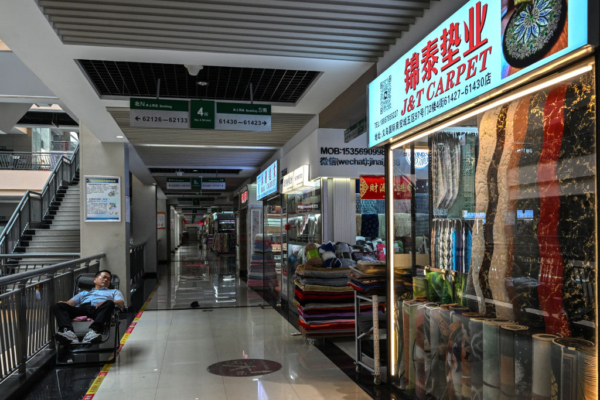
Currently, the number of Middle Eastern traders in Yiwu market has decreased by around 50%. Yu Qingwen, who engages in foreign trade business in Yiwu, mentioned that the peak shipping season from March to April did not arrive this year, with a significant number of orders being halted due to conflicts.
A small-scale general merchandise supplier familiar to Yu Qingwen usually experiences a 50% to 100% increase in Ramadan orders compared to regular times, with monthly sales exceeding 20 million RMB. However, between March and April this year, they only sold goods worth a little over a million RMB, less than a tenth of the usual amount, with 90% of orders evaporating.
Recently, a clothing foreign trade businessman at the Yiwu International Trade City, Zhou Bin, shared with Dajiyuan that the market’s foot traffic has decreased by nearly half compared to pre-war times. Zhou Bin pointed out that since a large amount of raw materials depend on refined oil, including plastics and fibers, the prices of raw materials have surged across the board, directly squeezing profit margins. The war has led to shrinking consumer demand, decreased purchasing willingness, and a combination of multiple factors, resulting in the industry facing dire straits.
If the market demand continues to remain low, the orders for stocking up for Christmas during the summer are likely to plummet again. At present, the survival pressure for small and medium-sized enterprises is whether they can withstand until after the war ends.