
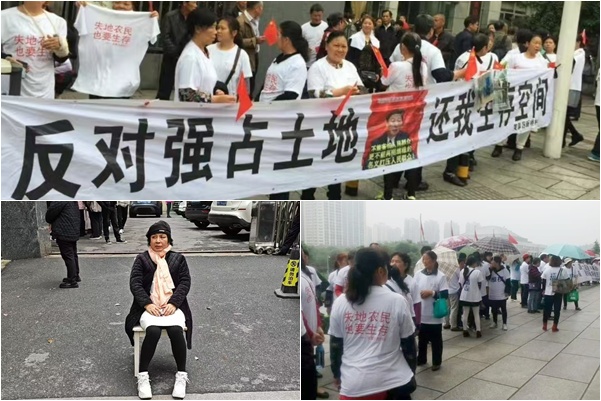
In a village in Furong District, Changsha City, Hunan Province, China, resident Hu Yalan has been fighting for her rights after her land and house were requisitioned by the government without proper compensation. She has been facing long-term suppression and surveillance by the local government for her persistent efforts in seeking justice.
Hu Yalan and her husband, Liu Jianguo, owned a brick and wood structure house with a building area of 458.6 square meters. In 2004, the village committee carried out relocation and resettlement, deceiving villagers into signing unfair agreements through fraudulent means. Initially, Hu Yalan hoped to resolve the issue through legal procedures, but she realized that the judicial process was ineffective. She then self-taught law and led villagers in their fight for rights.
On March 27th, Hu Yalan once again visited the petition office in Furong District, Changsha, to submit petition materials, but she was taken to the police station for recording by community staff and police officers (Badge Number: 012723) before being released.
Recently, Hu Yalan revealed that on October 26, 2004, village committee staff in Xinqiao Village deceived Liu Jianguo by concealing the fact that the land had already been converted to state-owned land by Hunan Provincial Planning Commission in 1992. They coerced him to sign the “Relocation Compensation Agreement” and “Xinqiao Village Villagers’ Self-built Housing Settlement Agreement,” but the compensation criteria were based on collective land.
Hu Yalan pointed out that these agreements lacked reasonable compensation in at least three aspects. Firstly, their house was located on Guhancheng No. 3 plot of land, which had been transferred to state-owned land for property development, and should have been compensated according to the market price of state-owned land, not the collective land acquisition price. The price difference per square meter was nearly 3,000 yuan.
Secondly, there was no provision for villagers’ production resettlement, which is crucial for ensuring farmers’ livelihood after land acquisition.
Thirdly, the living settlement houses were calculated at only 12 square meters per person, while the policy at the time stipulated 55 square meters per person.
During the initial relocation, villagers were not informed that the collective land had been transferred to Huacheng (real estate) in 1993. Hu Yalan emphasized the dissatisfaction among villagers with the government’s compensation plan, where they had to self-build houses and take loans of over 100,000 yuan. Over half of the villagers did not agree with the government’s compensation implementation.
Hu Yalan mentioned that she initially hoped to resolve the compensation issue through legal procedures, but the various levels of government and judicial departments colluded and shirked responsibility, blocking the judicial process.
Since 2015, Hu Yalan has led villagers in applying for hundreds of village affairs disclosures and government information disclosures, questioning the allocation of compensation funds for villagers and overseeing public welfare projects such as road construction in Xinqiao Village.
Hu Yalan expressed that the villagers have been fighting for their rights, but the darkest aspect is the inaction of the municipal government, with relevant departments delaying, intimidating, and threatening them. She stated that using avenues like government information disclosures and administrative litigation is futile. The poor rule of law environment in China has made her lose faith in the courts.
Throughout over two decades of fighting for rights, Hu Yalan has been illegally detained twice, with one instance resulting in a one-and-a-half-year sentence. She stated, “The authorities have retaliated against me because of my complaints and accusations, turning them into criminal cases. The judiciary system has completely rotted to the core.”