
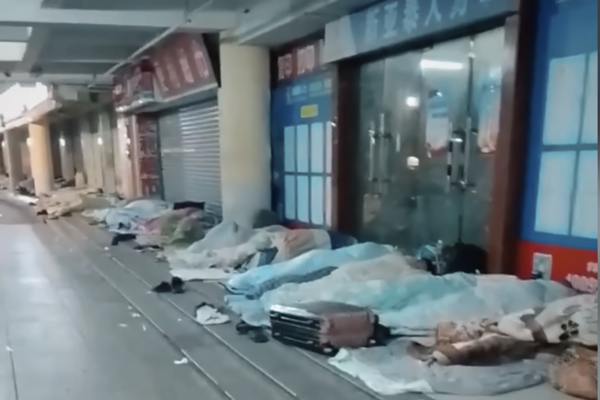
In China’s sluggish economy, many beggars have appeared throughout the country. The Chinese Communist Party has been emphasizing the “theory of bright economy” to cover up the truth. Recently, a legislative amendment changed the term “vagrants and beggars” to “displaced persons,” sparking online mockery.
On April 24, the Standing Committee of the National People’s Congress of China held a press conference to introduce the amendments to the draft of the Social Assistance Law. A spokesperson stated that the draft of the Social Assistance Law proposed four major amendments, one of which is changing the term “vagrants and beggars” to “displaced persons.”
The spokesperson claimed that this change “does not affect relief work” and is a modification based on the actual changes in social assistance work development, aiming to be “more accurate, neutral, and concise.”
As China’s economy continues to decline, the unemployment rate remains high, forcing many to sleep on the streets. Numerous videos online show people in dire straits begging for food at restaurants. There have even been reports of young people starving to death on the streets in some cities. Elderly individuals and children are sometimes found scavenging food from garbage bins.
On April 23, a netizen captured footage of numerous homeless individuals under and on a bridge in Guangzhou, Guangdong Province. [Video Link]
In the past, to conceal economic crises, the Chinese Communist Party would often play “word games,” creating new terms such as referring to unemployment as “joblessness” or “employment waiting.” In recent years, official terms for unemployment have included “flexible employment,” “self-employed economy,” “light entrepreneurship,” “slow employment,” among others.
Regarding the official change from “vagrants and beggars” to “displaced persons,” mainland Chinese netizens have mocked: “Changing it to ‘waiting for the rich’ would be more appropriate.” “Call them poets and fantasists instead.” “Waiting for executioners.” “Calling them ‘knights-errant’ would sound more positive.” “Using ‘awaiting wealth’ is more upscale.” “Call them a group rushing towards wealth.” “Just write ‘freelancers,’ wouldn’t that be more elegant?”
Some netizens also commented, “All their energy is spent on carving A4 paper.” “It’s really tough on them.” “One change will eradicate beggars from the world, impressive.” “Inventing these nonsense terms.” “The little bird sings.”
Previously, a video surfaced online showing a young man in Shenyang’s Zhongjie standing in a small square, reciting the poem “The Little Bird Sings” through a microphone, his voice filled with sorrow and anger.
The excerpt from the poem goes, “The best way to kill a little bird is, no matter if it’s quarreling or calling out, you write it down as the little bird singing! Regardless of it cursing or crying, you write it down as the little bird singing! No matter if it’s wailing or calling, you write it down as the little bird singing!”
This video made its way to the mainland Douyin platform, attracting many netizens to watch and comment. The barrage of comments showed that most netizens understood the underlying message: “For those who cry out for us.” “I admire him.” “I support you, wayfarer.” “A spark can ignite a prairie fire.” “Salute to those advancing social progress.” “The awakening of young people.” “Hope for civilization.” Some concerned netizens also advised the young man reciting the poem to “stay safe” and wished him well.
According to public information, this young man reciting the short poem gained popularity on major social media platforms in China as early as April 2025. The poem titled “Killing a Bird,” was authored by Zhou Changfeng, a member of the Chinese Writers Association and a poet.