
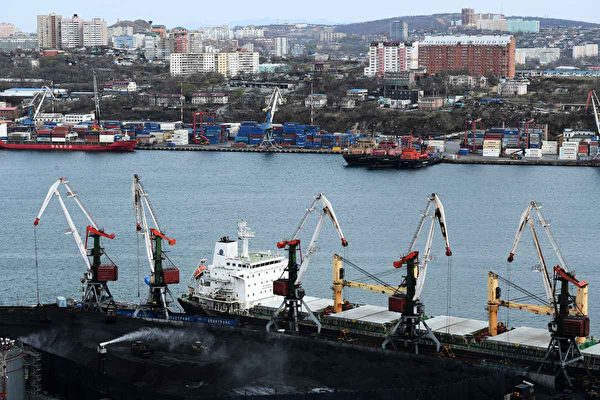
The Tumen River Highway Bridge connecting North Korea and Russia held a completion ceremony recently, with an expected completion date in June. This celebratory event has once again drawn attention to the complicated relationship between North Korea, China, and Russia. Experts suggest that the new Tumen River Bridge may still pose challenges for Chinese ships attempting to sail out to sea. Relations between North Korea and Russia overshadow those of North Korea and China, as North Korea and Russia still have concerns regarding China utilizing the Tumen River to access the Sea of Japan.
On April 21st, the Russian Embassy in North Korea announced through its “Telegram” account that the Tumen River Highway Bridge closure ceremony was held at the North Korean-Russian border.
According to reports from the Korean International Broadcasting Station, the Tumen River Highway Bridge linking North Korea and Russia is scheduled to be completed on June 19.
In June 2024, during a summit in Pyongyang, the leaders of North Korea and Russia reached an agreement to construct the Tumen River Highway Bridge. The project officially commenced at the end of April last year, with officials from both nations participating in the groundbreaking ceremony for the new road bridge across the Tumen River. Reports from that time indicated an anticipated completion by the end of 2026.
Currently, there is a railway bridge connecting the Tumen River Station in North Korea with the Hassan Station in Russia.
Analysts believe that the celebratory event of the Tumen River Bridge between Russia and North Korea presents a dilemma for China.
North Korea expert and assistant researcher at the Taiwan National Security Institute, Lin Zhihao, stated that the rapid construction progress of the bridge over the past year reflects a significant achievement. As the completion of the bridge nears, it effectively obstructs China’s aspirations to access the Tumen River outlet to the sea.
Zhihao further noted that the newly constructed North Korea-Russia bridge features closely spaced supports, with a height almost equal to the adjacent North Korea-Russia Friendship Railway Bridge (estimated around 7 to 10 meters high). This design restricts the passage of Chinese ships exiting from the Tumen port, except for small vessels, effectively locking China’s access to the Tumen River outlet.
In recent years, North Korea and Russia have been drawing closer. During Putin’s visit to Pyongyang in 2024, Russia and North Korea signed a “Comprehensive Strategic Partnership Treaty,” which includes a mutual defense clause. North Korea has deployed thousands of troops to fight alongside Russian forces in Ukraine.
In April this year, Russian Interior Minister Vladimir Kolokoltsev, Natural Resources Minister Alexander Kozlov, and Health Minister Mikhail Murashko visited North Korea consecutively.
Meanwhile, China has been attempting to strengthen its ties with North Korea. On March 12, the international train K27, which had been suspended for six years due to the COVID-19 pandemic, resumed its operation from Beijing to Pyongyang.
Zhihao highlighted that the interaction between North Korea and Russia is far more significant than North Korea’s relations with China. By prioritizing ties with Russia, North Korea seems to be aiming to enhance its ties with China subsequently. North Korea may be looking to surpass the scale of its relationship with China through the development of strong ties with Russia, gradually reducing its economic reliance on China. “For North Korea, establishing a close relationship with Russia first, then with China, before considering the United States, aligns with its current national security interests.”
He added that the new North Korea-Russia highway bridge is the first physical road bridge linking the Korean Peninsula since the times of Imperial Russia and the Soviet Union. The North Korea-Russia Friendship Bridge built in 1959 was merely a single-track railway bridge, mainly symbolic. Furthermore, the construction of this bridge indicates that Russia is effectively extending its control over the areas that were once part of the Qing Dynasty, solidifying its administrative influence.
Before the mid-19th century, both Vladivostok (known as “Vladivostok” in Russian) and the downstream banks of the Tumen River were territories of China. Through the “Treaty of Aigun” in 1858 and the “Treaty of Beijing” in 1860, Imperial Russia acquired around 400,000 square kilometers of land east of the Ussuri River, including Vladivostok. These unequal treaties ceded the last 15 kilometers of the north bank of the Tumen River to Russia, eliminating China’s direct access to the Sea of Japan through the Tumen River and transforming Jilin Province from a coastal province to an inland one.
The mouth of the Tumen River is located at the junction of China, Russia, and North Korea, indicating that China’s landlocked northern provinces depend on Russia and North Korea for maritime access.
The “Sino-Russian Mutual Assistance Pact” signed in August 1945 saw representatives from Chiang Kai-shek’s Nationalist government, such as Song Ziwen and Jiang Jieshi, proposing to Stalin the recovery of sovereignty over territories such as Dalian, Vladivostok, and the Kuril Islands. Eventually, an agreement was reached, where the Soviet Union agreed to return Dalian, Lüshun, and the Southern Manchuria Railway to China (in 1946), with an agreement to reclaim Vladivostok by China fifty years later.
On July 16, 2001, then Chinese Communist Party leader Jiang Zemin and Russian President Putin signed the “Sino-Russian Good Neighborly Friendship and Cooperation Treaty” at the Moscow Kremlin, officially renouncing China’s territorial claims concerning disputed territories with Russia. This marked the confirmation of Russia’s sovereignty over territories, including Vladivostok (Vladivostok), the Tumen River mouth, and the 400,000 square kilometers east of the Ussuri River (equivalent to the area of ten Taiwan islands). Jiang was subsequently criticized for “selling out” the country.