
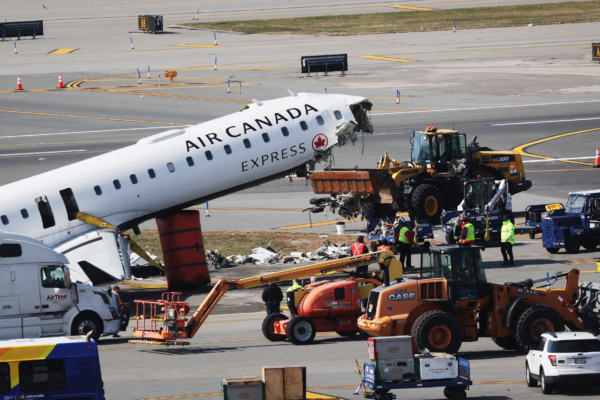
On April 23rd, the National Transportation Safety Board (NTSB) released the latest investigation report on the fatal accident that occurred at New York’s LaGuardia Airport last month, resulting in two deaths. According to the report, during the critical moments of the fatal runway collision on the evening of March 22nd, the air traffic controller had issued a warning and the driver of the fire truck had heard three “stop” commands, but tragically, the accident could not be prevented.
Based on reports from various media outlets including the Associated Press, around 11:35 PM on March 22nd, just 12 seconds before the plane touched down, when the aircraft was about 100 feet above the ground, the air traffic controller (tower) allowed the fire truck to cross the runway. However, just 9 seconds before landing, the tower urgently requested the fire truck to “stop!” The airport staff member driving the fire truck heard the controller’s frantic “Stop” shouts, but did not realize that the command was directed at their vehicle, thus they did not stop or evacuate the runway in time. Approximately 4 seconds before landing, the tower again issued a “stop” command, but the driver still did not comprehend it. It wasn’t until the aircraft was landing that another operator on the truck realized the urgent warnings were related to them, but by then, the fire truck had entered the runway and collided with Air Canada Express Flight 8624 as it was landing on Runway 4, resulting in the tragic deaths of two pilots.
At present, it remains unclear why the personnel on the fire truck did not immediately understand or take action in response to the warnings and why the safety systems failed to issue timely alerts. The NTSB pointed out that multiple safety systems failed during the accident, including the runway monitoring system failing to issue an immediate conflict alert, the fire truck lacking a transponder which resulted in the ground tracking system being unable to locate it promptly, the runway warning lights changing only a few seconds before the accident, and the airport’s advanced ground surveillance system (ASDE-X) not functioning properly.
The investigation by the NTSB also mentioned that at the time of the accident, there were only two air traffic controllers on duty at the tower, who were simultaneously handling other emergency aviation incidents, indicating a high overall workload. While such nighttime staffing levels are in line with standards, they may increase risks during high traffic or unexpected situations.
The Port Authority of New York and New Jersey responded to the NTSB report on Thursday, stating that they are conducting an internal investigation into the accident.
“We appreciate the work of the NTSB and their prompt release of this preliminary report,” said James Allen, Chief Operating Officer of the Port Authority of the two states. “We are conducting a comprehensive review of the preliminary investigation findings and materials. Our focus is clear: to ensure our safety procedures and protocols are as robust as possible and to strengthen them as needed.”
The accident has been preliminarily attributed by the NTSB to the result of “multiple system and communication failures” rather than a single error. In a matter of seconds, control instructions, ground vehicle reactions, and aircraft landing altitudes intersected, ultimately leading to an irrevocable collision.
The NTSB emphasizes that the investigation is still in the preliminary report stage, and a full investigation may take 12 to 24 months.