
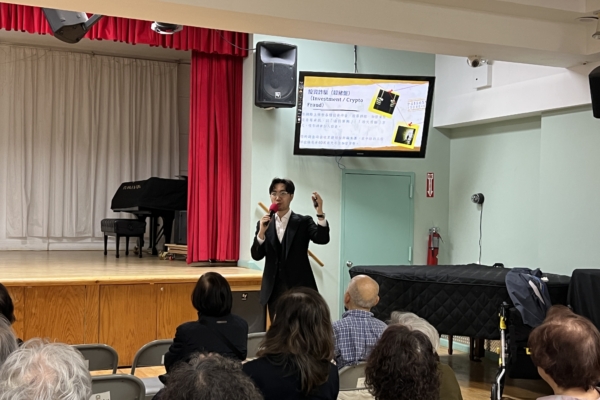
With the rapid development of artificial intelligence (AI) technology, fraudulent schemes are upgrading on a large scale. On April 23, the Taipei Economic and Cultural Office in New York, in collaboration with the New York Taiwan Center, held a “Fraud Prevention Seminar” led by Legal Secretary Lai Yichen. The seminar aimed to warn the public to be cautious of the widespread scam involving well-known figures like Morris Chang, Jensen Huang, and Lisa Su offering “free books” on social media platforms. It was highlighted that AI has become a vital tool for fraud groups, making scams more sophisticated and harder to detect.
Legal Secretary Lai, who has over a decade of investigative experience with the Taiwan Investigation Bureau, pointed out that in recent years, fraud groups have increasingly used familiar Chinese entrepreneurs as bait, such as Morris Chang of TSMC, Jensen Huang of NVIDIA, and Lisa Su of AMD. They lure users by placing “free book” ads on platforms like Facebook and Instagram, prompting users to provide contact information, leading to further scam activities through messaging apps like LINE.
According to Lai, the fraudsters exploit the high trust and admiration people have for these “beacons of Taiwan” and design seemingly reasonable investment schemes. He explained, “They start by sending you a book, then daily conversations to gain your trust, and finally, lead you into an investment trap step by step.”
Fraud typically begins with offering “free books,” establishing trust, and then transitioning to recommending stocks or investment opportunities, even creating the illusion of “guaranteed profits.” Lai cautioned, “Initially, they may let you make a small profit to make you believe it’s real. At first, you may only invest a few thousand, then it could escalate to tens of thousands or even more. Once you’ve invested all your savings, they will take everything, a very common tactic in recent years.”
AI technology is revolutionizing fraudulent practices. Lai highlighted that in the past, fraud groups relied on a large number of personnel to make phone calls, but now AI can automatically generate voice, dialogue, and even images, significantly reducing costs and increasing efficiency. “Previously, it took a dozen or twenty people taking turns to make calls. Now, with just a few computers and servers, they can make hundreds or even thousands of calls simultaneously,” he noted. “AI can mimic different voices, tones, all sorts of details, and even the voice of someone familiar to you.”
He gave an example of a financial personnel from a Taiwanese company who received a video call from the “boss” with the exact appearance and voice, demanding an urgent transfer of 8 million dollars. In a panic, the personnel wired the money, later realizing it was a scam using AI-generated images and voices.
“You can’t even determine if the call you’re receiving is from a ‘real person’ anymore,” he warned.
Lai mentioned that fraud groups operate with a high level of organization, akin to large corporations. Citing the shocking international case of the “Prince Group,” which laundered billions of dollars through investment fraud and multiple layers of cryptocurrency like Bitcoin and Tether.
“The level of professionalism in fraud groups is on par with a company, with detailed division of labor and complete operations,” he said. “This is no longer isolated criminal activity but a transnational industrial chain.”
It is noteworthy that victims are often not the vulnerable groups as commonly thought. Many cases involving losses of tens or even hundreds of thousands of dollars mainly affect high-income, high-educated individuals. Lai stated, “It’s not because they are foolish, but fraud groups tailor their strategies to match your interests and behaviors.”
Lai highlighted that fraud groups utilize AI and algorithms to analyze users’ online behaviors, such as search history, click preferences, to precisely understand personal interests and lifestyles, and then target them with “tailor-made” scam advertisements. “While you think you’re just scrolling on your phone, your interests, age, investing habits could all be analyzed,” he emphasized.
In the face of continuously evolving fraudulent tactics, the organizers urged the public to be vigilant, especially regarding messages related to “celebrities giving books,” “guaranteed profits,” and “unofficial investment groups.”
Lai proposed the “Five Steps to Fraud Prevention”: “Pause”: Stay calm when receiving suspicious messages; “Consider”: Evaluate the content for reasonableness; “Verify”: Check through official channels for verification; “Reject”: Refuse any money requests; “Report”: Alert family and friends and report to authorities.
He stressed, “Free is often the most expensive price to pay; in the AI era of fraud, it’s not rougher but more realistic.”