
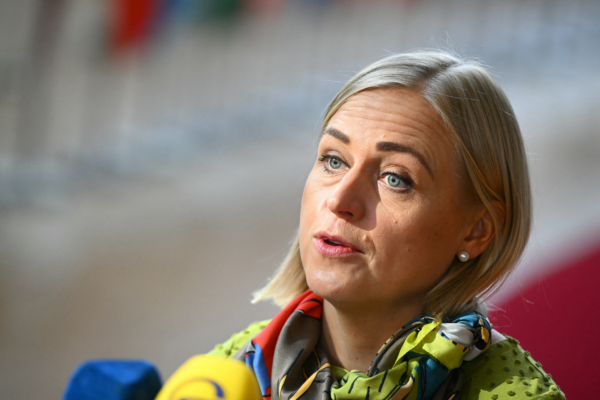
Against the backdrop of Beijing actively pushing for trade or investment agreements with Europe, the Finnish Minister of Foreign Affairs stated on Thursday (April 23) that the close relationship between Beijing and Moscow makes it impossible to discuss the EU-China agreement. Overseas media reports on this issue have been titled “Xi Kicks the Iron Plate!”
According to the South China Morning Post, Finnish Foreign Minister Elina Valtonen made it clear in an exclusive interview with the newspaper in Helsinki that the close relationship between the Chinese Communist Party (CCP) and Russia would be a “qualifying factor” for Beijing being denied the opportunity to initiate negotiations for a free trade agreement with the EU. This statement pours cold water on Beijing’s hopes for a EU-China trade agreement.
Beijing has recently hinted at the possibility of reaching a trade or investment agreement with European leaders during recent meetings. German Chancellor Friedrich Merz also mentioned last month that the two sides may potentially sign an agreement in the future. While formal negotiation talks have not yet started, such proposals have appeared in several official diplomatic reports from the CCP.
The firm stance of Finnish Foreign Minister Valtonen carries significant weight. As any agreement negotiation within the EU requires the support of all 27 member states, Finland’s position implies that the country can effectively veto any steps towards this direction.
Speaking in the Finnish Parliament building, she stated, “I do believe that this is a qualifying factor… I think so.”
Valtonen pointed out that the CCP does benefit from the Russia-Ukraine conflict. She mentioned that Moscow has now become a secondary partner to Beijing, with little to offer besides its abundant natural resources. “If they (CCP) can get these resources at a low price, of course, it benefits China,” she added.
She also bluntly stated that Beijing’s support for Russia violates the principles of the United Nations Charter, saying, “This is something we cannot accept.”
The EU has previously warned that there are signs showing that the CCP is providing dual-use items to Russia. A senior EU official even noted that approximately 80% of the components used in Russian weapons come from China.
In fact, Brussels officials have been skeptical about reaching any official EU-China agreement for a long time, as there are many unresolved issues in their bilateral trade relationship.
A long-negotiated EU-China investment agreement has been pending approval since 2021 and remains in limbo. The root of the disagreement lies in the mutual implementation of sanctions concerning human rights issues in Xinjiang, which has led to a stalemate in the bilateral relationship.
Subsequently, Beijing has refused to openly condemn Russia’s invasion of Ukraine and has been reluctant to respond positively to European demands to restrain Russian President Putin. This has further deepened the political mistrust between Beijing and the EU.
Valtonen mentioned that now is the appropriate time for serious discussions within the EU on the EU-China issue. She acknowledged that each EU member state has its own considerations, making it difficult to form a unified position. However, she emphasized, “If Europe can unite on this issue, it will be stronger.”
The statement from the Finnish Foreign Minister highlights that the trade tensions between the EU and China are now deeply intertwined with the geopolitical consequences of the Russia-Ukraine conflict, making them inseparable. Analysts point out that with the CCP continuing to provide economic and material support to Russia, the actual space for substantial improvement in EU-China relations is extremely limited.