
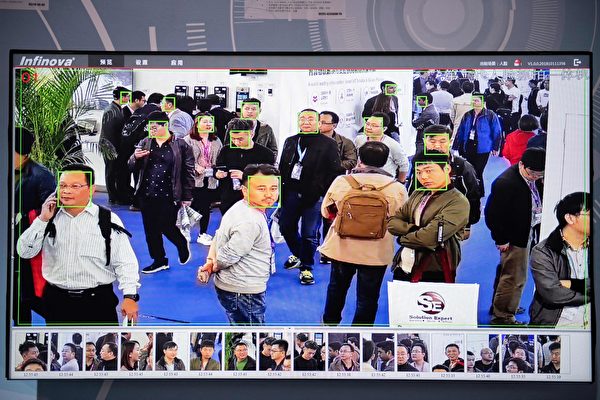
In a recent case in Shanghai, a regular citizen was fined for riding a bicycle on the sidewalk in violation of regulations. Surprisingly, there were no law enforcement officers present at the scene; instead, the person’s identity was recognized by a facial recognition surveillance system. This typical enforcement case reflects how the Chinese Communist Party’s “facial recognition” electronic monitoring system has expanded from targeting specific groups to ordinary citizens, evolving into a ubiquitous surveillance mechanism penetrating every aspect of social governance.
According to a report by French newspaper Le Monde, a Shanghai resident, Mr. Li Yan (pseudonym), recently received a text message from the police informing him of a 50 yuan fine for biking on the sidewalk. While the fine amount was not substantial and he did not deny the violation, what truly unsettled him was the way the police identified him.
That day, he did ride his bike for a few dozen meters without police interception, and his bicycle did not have a license plate. The text message only mentioned that his identity was verified using “electronic technology.”
In recent years, due to the proliferation of online scams through text messages, Mr. Li Yan took the initiative to contact the police to verify, confirming that his face had been automatically recognized by a public safety camera.
He pointed out that he has no political dissent against the government and no suspicious interactions that would raise concerns for the government. “If someone as inconspicuous as me can be automatically identified on any street, one can imagine how far this surveillance will develop in the future,” he said.
The use of “facial recognition” technology in China’s traffic police system has been around for nearly a decade. As early as 2016, the Shanghai traffic police began piloting the use of the “facial recognition” electronic monitoring system to catch violators not wearing seat belts or using phones while driving. At that time, the director of the Science and Technology Department of the Shanghai Public Security Bureau Traffic Police Detachment, Sang Zhigang, mentioned that the electronic probes could take clear pictures of drivers’ faces, perform facial recognition in the backend, and then issue fines through the traffic violation processing system.
According to information disclosed by the Xuhui Sub-bureau of the Shanghai Public Security Bureau on June 16, 2025, by the end of 2024, Xuhui District had installed 120 sets of facial recognition equipment.
The use of “facial recognition” enforcement has been implemented in several mainland Chinese cities such as Shanghai, Xi’an, Zhengzhou, Nanchang, Wuhan, Chongqing, Fuzhou, shifting law enforcement focus from checking vehicles to precise identification of individuals.
Furthermore, the application of “facial recognition” monitoring technology has already permeated into daily life in China. At airports like Shanghai Hongqiao, passengers can board flights solely based on facial recognition; some residential communities use facial recognition for access control; and gym cameras can identify members from several meters away.
Canadian democracy activist and Chinese writer Sheng Xue, in an interview with Epoch Times, expressed that every Chinese person who has experienced or noticed this situation would have a consciousness of potentially being under surveillance at all times, leading to a high level of self-censorship and self-correction in society: “Do not get into trouble, do not speak out politically, do not behave inappropriately. This approach has created the effect of a ‘total surveillance prison’ throughout China.”
Zeng Jianyuan, director of the Taiwan Chinese Democratic Academy, raised legal concerns. He told Epoch Times that China’s social credit system currently lacks clear legal basis, stating, “So far, there is no law empowering the state or local governments to monitor people’s behavior in public spaces.”
He also pointed out another hidden danger of “technological law enforcement”: the possibility of machine errors in judgment. “When crossing the road, if someone is accused of running a red light, what if they were avoiding another accident? This situation occurs frequently, and sometimes, additional evidence is required for judgment. However, machines often skip these procedures.”
There have been precedents of misjudgments by surveillance systems. During the Communist Party’s National People’s Congress and Political Consultative Conference in March 2024, facial recognition machines were used to identify individuals passing by guard posts near Tiananmen Square. A Hong Kong journalist triggered an alarm on the machine, mistakenly identified as a “Hengda petitioner.”
Sheng Xue believes that facial recognition cameras could not only be used for surveillance but also become tools for profiting.
She said, “Once facial recognition cameras in China are put into use, they will be monopolized, and monopoly is inherently linked to power,” adding, “We see in some Chinese cities that several surveillance cameras are installed at intersections.”
“Considering China’s substantial initial investment in surveillance equipment, during economic downturns in China, these surveillance tools become revenue-generating tools,” she stated. Economic downturn serves as an important driver for this shift since it can both save administrative costs and create new fine revenues.
Zeng Jianyuan believes that without a transparent oversight mechanism, it is unclear how the government uses the fines collected. He emphasized that under economic pressure, the “fine economy” has quietly emerged within local governments in China.
Similarly, the US CNBC website published an investigation about the Chinese government’s efforts to establish a national social credit system titled “China wants to track and rate every citizen’s behavior,” indicating that the social credit system could be abused.
Since the Communist Party launched the social credit system in 2014, there have been dozens of pilot projects in China where local governments link citizens’ credit ratings to policies on admissions, library services, rental benefits, and public transportation usage. For example, Suzhou’s “Osmanthus Division,” Hangzhou’s “Qianjiang Division,” Xiamen’s “Egret Division,” and Fuzhou’s “Jasmine Division.”
Zeng Jianyuan also mentioned the significant issue of missing persons in China. Despite the abundance of surveillance cameras on the mainland, they have not played a role in finding missing people. “Evidently, the problem lies not in whether these tools malfunction but in the people operating them behind the scenes,” he said.
Sheng Xue also pointed out that China has never truly entered modern civil society: “China’s overall social governance has always been based on man rather than institutions, rules, or laws.” This fluidity within the surveillance system’s boundaries, driven by political needs and economic pressures of the Communist Party, lacks constraints.