
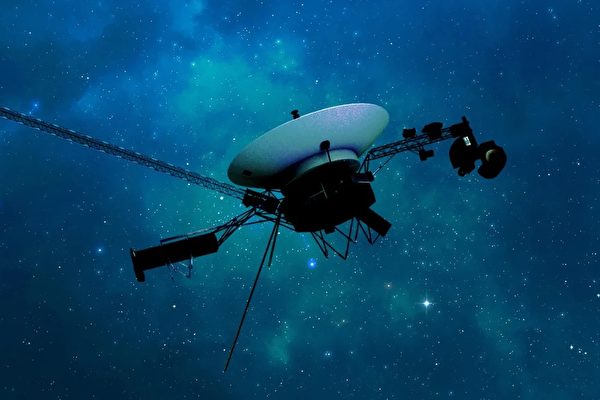
The “Voyager 1” spacecraft of the National Aeronautics and Space Administration (NASA) has been a witness to human intelligence for nearly 49 years. It continues to operate in space, showcasing a remarkable feat. In order to keep this aging spacecraft running in the interstellar space over 15 billion miles away from Earth, NASA has recently shut down one of its scientific instruments to conserve the decreasing power supply.
Engineers at NASA’s Jet Propulsion Laboratory (JPL) in Southern California issued a command last Friday (April 17) to turn off the Low-Energy Charged Particle (LECP) experiment on “Voyager 1.” The LECP instrument has been in operation almost continuously since the launch of Voyager 1 in 1977. Its purpose is to measure low-energy charged particles from the solar system and beyond, including ions, electrons, and cosmic rays.
However, a small electric motor used for rotating sensors for full-sky scans within the LECP system will continue to operate, consuming only about 0.5 watts of power. Engineers hope that keeping this small electric motor running will allow the team to restart the instrument when more power becomes available in the future.
The decision to shut down the LECP device was not made randomly, as NASA engineers had agreed several years ago on the sequential shutdown of various instruments on Voyager 1 to minimize power consumption as much as possible.
Voyager relies on plutonium decay heat to generate power and is expected to lose approximately 4 watts of power each year. As time goes on, the spacecraft’s power supply gradually diminishes. NASA’s teams are currently working hard to extend its remaining lifespan.
“While shutting down scientific instruments is not something anyone wants, it is the best choice at present,” said Kareem Badaruddin, Voyager mission manager at JPL, in a statement. Badaruddin added, “Voyager 1 still has two science instruments operating— one for detecting plasma waves, and the other for measuring the magnetic field. They continue to operate well, providing data from previously unexplored areas of space.”
NASA stated that during a routine roll maneuver on February 27, Voyager 1 experienced an unexpected power decrease, significantly increasing the pressure on the ground team to act quickly. Engineers are confident that shutting down the LECP will buy Voyager 1 approximately a year of breathing space. During this time, engineers are also finalizing a larger energy-saving plan called “the Big Bang” to further extend the lifespan of both Voyager 1 and Voyager 2.
The concept of this plan involves replacing a batch of power-consuming devices all at once—hence the nickname “the Big Bang”— by shutting down some equipment and substituting them with low-power alternatives to maintain adequate temperatures for the spacecraft to continue collecting scientific data.
This shutdown highlights the increasing challenges faced by the Voyager team as the operational lifespans of both Voyager 1 and Voyager 2 far exceed the initial mission plans. When they left Earth, each carried ten identical sets of instruments, seven of which have already been shut down. Voyager 2’s LECP instrument was shut down in March 2025.
Voyager 1 is currently more than 15 billion miles away from Earth, the farthest spacecraft from humanity. Voyager 2 is over 12 billion miles away. Launched in the latter half of 1977, they entered interstellar space in 2012 and 2018, respectively, becoming the only spacecraft to operate in interstellar space and directly sample it. The information collected by these two space probes helps scientists understand the shape of the heliosphere like a comet and how it shields Earth from high-energy particles and radiation in space.
When launched in 1977, no one could have anticipated that they would continue to surprise scientists after the initial 4-year mission plan, now nearing its 49th year, continuing to transmit unique data from interstellar space to the ground.
They are also the longest-operating spacecraft of NASA and the farthest from humanity. They have flown by Jupiter and Saturn, with Voyager 2 also passing Uranus and Neptune.
Powered by Radioisotope Thermoelectric Generators (RTGs), which convert heat generated by plutonium decay into electricity, they are facing more and more aging issues after nearly five decades in space. Engineers have had to gradually shut off heaters and scientific instruments while ensuring the spacecraft does not get too cold to prevent damage to critical systems like fuel lines.
Badaruddin stated, “The team remains focused on extending the operational time of both Voyager spacecraft as much as possible.”
Linda Spilker, project scientist for the Voyager mission at NASA’s Jet Propulsion Laboratory, remarked last year, “The Voyager probes are at every moment exploring an area never before reached by any spacecraft. This also means that every day could be our last day (referring to the moment when Voyager runs out of power and can no longer function). But that day could also bring another interstellar discovery. Therefore, we are doing everything we can to ensure that Voyager 1 and Voyager 2 continue to push forward for as long as possible.”