
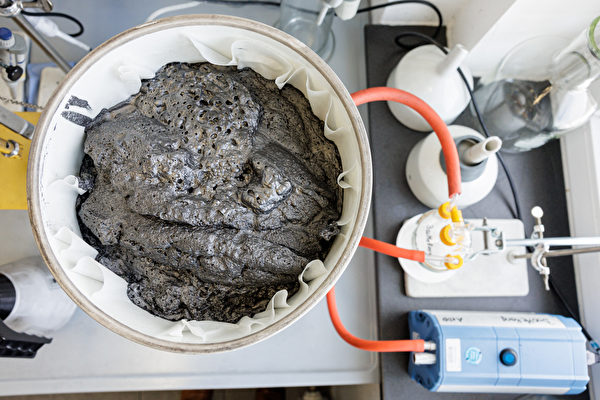
In order to break away from relying on China in the supply chain, Australian graphite producer Syrah Resources Ltd. has recently received support from the U.S. government. Syrah operates one of the world’s largest graphite mines in northern Mozambique, Africa.
On March 26, Syrah Resources Ltd. announced that it has received a non-binding strategic financing proposal from the U.S. Department of Energy (DOE), the U.S. International Development Finance Corporation (DFC), and Australian pension fund AustralianSuper. The company plans to raise 104 million Australian dollars (approximately 72 million U.S. dollars) through an irredeemable share placement, reshaping Syrah’s balance sheet.
According to the proposal, most of Syrah’s debts will be converted into new issued shares, or converted into convertible loan notes. With these adjustments, Syrah’s liquidity could increase significantly, rising up to 198 million U.S. dollars, and the company will not need to pay cash interest or principal for the next three years.
These proposals are subject to various conditions, including the signing of binding formal documents, government and regulatory approvals, approval from U.S. DFC and DOE, as well as approval from Syrah shareholders.
If the proposals are realized, after the transaction, DFC will become Syrah’s second largest shareholder. Syrah operates the Balama Graphite mine in Africa, which is a major global natural graphite resource. The mine has mining reserves for several generations, high-grade deposits, and integrated processing facilities, enabling Syrah to continue participating in the battery anode materials and electric vehicle markets. The current ore processing capacity is 2 million tons per year, with a graphite output of 350,000 tons per year.
On March 25, DFC released a news release on its official website regarding the strategic investment in Syrah Company.
The DFC news release mentioned: “DFC has proposed an innovative debt management structure that will firstly convert a portion of DFC’s existing loan to Balama into Syrah’s common stock, while the remaining DFC loan balance will be converted to convertible loan notes (CLN) issued by Syrah. In addition, DFC will make a new investment that will provide immediate liquidity for the operation of the Balama mine, with an expectation to raise over five times the amount from private investors to support Syrah’s operations. As part of the proposed transaction, DFC will also receive warrants to acquire more shares of Syrah, and retain the option to provide additional CLN financing to pay for the Balama mine or expenses.”
DFC CEO Ben Black stated, “In today’s era of global competition, economic security is national security. Through this transaction, we will ensure that the United States gains access to one of the world’s largest graphite reserves, creating job opportunities for the U.S. and its allies, and supporting a crucial economic hub for the people of Mozambique.”
Syrah is a graphite supplier, and graphite is an indispensable material for battery anodes. Currently, global graphite processing is heavily concentrated in China, prompting efforts from the U.S., Australia, and Europe to support alternative supply chains.
In January 2024, Syrah’s factory in Vidalia, Louisiana achieved a key milestone by producing the first batch of purified spherical graphite. The factory’s annual production capacity for Active Anode Materials (AAM) is 11,250 tons, with 8,000 tons supplied to Tesla. This development made Syrah the first commercial-scale, vertically integrated natural graphite AAM supplier outside of China. Syrah plans to continue expanding, aiming to increase AAM’s annual production capacity to 45,000 tons.
Due to the low-priced synthetic graphite produced by Chinese manufacturers leading to market oversupply, Syrah faced challenges. The funding support from DFC has helped Syrah overcome these difficulties.