
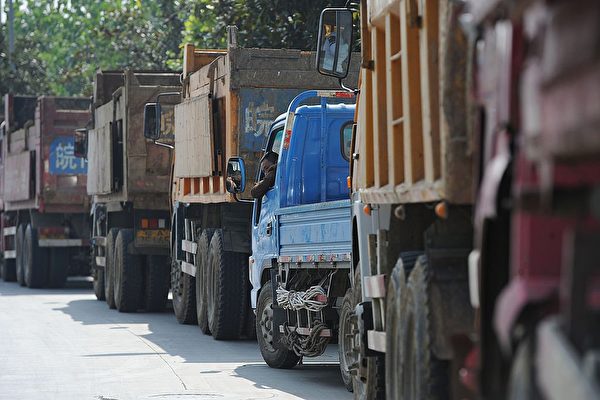
Ongoing Middle East conflicts have led to a significant rise in international oil prices, impacting transportation costs in China. Following the adjustment of domestic refined oil prices by the Chinese authorities, truck drivers and logistics industry professionals in various regions have expressed that their operating pressures have further intensified.
Against the backdrop of China’s economic slowdown and weak transportation demand, the National Development and Reform Commission of the Chinese Communist Party recently announced an increase in gasoline and diesel prices. According to the adjustment plan officially disclosed by the Chinese government, gasoline prices are raised by about 695 yuan per ton, and diesel prices by around 670 yuan per ton, translating to an increase of approximately 0.5 yuan per liter for 92 octane gasoline.
The recent oil price hike has created new challenges for grassroots industries and ordinary citizens. A “Freight Adjustment Notice” dated March 8, 2026, has been circulating in the logistics industry. The notice states that due to the continuous increase in refined oil prices, transportation costs have significantly risen. In order to maintain normal operations and transportation service quality, relevant companies have decided to adjust existing freight rates, which will be effective immediately. The notice describes this price adjustment as a “necessary move” and hopes for understanding and cooperation from cargo owners and logistics operators. Industry insiders believe that such notices indicate that the pressure from rising oil prices is beginning to impact the transportation industry.
In Qingdao, Shandong Province, Mr. Liu, a long-distance truck driver, told reporters, “The fuel price has already reached 6.7 yuan, and it is expected to rise further. The freight market has been tough, with many trucks competing for jobs. As soon as oil prices go up, costs rise immediately, but it’s difficult for freight rates to follow suit.”
According to a screenshot of oil price information circulating online, on March 10th, gasoline prices in Liaoning Province had increased to 7.74 yuan per liter for 92 octane, a rise of 0.57 yuan; 95 octane gasoline was priced at 8.27 yuan per liter, up by 0.60 yuan; 98 octane gasoline reached 9.01 yuan per liter, marking a 0.66 yuan increase; and 0 diesel was priced at 7.20 yuan per liter, up by 0.57 yuan. Several drivers expressed that the continuous uptrend in oil prices is further pushing up transportation costs, exacerbating the operational pressures in the logistics industry.
Mr. Zhang, a logistics company manager in Guangdong, stated that fuel costs typically account for over 30% of transportation expenses. He remarked, “Affected by the situation in the Middle East, fuel prices have surged suddenly. If this situation persists, some small logistics companies may struggle to survive. There are already logistics companies in Northeast China suspending operations. Transporting goods from Northeast to North China or East China, where profit margins are already thin, has become unsustainable for many companies.”
In recent years, China has been expanding its crude oil imports. Data released by the General Administration of Customs of China indicates that in 2025, China imported approximately 5.78 billion tons of crude oil, averaging around 11.55 million barrels per day, reaching a historical peak. Several energy agencies point out that China’s external dependence on oil has exceeded 70%, with a significant portion of the supply coming from the Middle East.
Data from the energy research firm Kpler shows that China has added nearly one million barrels a day to its crude oil inventory since 2025, with a considerable portion allocated to replenishing national strategic reserves. A report from the energy market analysis website J.Kemp Energy Analysis also reveals that China increased its crude oil stocks by about 54 million tons over the past year, equivalent to roughly 400 million barrels.
China is the world’s largest oil importer, with over 70% of its oil demand relying on imports. Observers suggest that the Chinese authorities highly depend on oil imports but lack a transparent and stable energy policy. In times of international turmoil, the domestic economy is often the first to bear the brunt.
Amid threats from Iran to block the global oil transportation chokepoint—Hormuz Strait, tensions in the Middle East have escalated further. According to data from the U.S. Energy Information Administration (EIA), about one-fifth of global oil transportation routes pass through this channel. Ship monitoring firms Windward and Kpler’s data indicate that numerous oil tankers have halted near the strait, with several international shipping companies beginning to withdraw from related routes, leading to a noticeable surge in international oil prices.
For the Chinese government, this crisis resembles a boomerang effect. Some China experts point out that Beijing’s long-standing reliance on energy trade with authoritarian regimes like Iran has provided access to cheap oil on the surface but has failed to establish a genuinely stable and reliable energy security system.
This scholar criticized, “Beijing’s energy strategy is characterized by shortsightedness and speculation. By excessively tying the nation’s energy lifeline to the volatile Middle East region, this reliance on ‘poison as antidote’ makes China’s transportation, logistics, and manufacturing industries vulnerable to international upheavals. The so-called ‘energy security’ in the policy logic of the Chinese Communist Party functions more as a chip in geopolitical games, rather than a strategic bottom line concerning national development and livelihoods.”
Meanwhile, this geopolitical risk is gradually impacting grassroots industries in China. A long-haul truck driver told reporters, “We were barely managing in this industry to begin with. As soon as oil prices rise, our profits are nearly wiped out. While authorities are settling scores on the international stage, it’s us drivers who end up bearing the costs. If prices continue to rise like this, many drivers may truly reach their breaking point.”
Analysts point out that this conflicting situation highlights structural issues in China’s energy policy: huge investments to maintain dependence on Middle Eastern energy channels while lacking institutional arrangements to mitigate international risks. When international oil price fluctuations intensify, the pressure often falls first on domestic transportation industry and ordinary laborers.