
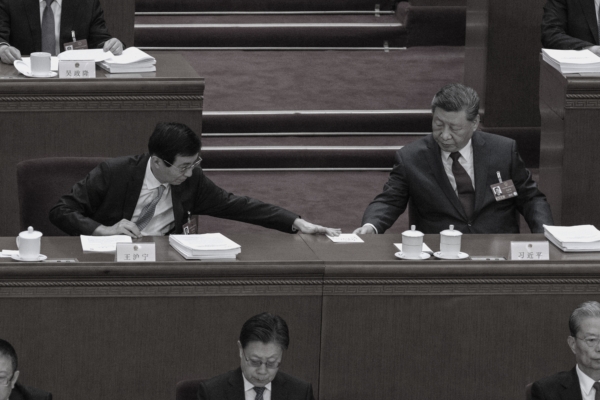
On March 9th, at the second plenary session of the 14th National People’s Congress of the Chinese Communist Party, which was attended by media reporters from Hong Kong, some details of the meeting on the stage caught the attention of the public.
According to a report by “Ming Pao” on March 10th, the second plenary session of the CCP National People’s Congress commenced at 9 a.m. on the 9th. Since around 7 a.m., the staff had been busy making preparations in an orderly manner. Each report placed in front of CCP leader Xi Jinping was meticulously checked page by page by designated personnel to ensure accuracy before being neatly arranged, and several pens were placed in designated positions in the front. Other documents and materials of CCP leadership were also sorted and arranged by staff one by one, corresponding to their designated places.
Subsequently, the service staff responsible for beverages brought water cups and gently placed them in the designated corner of each person’s table, cleaned and organized the tabletop, and then had someone check to make sure everything was accurately in place.
Political commentator Li Lin expressed to Dajiyuan that the prior arrangement of documents on the desks of CCP leaders before the two sessions inadvertently exposed the strict control within the CCP.
He stated that these documents had already been checked before being placed on the desk. Another check was conducted before the meeting, the purpose of which, of course, is to ensure that the leaders on the podium do not see any content other than the conference documents.
“This also easily brings to mind the scene at the 20th National Congress of the CCP, where Hu Jintao was escorted out of the venue after flipping through documents in his hand at Xi’s request. At that time, some speculated that Hu saw something he shouldn’t have and raised objections.”
Li Lin pointed out that such strict control actually demonstrates the weakness of the Xi regime. If even their internal personnel need to be safeguarded to this extent, it shows that the support base for this regime within the party is very weak.
At the 20th National Congress of the CCP, a scene that shocked the world occurred, with international media photographers and reporters capturing the moment when former CCP General Secretary Hu Jintao, seated next to Xi Jinping, was reluctantly escorted out of the meeting by staff. This scene sparked discussions within the international media.
From the footage, a staff member first whispered to Hu Jintao, then picked up his glasses and attempted to help him up from the seat. Hu Jintao reached out to grab a document in front of Xi Jinping, but was stopped by Xi. As Hu Jintao was being pulled up, he tried to turn back to sit down, and at this moment, a second person approached Hu Jintao, spoke to him, and gestured for him to leave. During the standoff between Hu Jintao and the staff, it was evident that he was resisting the request.
Xi Jinping, seated on the right side of Hu Jintao, watched without uttering a word. Before being escorted away, Hu Jintao patted Xi Jinping on the back with the back of his hand and spoke to Xi, to which Xi nodded. Hu then patted the arm of the then CCP Premier Li Keqiang before being led out of the venue by the staff.
Several hours after the incident, the official Chinese media Xinhua News Agency posted in English on overseas social media platforms that due to health issues, Hu Jintao was taken to a nearby room to rest at the venue. However, the Chinese version of the Xinhua report made no mention of this event.
In high-definition video footage, it was discovered that the person escorting Hu Jintao had a name tag that read “Kong Shaoxun”. Kong Shaoxun is the Deputy Director and head of the Secretariat of the CCP Central Office, with his superior being the Director of the Central Office, Ding Xuanxiang.
On the day of the incident, “Hu Jintao” faced censorship on the Chinese social media platform Weibo, where only messages from the day before and official accounts were visible.
Some netizens subtly discussed the matter on Chinese community websites, “The former leader was escorted out by the current leader,” “Is this the legendary ‘all-process democracy’?” However, these comments were swiftly deleted.