
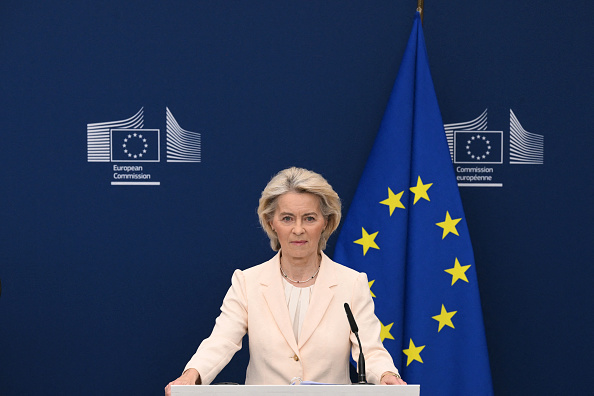
On March 9th, Ursula von der Leyen, President of the European Commission, emphasized the need for the European Union to demonstrate its strength more decisively rather than relying solely on a rules-based system to address threats. She made these remarks during an EU ambassador meeting, stating that while the EU will continue to uphold the rules-based system established with allies, it should not solely rely on it for protecting its interests or assume that the rules will shield it from complex threats.
Von der Leyen asserted that the EU can no longer act as the guardian of the old world order, as the rules-based old world order has faded away and will not return. She stressed the importance of readiness to assert EU power more forcefully, utilizing all available tools to counter aggression and external interference, be it economic, diplomatic, technological, or military, and adopting a more pragmatic approach globally in conducting business.
She highlighted that security should be a fundamental principle guiding EU actions, encompassing a shift from defense to data, from industry to infrastructure, and from technology to trade as the default mindset.
Emphasizing the need for internal reforms within the EU to adapt to new circumstances, she urged urgent reflection on whether the EU’s strategic concepts, institutions, and decision-making mechanisms designed in a post-war stable, multilateralism-emphasizing world can keep pace with the rapid changes in today’s world. Von der Leyen questioned whether the comprehensive system constructed, though initially based on consensus and compromise, currently assists or weakens the EU’s credibility as a geopolitical actor.
Regarding security challenges in Europe, Von der Leyen affirmed the EU’s unwavering support for Ukraine regardless of events elsewhere and committed to fulfilling the pledge of providing a €900 billion loan to Ukraine “securely and unequivocally.”
Turning to EU expansion matters, she underlined the preparations needed to foster closer ties between the Western Balkans, Moldova, and Ukraine with the EU alliance. She stressed that expansion is not primarily an ideological matter but rather a question of European common interests and security.
(Source: Reuters)