
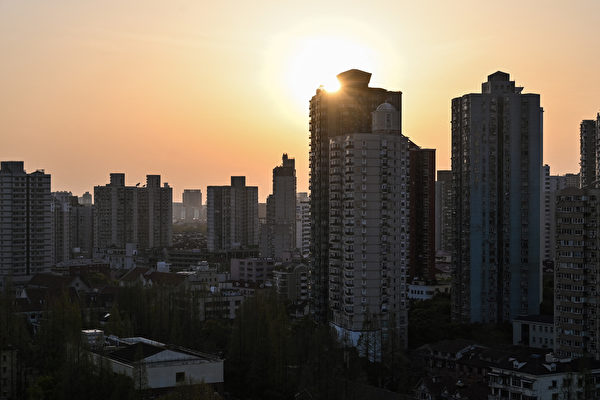
Shanghai’s “Seven Measures” real estate new policy landed last week, and multiple media outlets have reported a phenomenon like a “twofold increase in consultation volume” and the reappearance of “Wenzhou speculative housing groups”, creating a market atmosphere of “return of the buying frenzy, Wenzhou speculative housing groups sweeping Shanghai once again”, according to local bloggers in Shanghai. However, the reality seems to be vastly different from the media narratives. The so-called “buying frenzy” appears to be more of a market performance carefully orchestrated under the stimulus of high commissions.
China Overseas Development Limited (referred to as China Overseas, stock code: 0688.HK) is a centrally-controlled state-owned real estate company headquartered in Hong Kong, directly under the State-owned Assets Supervision and Administration Commission of the State Council of the People’s Republic of China, with its parent company being China State Construction Engineering Corporation. As one of the most essential real estate platforms in the Chinese construction system, China Overseas has long been considered an “outstanding student” in the industry, holding a significant position in engineering construction and real estate development and has consistently ranked in the Fortune Global 500 for years.
Recently, China Overseas released its latest sales data: in February 2026, the total contracted property sales of China Overseas Group and its subsidiaries, joint ventures, and associated companies (collectively referred to as the “China Overseas Series Companies”) amounted to approximately 8.464 billion yuan, a year-on-year decrease of 35.9%, corresponding to a sales area of around 358,700 square meters, down by 45.0% year-on-year.
From January to February 2026, the cumulative contracted property sales amount for China Overseas Series Companies was around 22.942 billion yuan, a decrease of 9.0% year-on-year, with a total sales area of about 875,400 square meters, down 29.7% year-on-year.
Shanghai financial blogger “Dan Xiaohuang” stated in his latest self-media program that to understand the real situation of the current Shanghai property market, one must first look at China Overseas’ data. Being an “outstanding student” in the real estate industry, its market performance is often seen as a crucial indicator of the industry’s vitality.
On February 26, Shanghai officially introduced the real estate adjustment policy “Seven Measures for Shanghai”. This policy mainly involves adjustments in terms of purchase restrictions, housing provident fund, and property taxation, including relaxing purchase conditions, expanding housing qualification, raising the amount of provident fund loans, aiming to stimulate market demand by lowering the threshold for property purchase.
After the policy was implemented, several mainland media quickly reported signs of the real estate market “warming up”. For instance, “21st Century Economic Report” titled their article “One Week after ‘Seven Measures for Shanghai’: Wenzhou Customers Appear, ‘Spring’ Feeling Gradually Strong in Shanghai Real Estate”, citing data from Shanghai Lianjia showing a 106% increase in online consultation volume for new properties after the new policy. On the first weekend in March since the new policy, the online consultation volume for new properties increased by 80% compared to weekends in January. Additionally, data from 58 Anjuke platform displayed a 97.6% month-on-month increase in user-initiated consultation volume, with a 180% improvement in conversion efficiency.
Another media outlet, “Cailianshe”, also reported under the title “One Week After Shanghai’s New Real Estate Policy: Demand Heats Up, Second-hand Housing Welcomes ‘Red Opening'”, stating that the second-hand housing market in Shanghai has shown restoration strength beyond market expectations.
However, “Dan Xiaohuang” pointed out that if the market indeed showed clear signs of heating up, China Overseas’ sales data should have shown improvement in tandem. But the actual situation seems to be that “volume is dropping faster than prices”—sales area significantly shrinking while property prices are still being barely maintained. This indicates that the luxury housing market that China Overseas primarily targets is no longer selling, although the unit prices are holding up, the picture of “sold area” is distressingly low.
He believes that when market pressure has reached the key central state-owned housing enterprises, it signifies that the myth of the most value-preserving “central state-owned properties” is gradually shaking. This decline in sales data not only represents a downturn but also symbolizes a turning point in market confidence.
Regarding the media reports of the “Wenzhou C-license luxury cars” flocking to Shanghai sales offices, “Dan Xiaohuang” dissected the underlying tricks: these Wenzhou customers did not come spontaneously but are actively coordinated by China Overseas with Wenzhou intermediaries, paying people to “front-run”.
He said that with heavy rewards come brave people: China Overseas has fully opened its “distribution model”. Under the temptation of tens of thousands or even millions in commissions, even in heavy rain, the intermediaries must record videos for social media, creating a scene of “lines queuing to view properties with a verified capital of 20 million”.
In his view, this practice fundamentally exploits the long-standing symbolic significance of the “Wenzhou speculative housing groups” in the market—as an investing group regarded as a market indicator—to shape market enthusiasm, aiming to stimulate potential homebuyers.
He believes this is more like a marketing campaign aimed at attracting potential homebuying funds from cities like Hangzhou and other surrounding areas into Shanghai.
If “Dan Xiaohuang” raised doubts from a high-end market data perspective, another microblog-verified renowned financial blogger in Shanghai, “Master Mei”, debunked the “buying frenzy” lies through on-the-ground observations in grassroots communities.
Recently, “Master Mei” ventured into the old residential area of Weifang Xincun in the core area of Pudong and conversed with local real estate agents.
When directly asked, “After the new policy, isn’t it reported that a buying frenzy has emerged?” the agent’s simple response was, “No significant changes.”
In his opinion, compared to the media’s claim of a “rapid market recovery”, the actual transaction situation in ordinary communities remains subdued.
“Master Mei” bluntly stated that the so-called “buying frenzy after Shanghai’s new real estate policy” is just hype—a market narrative magnified to a great extent.
“Dan Xiaohuang” concluded that even the first-tier high-end housing projects are facing difficulties in sales, which indicates that the purchasing power of high-end buyers has been prematurely depleted. Behind this “structural heat”, the true state of Shanghai’s real estate market can only be described in four words—on its last legs.