
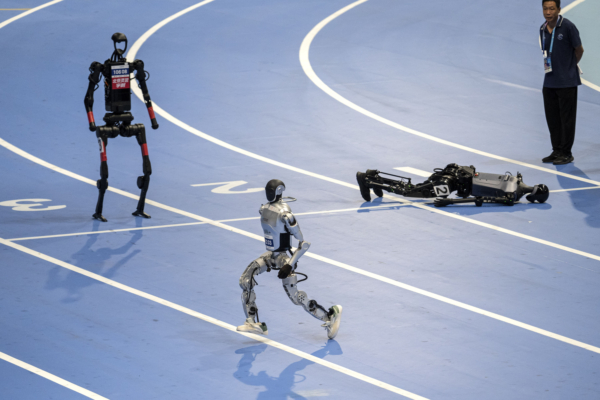
Recently, Longgang District of Shenzhen City has introduced a policy to support the artificial intelligence and robotics industry, offering subsidies of up to 2 million yuan (RMB). Scholars have analyzed that within China’s state-led economic system, there tends to be a herd mentality in investing, leading to the outcome of new investment bubbles and overcapacity.
According to a document released by the Longgang District Artificial Intelligence (Robotics) Department on March 8th, titled “Measures to Support the Development of OpenClaw & OPC in Longgang District, Shenzhen (Draft for Soliciting Opinions)”, the local government plans to promote the development of the intelligent industry through subsidies, open data resources, and demonstration projects.
The document indicates that authorities will support companies in developing the OpenClaw intelligent system and provide deployment services. Companies contributing key code, developing industry skills packages, and implementing intelligent application projects may receive subsidies of up to 2 million yuan.
Additionally, Longgang District plans to introduce “OpenClaw Digital Employee Application Vouchers” to support companies in purchasing or building intelligent system solutions, with a maximum subsidy of 2 million yuan per enterprise. Furthermore, the government will open up public data resources in areas such as low-altitude, transportation, and medical sectors, offering up to a 50% discount on related data services fees.
Guangdong scholar Huang Wenyi (pseudonym) expressed to a reporter, within the Communist Party’s bureaucratic system, economic development often intertwines with political movements, resulting in a form of “campaign-style economy” characterized by top-down promotion, ultimately causing harm to the people and economy.
He remarked, “In China’s state-led economic system, companies often base their decisions not on real market demands but around policy signals to cater to the authorities, leading to a herd-like investment approach.”
He explained that the fundamental reason for this phenomenon lies in the distorted nature of the CCP system on economic operations, where industrial directions are often determined by political power. As the CCP continuously introduces new tracks and concepts, companies and local governments are locked into policy frameworks, resulting in a new cycle of investment bubbles and overcapacity.
Moreover, Longgang authorities proposed setting up demonstration projects in areas such as intelligent manufacturing, smart government affairs, smart industrial parks, and intelligent healthcare, offering a maximum reward of 1 million yuan to selected projects. A 30% subsidy will be provided to AIGC companies in the district accessing domestic multimodal large models, with a limit of one million yuan per enterprise annually.
Jiangxi financial scholar Wang Ting (pseudonym) elaborated, “Local CCP governments use financial subsidies to drive companies into new technological fields, a model that has been ongoing for years in China’s technology industry. Industrial development often does not stem from market choices but results from the mutual drive of political power and vested interest groups.”
Wang provided an example, citing the pandemic period as a typical case. President Xi Jinping’s mandate of achieving zero cases led to massive lockdowns and repeated nucleic acid testing by grassroots officials. Some companies closely connected to power seized the opportunity to undertake testing and epidemic prevention projects, reaping substantial profits. This practice of leveraging political movements to drive industries and financial gains essentially represents the CCP’s customary method of accumulation.
Apart from Shenzhen, many Chinese local governments emphasized the development of the robotics industry during the ongoing political meetings. During these meetings, Jiangsu Province Governor Xu Kunlin presented the local economic plans, stating that Jiangsu currently has over 1,500 artificial intelligence companies and has launched dozens of large models and related algorithm products. The local government plans to expand the application of artificial intelligence and robotics in manufacturing, transportation, and other sectors.
Researcher Song Kunlun, who studies China’s industrial policies, mentioned, “From the CCP leadership to grassroots officials, there has been a consistent emphasis on the development of the robotics industry, indicating that under the bureaucratic system, local officials often rush to make statements in line with central slogans on industrial policies.”
He expressed concern that this top-down political mobilization economic model easily turns industrial development into an administrative competition. He warned that if this approach continues, China’s economy may likely repeat the economic pitfalls of the Great Leap Forward movement of the 1950s within a few years. In such a system, the ultimate burden of policy mistakes inevitably falls on ordinary citizens.
In recent years, the CCP authorities have continuously introduced so-called strategic emerging industries, ranging from solar energy, semiconductors, new energy vehicles, to artificial intelligence, with local governments generally relying on financial subsidies, tax incentives, and policy-based financing to drive business expansion.
Song Kunlun stated that this power-led industrial model often generates an initial investment frenzy but later struggles to escape the burst of bubbles. He predicted that the Chinese new energy vehicle industry has already entered a phase of decline, and the next industry likely to face bankruptcy could be the currently acclaimed robotics industry. Under the CCP system, each cycle of industrial trends typically leaves behind debts, bubbles, and wasted social resources.