
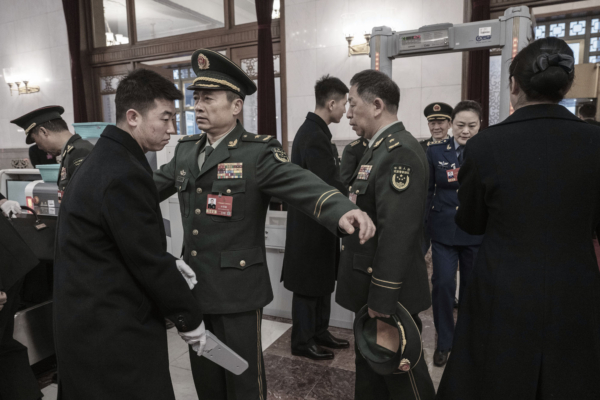
During the 2026 annual sessions of the Chinese People’s Political Consultative Conference and the National People’s Congress, a series of unusual phenomena within the military have attracted external attention. Several senior military leaders were notably absent from important meetings, with Chinese Communist Party leader Xi Jinping warning at the military delegation meeting that “there must not be anyone with disloyalty to the Party.” Analysts believe that the ongoing purge within the military reflects a complex situation of power struggles and institutional pressures.
The National People’s Congress of the Chinese Communist Party opened in Beijing on March 5, 2026, with a noticeable increase in the number of absences compared to previous years. Official figures show that out of the 2878 delegates expected to attend the conference, only 2765 were present, leaving 113 absentees. Against the backdrop of the escalating purge within the Chinese military, the absence of military representatives has raised concerns.
Public records indicate that there are 18 generals representing the military in the National People’s Congress. At the military delegation meeting of the 14th National People’s Congress on the afternoon of March 7, only 5 out of 18 generals were present, while the other 13 generals were absent from the meeting.
Similar anomalies were observed among the military representatives within the Chinese People’s Political Consultative Conference (CPPCC) system. Among the military CPPCC members, only one general attended as a member, while 5 general CPPCC standing committee members were absent from the meeting.
During the aforementioned military delegation meeting, Chinese Communist Party leader Xi Jinping emphasized the importance of loyalty to the Party within the military, stating, “The military holds the guns, and there must not be anyone with disloyalty to the Party within the military.” He called for the continued advancement of anti-corruption efforts within the military, strengthening supervision in areas such as fund allocation, exercise of power, and equipment quality.
On the afternoon of March 5, General Zhang Shengmin emphasized the need for “deepening political rectification and anti-corruption” during the military delegation subgroup deliberations.
Researcher Shen Mingshi from the Taiwan Institute for National Defense and Security Studies told Epoch Times that a significant feature of Xi’s speech was directly addressing internal issues within the military. He stated that the speech not only touched on corruption but also mentioned loyalty crises, command system instability, and combat readiness issues, reflecting to some extent the structural challenges within the military.
Shen Mingshi believes that while the ongoing anti-corruption actions are officially aimed at disciplinary rectification, they are difficult to completely divorce from the factor of power struggles. From Guo Boxiong and Xu Caihou to multiple recent cases of senior leaders being purged, it indicates the long-standing factional competition within the military.
Su Ziyun, director of the Strategic and Resources Department at the Taiwan Institute for National Defense and Security Studies, believes that in the highly politicized environment of the Chinese Communist Party, political loyalty often takes precedence over professional competence.
Since the 18th National Congress of the Chinese Communist Party, five members of the Central Military Commission have been under investigation or removed from office. Currently, among the leadership of the Military Commission, only Xi Jinping and Zhang Shengmin remain in their original positions. Statistics show that in the past three years, 36 senior officers have been stripped of their qualifications as delegates to the National People’s Congress, including 16 generals.
Seasoned military commentator Mark stated that anti-corruption serves not only to maintain discipline but also as a crucial means of consolidating power. With long-standing exchanges of interests within the military promotion system, if fully investigated, many officers may be implicated, making anti-corruption an easy tool in practice to eliminate potential political opponents.
He noted that this political operating mode often involves “using one group to take down another group,” followed by a cleanup of the original implementers, resulting in a constant turnover of high-ranking military officials.
Su Ziyun summarized the current pressures facing Xi Jinping as “four-stress” pressures. He mentioned that in terms of “guns,” the internal instability of the military challenges the principle of “the Party commands the guns.” In terms of “knives,” the important posts within the Beijing Armed Police system are held by personnel transferred from outside, indicating a lack of trust in the existing system. In terms of “money bags,” changes in the energy landscape may bring economic pressures. And regarding “pens,” some sensitive official information that appears on the internet without swift deletion reflects potential variations in internal public opinion control systems.
Su Ziyun estimated that around 57% of the top generals have been either purged or investigated, a situation not commonly seen in the history of the People’s Liberation Army.
Regarding the impact of frequent turnover in the top ranks of the Chinese military on combat readiness, Shen Mingshi believes that establishing a new command chain and completing joint training typically takes two to three years. If key positions remain vacant for an extended period, the command system is prone to instability.
He stated that under such circumstances, if a sudden event occurs, the military’s ability to effectively execute complex military operations will be put to the test.
Su Ziyun also believes that prioritizing political loyalty above the overall operational capability of the military could weaken its combat effectiveness. If future military operations encounter setbacks, it could further affect the legitimacy of the regime’s rule.
Mark pointed out that when large-scale investigations leave the military in a state of widespread uncertainty, it becomes challenging to form a stable fighting force. However, he believes that from a leadership perspective, if the entire command system can be reorganized within a few years, the short-term turmoil may be seen as an acceptable cost.
The aforementioned analysts believe that the internal power struggles, organizational adjustments, and external strategic pressures within the military, combined, could become significant variables affecting the development of the Chinese military in the coming years.