
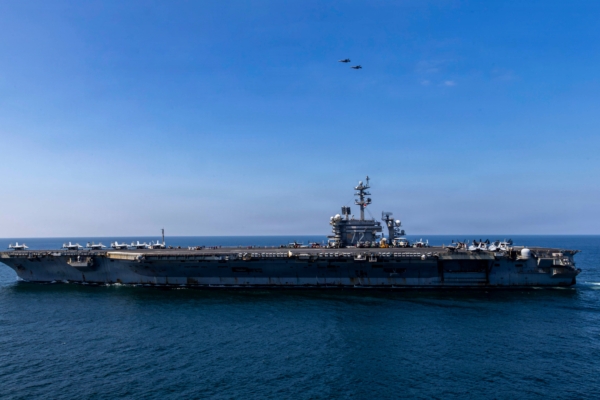
The United States has been carrying out its military operation “Epic Fury” against Iran for a week now. The aircraft carriers USS Lincoln and USS Ford are actively involved in the conflict, with unprecedented numbers of bunker-busting bombs onboard.
The latest and largest Gerald R. Ford-class aircraft carrier strike group is conducting round-the-clock operations in the Mediterranean Sea to support the “Epic Fury” mission. The U.S. Central Command announced on its website that the USS Lincoln carrier strike group is also deployed in the Middle East, where American forces are exerting pressure on Iran from the sea.
Footage shared by the U.S. military shows fighter jets taking off from the USS Ford, which is being used to target Iranian sites.
Additionally, in response to Iran’s expanding underground “missile cities,” U.S. supercarriers are being equipped with thousands of 2,000-pound penetrating bombs for onboard aircraft.
Iran has spent decades building underground bunkers to protect its vast missile stockpiles. These extensive underground facilities in the depths of mountains, known as “missile cities,” along with fortified command centers, have become targets for attacks by the U.S. and Israeli forces.
To address this, the USS Ford and USS Lincoln carriers have stockpiled thousands of 2,000-pound BLU-109 bunker-busting bombs in their arsenals.
Standard high-explosive bombs detonate upon impact, creating massive surface craters that have little effect on heavily reinforced underground structures, allowing them to remain intact and operational. In contrast, BLU-109 bunker-busting bombs are designed with a one-inch thick steel casing to penetrate up to six feet of reinforced concrete before detonating. Equipped with Joint Direct Attack Munition (JDAM) tail kits, these heavy bombs are GPS-guided smart weapons capable of precisely targeting bunker entrances.
U.S. carrier-based aircraft such as the F/A-18 Super Hornet and stealthy F-35C Lightning II fighters can deliver these heavy munitions directly onto heavily defended Iranian targets.
Amid escalating tensions, this substantial ammunition stockpile reflects a tactical shift for the U.S. Navy, gearing up for a potential war where nearly all high-value Iranian targets are hidden underground.
According to The Wall Street Journal, analysts indicate that almost all of Iran’s dozens of missile bases are located underground, but their above-ground structures, roads, and entrances can be identified through satellite imagery. The Pentagon and the Israeli military have spent years pinpointing these facilities.
Researcher Sam Lair points out a fundamental flaw in Iran’s “missile city” concept: mobile launchers that were originally intended to be mobile are now fixed in known positions, making them easier to target and destroy.
Satellite imagery captured on March 1 near a base close to Isfahan revealed an undamaged missile launcher vehicle seemingly moving on a nearby road. Following an attempted strike by American or Israeli warplanes, evidenced by a nearby crater, the same location was subjected to intense bombing on the following day, damaging several tunnel entrances at the underground facility.
Lair’s analysis, based on satellite images taken by commercial satellite imaging company Planet on March 3 near Kermanshah, suggests that the entrance and nearby roads of an Iranian site were targeted by heavy U.S. airstrikes.
Analysts note that U.S. airstrikes appear to be primarily focused on military bases in southern Iran, while Israeli aircraft are primarily targeting facilities in the northern region.