
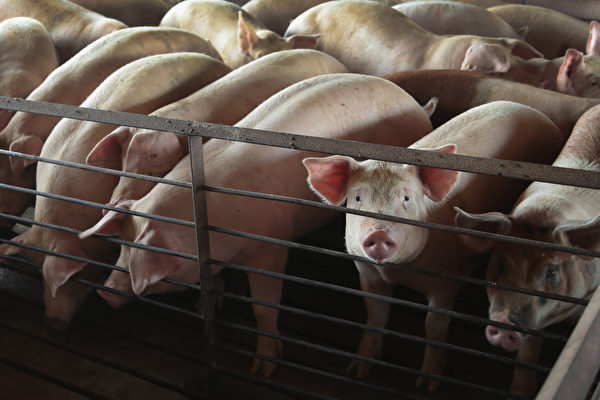
In China, the price of live pigs (Duroc/Landrace/Yorkshire hybrid) on March 6th dropped below 11 yuan per kilogram for the first time, reaching 10.48 yuan per kilogram, marking a 7.3% decrease from the previous week. Additionally, the average price of pork this week also saw a decline of 4.3%. The sales revenue of the three major pig companies in China also showed a decrease in February. The industry believes that the price of pork in China continues to hover at low levels, with a lingering downward trend.
This week, the average price of live pigs in China dropped compared to the previous week. According to data from China’s pig breeding website, on March 6th, the price of live pigs (hybrid of Duroc/Landrace/Yorkshire) was 10.48 yuan per kilogram, compared to 11.31 yuan per kilogram the previous week (February 27th), representing a 7.3% decrease. The average price of live pigs this week was 10.63 yuan per kilogram, showing a 10.1% decrease compared to the previous week’s average of 11.83 yuan per kilogram.
The “Duroc/Landrace/Yorkshire” hybrid pigs are a combination of three excellent foreign breeds – Duroc (sire), Landrace (first sire), and Yorkshire (first dam), known for their fast growth and high lean meat ratio. They are currently the mainstream model for large-scale farming and market supply of pork in mainland China.
According to data from the Chinese Ministry of Agriculture and Rural Affairs, on March 6th, the average price of pork in wholesale markets was 17.02 yuan per kilogram, a 3.8% decrease from the previous week (February 27th) when it was 17.7 yuan per kilogram. This week, the average price of pork was 17.17 yuan per kilogram, down by 4.3% compared to the previous week’s average of 17.95 yuan per kilogram.
Meanwhile, the sales announcements of the three major listed pig companies in China – New Hope Group, Muyuan Foods, and Wens Food Group – for February showed a decline in sales revenue for pork products compared to the previous month and the same period last year.
New Hope Group’s “February 2026 Sales Brief” on March 7th reported a 18.49% month-on-month and 7.42% year-on-year decrease in sales revenue for pork products, with an average price of 11.45 yuan per kilogram showing an 8.25% month-on-month and 21.79% year-on-year drop.
Muyuan Foods’ “February 2026 Sales Brief” on March 6th revealed a 18.72% year-on-year decrease in the average price of pork products at 11.59 yuan per kilogram, with a 23.98% year-on-year drop in sales revenue.
On March 5th, Wens Food Group released its “February 2026 Main Product Sales Brief”, stating that the company sold a total of 2.697 million pigs (including live pigs and fresh products) with a revenue of 3.956 billion yuan in February 2026. The average price for live pigs was 11.62 yuan per kilogram, showing month-on-month changes of -9.00%, -15.79%, and -8.86%, and year-on-year changes of 3.80%, -15.58%, and -22.33%.
Moreover, from the perspective of average selling prices, the sales prices of pork products of the three major listed pig companies all showed decreases both month-on-month and year-on-year. The month-on-month decrease ranged between 7% to 9%, while the year-on-year decrease was between 18% to 23%. The sales volume of pork products from the three major pig companies also saw a decline.
Regarding the situation of the low pork prices in China, on March 7th, citing the viewpoint of Dadi Futures, The Paper reported that the continuous price decline has led to poor market sentiment and a lack of positive driving factors in the short term. With strong supply and weak demand, the market is mainly focused on the prospect of pork prices bottoming out. As the cost line of pig prices hits a low bottom, industry losses are accumulating, and it is expected that the pace of reducing production capacity will be catalyzed by the bottoming out.
Xinhua Futures believes that in March, the pork consumption season in China after the New Year is slow, with continued supply pressure. Supply-side pressure remains the primary reason for the suppression of live pig prices in March, with expectations for a bottoming out of pork prices. In the medium term, supply-side pressure persists, with a high number of newborn piglets and significant pressure on the first-half pig production in 2026. The pace of capacity digestion remains slow, requiring deeper industry losses to drive capacity digestion, leading to a continued bottoming out trend, indicating that it will take time to resolve the problem of excess supply.
The term “live pig” refers to pigs that are alive, excluding breeding pigs, and is a collective term for domestic pigs that have not been slaughtered.