
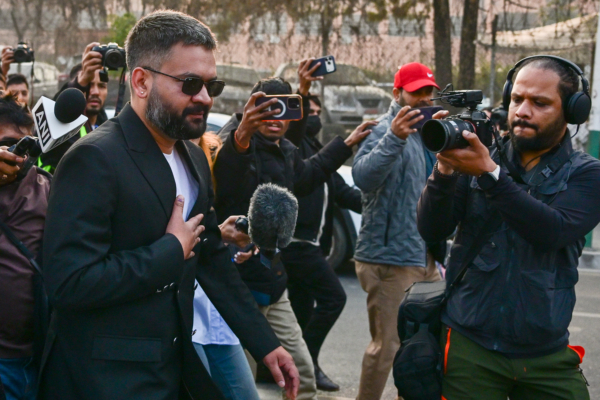
On Saturday, Nepal announced the preliminary election results for the first time since the Z Generation uprising, with the National Independent Party (RSP) led by former rapper Balendra Shah leading in the parliamentary elections held on Friday.
According to the report from the Associated Press, data released by the Election Commission of Nepal shows that the National Independent Party has won 27 out of the 165 direct seats and is leading in another 90 constituencies.
This is the first election held in Nepal since the youth-led uprising that erupted last year. In September last year, Nepali youth initiated a historic uprising sparked by the authorities’ decision to ban social media. Protesters pointed fingers at government corruption and social injustice, resulting in nationwide demonstrations. The government deployed police to suppress protests, leading to the deaths of dozens and injuries to hundreds. The incident forced then-Prime Minister Khadga Prasad Oli to resign.
Balendra Shah, the Prime Ministerial candidate of the National Independent Party, won the mayoral election in Kathmandu in 2022 and became a key figure in last year’s people’s uprising.
Despite being formed only three years ago, the Independent Party has surged ahead to become the leading party in this election, garnering massive support.
Balendra’s core campaign issues include improving healthcare and education for the people of Nepal. Public anger towards the previous government has fueled his campaign.
In the southeastern constituency, Balendra is directly competing against Oli, and as the vote counting continues, he has gained a significant lead.
The remaining six publicly announced parliamentary seats were won by the Nepal Congress Party (NCP) and two communist factions.
The Nepalese parliament has a total of 275 seats, with 165 members being directly elected by voters to enter the House of Representatives, while the remaining 110 seats will be allocated through a proportional representation system, with each party receiving seats based on the proportion of votes they receive.
Vote counting in most constituencies across the country is still ongoing, and the final election results are expected to be announced within the next two days. Ballot boxes from remote villages in the northern mountainous regions are being transported to the counting centers via helicopter.
For a long time, the Nepalese political landscape has been dominated by the Nepal Congress Party and the Nepal Communist Party (Unified Marxist–Leninists). If Balendra Shah wins this election, he is expected to reshape the political landscape of this landlocked South Asian country.