
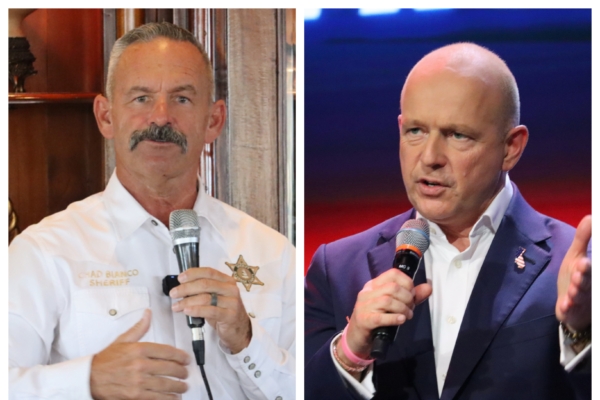
From August of last year to the beginning of this month, a total of 10 gubernatorial election polls from various organizations or institutions have shown that the two Republican gubernatorial candidates, Steve Hilton and Chad Bianco, have consistently ranked in the top two positions. This may give the impression that both Republican candidates will win in the primary election.
March 6th is the last day for gubernatorial candidates to file for candidacy. Currently, there are a total of 27 candidates, including 13 Democrats, 8 Republicans, and 6 independents and other party members. It is not easy for Republican gubernatorial candidates to win in deep blue California. According to data from LegalClarity.org at the end of January this year, the total number of registered voters in California is 23,093,274, with nearly 45% registered as Democrats (10,376,887 people), over 25% as Republicans (5,824,749 people), and independents and other party members accounting for about 29%.
Looking at the trend of voter turnout from Proposition 50 passed in November last year, it can be seen that 64.2% of voters support redistricting plans extremely favorable to the Democratic Party, abolishing the districts drawn by the independent commission in 2020, which could enable the Democratic Party to secure approximately 92% of congressional seats.
Given the above circumstances, the likelihood of both Republican candidates winning simultaneously is very low. Could it be that two Democratic candidates will win in the primary election, excluding the Republican candidate?
Carl DeMaio, chairman of “Reform California” and Republican state assembly member of the 75th district, expressed that this scenario has occurred multiple times. In a recent video, he stated: “Democrats, billionaires, and special interest groups all favor the ‘top two’ system in the primary election because they can manipulate votes by diluting the votes, depriving Republicans of the opportunity to advance to the final election.”
DeMaio mentioned that Paul Mitchell, a Democratic data expert behind the redistricting proposal, conducted simulations based on polling, population, race, and voter turnout. The probability of a Republican candidate winning in the primary election is only 12% (up to 20%), while the probability of being eliminated is higher.
DeMaio pointed out that in various polls, around 14% of Democratic voters are undecided, with a potentially higher percentage among Republican voters. Approximately 35%-38% of the votes are likely to be cast for Republicans in the primary. Hilton and Bianco have garnered most of the votes in the polls, with their campaign funds totaling over 2 million dollars. Democrats are likely to spend 30 million dollars to compete for the California governorship, and their voters have shown more “discipline and unity.”
DeMaio conducted separate 30-minute video interviews with Hilton and Bianco. “I like both candidates, but we must choose one of them,” he said. He encouraged the public to register on the “Reform California” website, as the organization is soliciting opinions and communicating with both Republican candidates to ensure that one of them makes it to the final election.
On February 26th, a poll from the California Public Policy Institute showed Hilton leading with 14% support, followed by other candidates: Democratic candidate Katie Porter at 13%, Bianco at 12%, Democratic candidate Eric Swalwell at 11%, and Democratic billionaire Tom Steyer at 10%. Importantly, nearly 40% of the votes are divided among other candidates or undecided voters.
On the 23rd, a poll from Independent Voter News indicated Bianco leading with 23%, Swalwell at 18%, Hilton at 15%, Porter at 12%, and Steyer at 8%.
On February 18, a poll from Emerson College showed Hilton leading with 17%, followed by Bianco and Swalwell at 14%, Porter at 10%, and Steyer at 9%.
If no stronger Democratic candidate joins the race, the governor will be chosen among these five candidates. Rusty Hicks, who has been serving as the California Democratic Party chair since 2019, recently issued a public letter urging Democratic candidates, if they insist on participating in the primary, to prepare to suspend campaigning and support other candidates by April 15.
“The possibility of two Republican candidates making it to the (November) election and excluding California Democrats is relatively low… but not impossible. We will work to take necessary measures to prevent this scenario,” Hicks said, urging Democratic candidates to honestly assess their qualifications and the feasibility of their campaigns.