
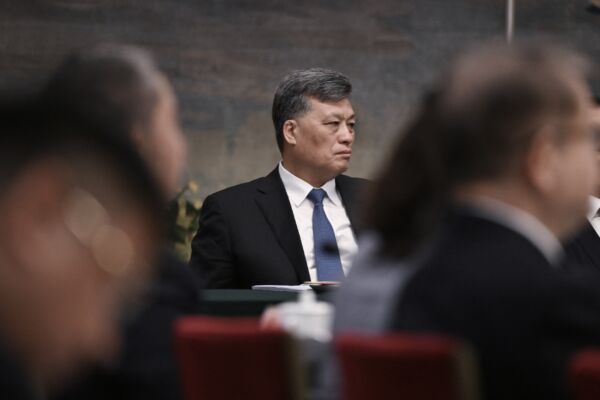
The 14th National Committee of the Chinese People’s Political Consultative Conference (CPPCC) Fourth Session opened at 3 p.m. yesterday (March 4th) at the Great Hall of the People in Beijing. Member of the Politburo of the Communist Party of China, Ma Xingrui, who was supposed to be seated at the podium, did not appear. The National People’s Congress (NPC) also released the list of the Presidium yesterday, and Ma Xingrui did not appear in the list as usual. Analysts point out that due to the increasing opacity of CCP politics, it is easier to spark speculation.
The official list of the Presidium and Secretary-General of the Fourth Session of the 14th National People’s Congress was announced yesterday evening by the CCP. This year, the Presidium consists of 167 members, a reduction of 9 from last year’s 176. The members of the Presidium mainly consist of members of the NPC Standing Committee, as well as “Party and state leaders,” local officials, and others.
Compared to last year, two fallen Politburo members and vice chairmen of the Central Military Commission, He Weidong and Zhang Youxia, were not seen in this year’s list. Ma Xingrui, who was previously ranked behind Xi Jinping, also did not appear.
The Presidium list this year added 5 new members, who are local officials who took office last year. Meanwhile, 14 people are less on the list, including 6 who have fallen from power: former Party Secretary of Inner Mongolia Sun Shaohong, former Governor of Inner Mongolia Wang Lixia, former Governor of Guangxi Lan Tianli, former Vice Chairman of the Central Military Commission Zhang Youxia, He Weidong, and former Chief of Staff of the Joint Staff Department of the Military Commission Liu Zhenli. Others include 1 resignation, 2 high-ranking officials who have stepped back, and 4 members of the NPC Special Committee who have been removed from their positions.
Ma Xingrui is the only one among these 14 people whose whereabouts are unknown.
The CPPCC National Committee meeting opened in Beijing at 3 p.m. on March 4th. According to custom, members of the Politburo Standing Committee and Politburo who do not hold CPPCC positions sit in the second row of the podium. However, Ma Xingrui did not attend.
Ma Xingrui stepped down as Party Secretary of Xinjiang in July last year, and he was officially reported at that time to have another appointment. By the end of November last year, Ma Xingrui was absent from the collective study session of the Politburo. He subsequently missed important high-level meetings such as the Central Economic Work Conference and the Politburo’s “democratic life meeting.”
There have been continuous rumors overseas recently about Ma Xingrui’s downfall.
Ma Xingrui is accused of having a close relationship with Xi Jinping’s wife, Peng Liyuan, and therefore gained promotion.
American political commentator Chen Pokong told Epoch Times that Ma Xingrui has been in trouble for a long time, but because Xi Jinping and Peng Liyuan are protecting him, Xi wants to save face and plan a soft landing for Ma Xingrui, but Ma Xingrui’s downfall can be said to be an inevitable matter that cannot be reversed. “This indicates that Xi Jinping’s power is not as strong as imagined by the outside world. There is still a strong opposition within the party, including the mainstream factions of the political veterans, the mainstream factions of the princelings, and even the majority of the upper echelons of the CCP who are probably against Xi Jinping in secret.”
Researcher Shen Mingshi of the Taiwan Institute for National Defense Studies told Epoch Times that it is difficult to say whether handling Ma Xingrui is an active decision of Xi Jinping or a pressure that must be dealt with. Because Ma Xingrui may also have brought many benefits to Xi Jinping’s family, handling Ma Xingrui is like dealing with the issues of Xi Jinping’s family.
Independent commentator Du Zheng wrote in Taiwan’s media “Up Media” on February 28th that Ma Xingrui is a favorite of Xi Jinping and his wife politically. Now it is necessary to take down Ma Xingrui because of the corruption emanating from the military-industrial complex, coupled with Ma Xingrui’s appearance on the long list of benefits transferred by the Hengda Xu Jiayin family, and family corruption has also been reported, making it difficult for Xi and his wife to handle. Xi Jinping had to “shed tears to chop down Ma Xingrui” in the Year of the Horse.
He also pointed out that the complexity of the Ma case lies in the fact that Li Xi, who presides over the Central Commission for Discipline Inspection, now has to deal with the “partner” in Guangdong, and Ma Xingrui may also have evidence of Li Xi’s corruption in Guangdong.
Commentator Li Linyi said that as the CCP’s political black box becomes increasingly opaque, it is easier to spark speculation, but it is still difficult to say what the true situation is.
The Wall Street Journal recently reported that before Xi Jinping took office in 2012, although there was some secrecy in the Chinese political arena, there were still traces to follow. However, with the transition to a highly centralized system, political operations have become extremely opaque, forcing foreign scholars, officials, and corporate executives to revisit the era of “Beijing studies” from the Mao Zedong era, trying to decode the power symbols from the details in the official media’s words and pictures.
According to the report, this “study” includes researching meeting seat arrangements, the order of officials’ appearances, and even body language. For example, the Chinese officialdom emphasizes strict seat etiquette, with the highest-ranking officials in the center and others ranked by level and surname strokes. Once a certain official is absent, if their seat is “passed over” or filled by someone else, it often implies that their political career is in trouble.
The report pointed out that from He Weidong’s “slow-motion collapse” to Zhang Youxia’s “lightning clean-up,” and now Ma Xingrui’s “continued disappearance,” it shows that the power struggle at the top of the CCP is still intense and full of uncertainty.