
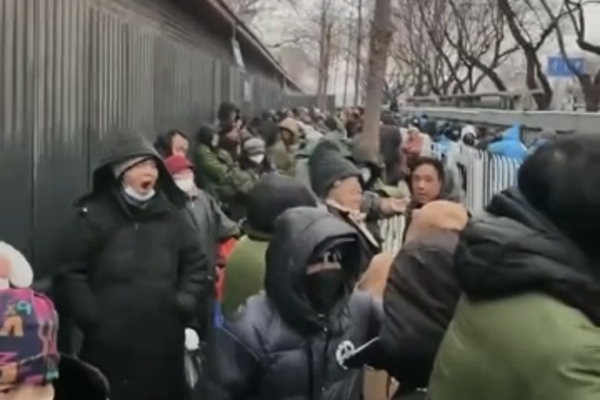
Every year in early March, Beijing remains chilly and overcast, with temperatures hovering around freezing, accompanied by light rain and snow. On the day of the opening of the National Committee of the Chinese People’s Political Consultative Conference (CPPCC), a large number of petitioners from all over the country had already gathered on the streets near the National Bureau of Letters and Visits in Beijing. Many people lined up overnight, hoping to submit materials to central authorities during the sessions of the two sessions to appeal their grievances or disputes.
During the two sessions of the CPPCC, a large number of petitioners gather outside the National Bureau of Letters and Visits. Hu Guiyou, a petitioner from Shaanxi, told reporters on March 5 that he arrived at the bureau at 6 a.m. and found a huge crowd already there: “There was a long line outside the Letters and Visits Office, stretching along the street. Many petitioners had their luggage or blankets with them, waiting on the roadside to register and enter the reception hall.”
A petitioner from Liaoning, Ms. Li, stated at the entrance of the Supreme People’s Court in Beijing that during the two sessions, a large number of petitioners from all over the country still gathered near the National Bureau of Letters and Visits. Many people stayed up all night in line to submit materials reflecting their issues: “It snowed again in Beijing yesterday, the weather was very cold, but there were still a lot of people. I looked around and saw at least a thousand people, and they have already started queuing for tomorrow.”
Petitioners queue overnight to appeal – a gathering of people outside the Letters and Visits Office
Li mentioned that many petitioners had arrived in Beijing even before the two sessions began, with some staying for months. “Many people’s problems have not been resolved, so they can only keep waiting in Beijing. I came at the beginning of the year and have been here for two months now.”
She also noted the frequent presence of “interception personnel” sent by local governments near the National Bureau of Letters and Visits. “They mainly target people from their own locality who arrive in Beijing, taking them away if spotted. Some are detained after being taken back, and others are put under surveillance.”
Wang, from Jiangsu, came to Beijing before the Spring Festival to avoid interception by security personnel. She mentioned that during the two sessions, authorities from various regions strengthened control over petitioners, making it difficult for some to leave their hometowns. “Many people simply cannot leave their areas. Some are discovered as soon as they purchase train tickets because their ID information is recorded.”
Wang said that due to the long queues at the entrance of the National Bureau of Letters and Visits, she decided to go to the vicinity of the Supreme People’s Court that day. “There are relatively fewer people there because access is conditional.”
Another petitioner, Ms. Zhou from Sichuan, also told reporters that a large number of petitioners had gathered in the vicinity of Xianongtan near the National Bureau of Letters and Visits. She said, “Now that area is filled with petitioners. I heard there are about two thousand people, a densely packed crowd.”
She mentioned that many individuals had been staying in Beijing for a long time. “Old problems remain unsolved, and new ones keep arising, which is why the numbers keep growing.”
Liu Guiping, a petitioner from Anyang, Henan, expressed anger during an interview, stating he had been tirelessly shuttling between local government and courts for many years to address housing disputes at home, yet no results were achieved. “We’ve visited many departments locally, they all say they will process it according to procedures, but the issues have been dragging on unresolved. That’s why we had no choice but to come to Beijing before the two sessions. I walked from Langfang, Hebei into Beijing, hoping to submit the materials to the Letters and Visits Department.”
Apart from petitioners from Shaanxi, Liaoning, Hubei, Sichuan, Henan, there were also petitioners from Shanghai, Tianjin, Shandong, and other regions present. They mostly gathered outside the National Bureau of Letters and Visits and the Supreme People’s Court. A petitioner named Mr. Liu, who didn’t want to disclose his full name, told reporters that interception personnel from various regions had also arrived in Beijing. “Liaoning has sent dozens of interceptors this time, taking people back, some are detained for ten days, some sent to mental hospitals, and some put under house arrest for a month. They are using all possible methods.”
Additionally, a group of dissidents in Beijing had been put under supervision by authorities, receiving warnings that they were not allowed to publish articles or images in foreign media outlets during the sessions, nor could they engage in social media activities.
Mr. Li, a human rights activist in Beijing, mentioned that during the two sessions of the CPPCC, Beijing often became a crucial time for petitioners from across the country to raise issues. Many petitioners believed that appealing in Beijing during the central meetings would attract more attention.
Mr. Li also criticized the Chinese Communist Party’s letters and visits system, stating that it was not an independent judicial relief channel but an internal complaint mechanism within the administrative system, with processing powers still in the hands of local governments. “Many petitioners believe that by coming to Beijing, their issues can be directly resolved. However, in reality, the vast majority of cases are eventually referred back to local authorities for handling.”
The letters and visits system was established early in the Chinese Communist Party’s rule and was initially seen as an important channel for the public to report issues. Nevertheless, as problems like land requisition, housing demolition, and judicial disputes continued to accumulate, the petitioner groups gradually expanded. Some scholars believe that under the current system, the CCP’s letters and visits system not only serves as a mechanism for buffering conflicts but also reflects the deep-rooted contradictions accumulated in the grassroots power structure of the CCP.