
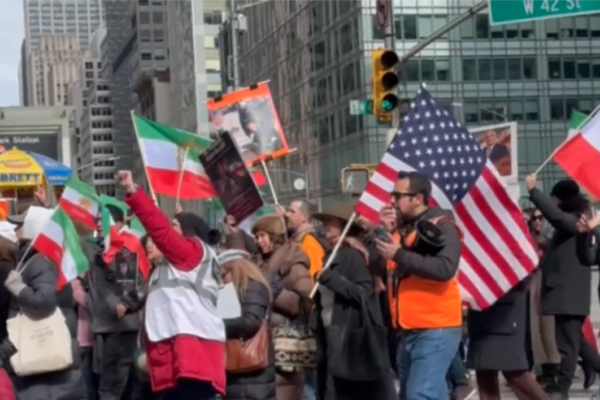
Iran’s Supreme Leader Ayatollah Khamenei was killed in a joint US-Israeli airstrike, sending shockwaves through Beijing and the central leadership of the Chinese Communist Party (CCP). The highest authorities in the CCP are internally assessing the potential impact of this event on the stability of the regime. According to sources within the CCP, senior officials are concerned about the demonstration effect created by anti-government protests in Iran and whether it could spill over into domestic Chinese society. The CCP’s Propaganda Department has ordered close monitoring of public sentiment trends and military responses.
Following Khamenei’s death, relevant departments within the CCP have been closely monitoring the movements of the Iranian military, the Revolutionary Guards, and key political figures, while also tracking the scale of street protests and internal reactions within the religious system.
Retired CCP insider Xing Hongbing, who once oversaw ideological work within the system, told Epoch Times, “The impact of Ayatollah Khamenei’s death in the US strike is as significant as any international event in the past twenty years that could shake the Communist Party internally. The timing of the event, coinciding with the recent arrests of Zhang Yuxia and Liu Zhenli, has shaken military morale, highlighting the uncertainty in Iran. There is fear of public venting of dissatisfaction and military insubordination.”
Multiple sources close to the CCP military system revealed that senior officials have instructed political work departments in various regions to increase the frequency of ideological reporting and for grassroots units to regularly report on soldiers’ discussions of the Middle East situation. Some units have temporarily added political study sessions emphasizing “maintaining political determination” and “preventing analogical interpretations.” The focus is on preventing discussions that could lead to speculation about regime change, with a uniform narrative being emphasized.
Another source familiar with the military system disclosed that specific units have held closed-door meetings where commanding officers have individually questioned lower-ranking soldiers about their views on the Iranian situation, requiring them to sign “clear stance” commitment forms. The meetings stress the prohibition of private discussions on related issues in WeChat groups or social circles, with violators facing “political disciplinary action.” The source added, “What they fear most now is private discussions, especially contrasting the situation in Iran with the domestic situation.”
In response to these developments, Chinese scholar Mr. Teng residing in Europe said in an interview, “The killing of Ayatollah Khamenei, Iran’s top leader, has led to anti-dictatorship protests in cities like Tehran, where people have taken to the streets to dance and celebrate. This easily raises concerns within the CCP about the fragility of its own ruling structure. The street protests in Iran symbolize people’s refusal to be enslaved under authoritarian rule. Top CCP officials are also aware that any major upheaval domestically could lead to accountability for them, thus showing high sensitivity.”
Since last Saturday, the CCP’s internet censorship system has placed discussions related to Iran under close monitoring. Platforms like Tencent, Douyin, WeChat Video Accounts, and Xiaohongshu have been filtering and censoring content related to the Iranian situation.
Internet user Ms. Liu told reporters that most of the information she has seen about Iran comes from official sources like CCTV and People’s Daily client apps. Simultaneously, some military observers, experts, and scholars within the system, such as Professor Li Li from the National Defense University, are advocating statements like “the US will face strong retaliation if it attacks Iran” and “the US dare not act recklessly,” prompting some internet users to question, “Weren’t they always saying the US wouldn’t dare to attack?”
Mr. Zhao, an operator on the WeChat Video Account platform, told reporters that content discussing topics like “assassination of leaders,” “military choices,” and “regime change” has been restricted, with some accounts being temporarily banned for reposting related comments. He stated, “These topics are of high sensitivity, triggering manual review by the system.”
An anonymous source familiar with the situation shared that certain local propaganda departments have issued directives to media outlets, emphasizing the need to focus on analyzing the international context of the Iranian battlefield when reporting, to avoid discussions touching on comparative issues with the Chinese system. The source mentioned, “Relevant departments do not want emotional spreading online, nor do they want societal discussions involving analogical thinking; many comment sections have already been blocked.”
Scholar Mr. Teng remarked that the CCP has emphasized “political security first” and “overall national security perspective” in recent years, maintaining a high level of vigilance over regime stability. “Not just the situation in the Middle East, extensive censorship of Western media reports at home indicates their fear, dreading that comparisons might spark anti-authoritarian protests. In some cities, I’ve heard authorities have mandated that restaurant gatherings of over 20 people require reporting to the local police station.”
An anonymous source familiar with the dynamics of the CCP military expressed that in Beijing’s view, every government protest action touches its nerves. “In pressure situations, the military’s stance becomes a focal point for any political system.” They believe that when assessing the Iranian situation, Beijing will also consider this variable in its internal stability assessment.
Some opinions suggest that the cautious stance adopted by the CCP regarding the Iranian situation stems more from a sense of safeguarding regime security. For the CCP, political stability always takes precedence, and regime security is paramount above all else.