
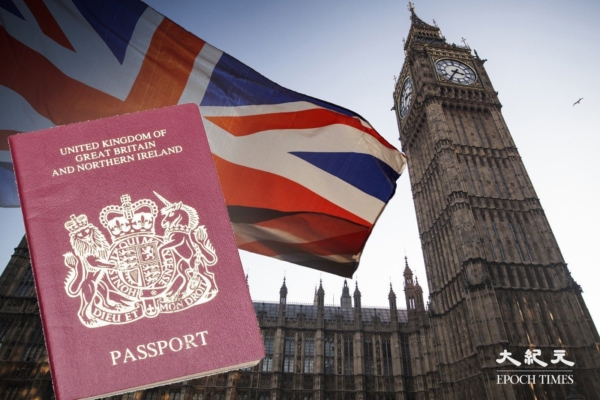
In recent news from Epoch Times on March 1st, 2026, The British National Overseas (BNO) visa scheme has been implemented for 5 years since 2021. However, the Labour Party government is considering raising the threshold for permanent residency, including raising the English proficiency requirement from B1 to B2 and adding an annual income threshold.
The Liberal Democrat Member of Parliament, Will Forster, along with over 30 members of the party, sent a letter to the Home Office on February 27th, criticizing the “midway changes” as “extremely unfair” when applicants are about to meet the criteria, urging the authorities to maintain the existing rules.
The UK government released a consultation document in November last year proposing to tighten the conditions for permanent residency. The new proposals include requiring applicants to have an English proficiency level of B2, and to provide income tax and national insurance records for the past 3 to 5 years, or meet an annual income threshold of £12,570 (approximately HKD 128,000).
The joint letter pointed out that over 200,000 Hong Kong residents have relocated to the UK through the BNO scheme, with a significant number set to reach the 5-year residency mark and qualify for settlement in 2026. Forster believes that raising the threshold at this crucial moment creates significant uncertainty for families who have made long-term plans according to the original regulations, adding “unnecessary anxiety and burden” for Hong Kong residents who have already experienced relocation and adaptation pressures.
The joint signatories expressed particular concern about the increase in language requirements without transitional arrangements, which could catch applicants preparing under the previous standards off guard. The letter warned that the new minimum income requirement may “permanently exclude” certain groups from settlement eligibility, including full-time caregivers, young students, and retirees.
For retired Hong Kong residents relying on savings or dividends for their livelihood, the new system could pose “actual economic pressures” or even significant difficulties; if unable to obtain permanent residency, some individuals may face challenges in accessing their retirement funds in Hong Kong.
The joint letter further emphasized that the establishment of the BNO visa was in response to the shrinking democratic freedoms in Hong Kong, providing a “humane pathway” for Hong Kong residents. MPs criticized that linking settlement eligibility with “quantifiable economic contributions” would contradict the original purpose of the scheme.
The letter mentioned that the UK government expanded visa eligibility to children born after 1997 in response to the Jimmy Lai case, a measure that is certainly “commendable.” However, it stressed that the authorities must maintain the current requirements to ensure the fairness and predictability of the system.
Forster urged the Home Office to refrain from making changes that are “neither fair nor well-considered” to fulfill the commitment to BNO Hong Kong residents.
According to data from the UK Home Office, since the implementation of the BNO visa scheme in 2021, over 242,000 applications have been received, with approvals exceeding 235,000 cases, resulting in an approval rate of over 97%. The data shows that in the past 5 years, 172,000 Hong Kong residents have moved to the UK, with nearly 670 cases granted permanent residency last year, some of whom initially entered on other visas before transitioning to the BNO route and obtaining settlement status early upon reaching a 5-year residency threshold.
The government previously estimated that the first batch of Hong Kong residents meeting the 5-year residency requirement will apply for citizenship within this year, with an expected number of around 92,000.
In January this year, organizations representing Hong Kong residents in the UK, including UK Welcomes Refugees, West Midlands Hongkongers Support CIC, Hong Kong Labour Rights Watch, and Re-Water CIC, released a survey regarding Hong Kong residents aged 50 or above who have moved to the UK. The results indicated that as high as 99% of respondents believed that the new policies violated promises, with nearly 95% describing the government’s actions as a “bait-and-switch.”
The survey identified this group as mainly “asset-based migrants,” with over 80% of families depending on savings for livelihood and directly contributing to the economy through tax payments and immigration health surcharge. The forced implementation of income thresholds could lead to institutional exclusion for this group.
The report mentioned that since Hong Kong residents must obtain permanent residency to withdraw Mandatory Provident Fund (MPF) savings, this policy change could create an “MPF deadlock.” The research team estimated that the total value of MPF held by BNO families aged 50 and above amounts to HKD 36.4 billion, and if unstable policies trigger capital outflows, the UK could face over HKD 34 billion in capital loss.
Citing data, the researchers indicated that only 22% of respondents who were certain about staying in the UK if the threshold were raised, while nearly 38% expressed considerations of leaving the UK or returning to Hong Kong.