
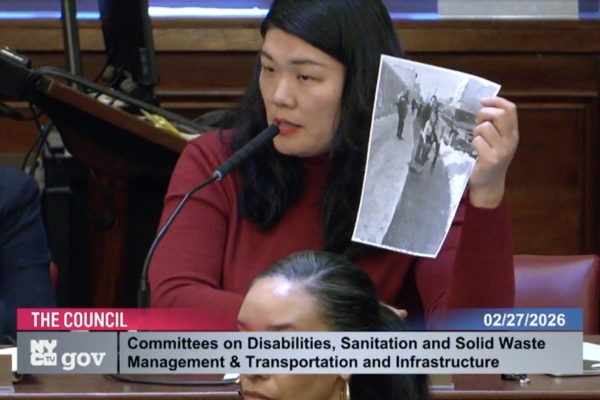
On February 27th, a joint public hearing was held by the City Council to discuss the impact of winter snow accumulation on pedestrian traffic in New York City. The Department of Sanitation (DSNY), the Department of Transportation (DOT), the Mayor’s Office for People with Disabilities Affairs, as well as representatives from community boards, business associations, and unions were present to testify. Key points of discussion included the division of responsibilities for sidewalk and bus stop clearance, the 311 complaint mechanism, and support measures for the elderly and people with disabilities.
DSNY Commissioner Javier Lojan stated during the hearing that sidewalks (including curb ramps) are legally required to be cleared by adjacent property owners, maintaining a minimum passage width of at least 4 feet (approximately 1.2 meters) and using salt or anti-slip materials when necessary.
Violations trigger inspections based on 311 complaints. Within a 12-month period, the first violation carries a fine of $100; the second violation is $150; and the third violation and subsequent ones are fined $250. Once a violation notice is issued, it will be handled by the Administrative Adjudication Office. The enforcement goal is not penalization but ensuring timely clearance of pathways to ensure pedestrian safety.
New York City has about 3,400 covered bus waiting shelters, which are maintained by the DOT contractor JCDecaux. The contract stipulates that cleaning must be completed within 4 hours after a storm, covering the interior of the shelter, a 3-foot perimeter, and pathways leading to the roadside. However, officials admitted that it is challenging to fully meet these standards during major storms.
There are over 9,000 uncovered bus stops in New York City, and the responsibility for cleaning them falls on adjacent property owners. Officials acknowledged an information gap, with many property owners unaware of their duties.
Common issues include disputes over responsibilities at multi-storefront intersections, where owners clean only the path to their own storefronts and neglect to clear pathways leading to the roadside.
Council Member William Zhuang of Brooklyn pointed out that over 17% of New Yorkers are aged 65 and older, nearly 5% are below 65 with disabilities, and approximately 20% of the elderly live in poverty. Many elders are unable to physically clear sidewalks due to limited mobility and fixed incomes that make hiring assistance financially burdensome.
In response, the DSNY stated that the department currently does not provide snow clearing services but some council members use discretionary funds to collaborate with community organizations to assist residents.
Zhuang also mentioned receiving multiple complaints on the same day regarding the area near the entrance of the N train subway station at Fort Hamilton Parkway and 62nd Street in Brooklyn, where several individuals slipped within 10 minutes due to lack of salt and snow accumulation on the sidewalk.
The DOT responded that if the area falls under its jurisdiction, they will conduct pre-treatment and salt spreading once the specific location is confirmed. Officials stated that if such incidents persist, they will work with the Brooklyn district office to improve the situation.
Zhuang also raised concerns about schools being open during snowstorms with uncleared bus stops and buses not running, yet parents not being adequately informed. He questioned whether there is clear communication between the DOT, the Department of Education (DOE), and other relevant entities.
City representatives noted that emergency preparedness is coordinated by the Emergency Operations Center (EOC), with ongoing communication between various agencies, including the DOE. The DSNY emphasized that the decision to cancel school bus services is not within their authority but assured that there is continual coordination and decision-making mechanisms among agencies.
During snowstorms, 311 temporarily stops receiving snow-related complaints until snow clearing and salting operations are complete. During the first storm, there were approximately 15,000 sidewalk-related complaints and around 4,500 violation notices issued. In the second storm, named “Hernando,” there were over 8,000 total complaints, with only 573 related to roads, with minimal complaints regarding pedestrian facilities and bike lanes.
Common issues identified include snowbanks blocking curb ramps after plowing, situations where property owners have cleared ramps only to have them blocked again by street snow, and incomplete cleaning at intersections and around fire hydrants. The city has geo-coded bus stops and commercial corridor intersections and developed a more comprehensive tracking system, while instructing operators to avoid blocking curb ramps.