
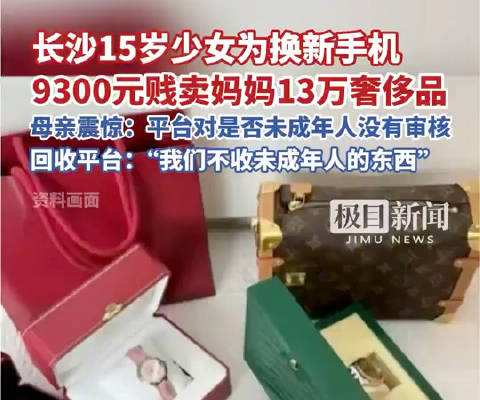
A 15-year-old girl in Changsha, Hunan, recently caught public attention for selling luxury items worth a total of 130,000 yuan in her home, including brand-name watches and backpacks, for a price of 9,300 yuan in order to buy a new cell phone.
Various media outlets in mainland China reported that on February 23, the girl sold a Cartier watch worth 46,200 yuan for 2,000 yuan, a Dior bag worth 29,500 yuan for 1,500 yuan, and a Longines watch worth 12,500 yuan for only 850 yuan.
The girl’s mother, Mrs. Ding, was shocked to discover this afterward and questioned the loophole in the identity verification process of the second-hand luxury goods recycling platform. It is still unknown whether the seller was a minor.
In response to this, the staff of the platform involved stated, “We do not buy things from minors.”
However, a student named Zhang who assisted in the transactions revealed that after being rejected for providing a minor’s ID initially, the other party asked if they could provide a family member’s identification. Eventually, the transaction was completed using an adult ID card, claiming it belonged to a “sister.”
The parents questioned that the platform not only failed to thoroughly verify the actual identity of the seller but also seemed to condone the use of others’ identification cards.
This incident has sparked widespread attention and controversy among netizens. Some netizens expressed that “parents should first reflect on their children’s education rather than questioning the existing loopholes in the recycling platform’s verification process.”
Officials from the Market Supervision and Administration Bureau of Furong District, Changsha, told mainland media that the relevant department is paying attention to this matter and is further investigating the specifics.
An article posted on the “Zhongqing Commentary” WeChat public account stated that some lawyers believe the 15-year-old girl has limited legal capacity to act, and the actual value of high-priced luxury goods has exceeded her level of understanding. The transaction behavior is not suitable for her age, intelligence, etc., rendering the contract’s effectiveness pending and generating no legal effect since the guardian refuses to acknowledge it.
Moreover, Article 157 of the Civil Code stipulates that after an invalid, revoked, or ineffective civil legal act, the person who obtained property through that act should return it; if it cannot be returned or is not necessary to return, compensation should be made at a discounted price. The party at fault should compensate the other party for the losses suffered; if both parties are at fault, each should bear corresponding responsibilities. This also means that from a legal standpoint, the platform involved should return Mrs. Ding’s luxury items or compensate for the corresponding property losses.
The article pointed out that the platform not only has verification loopholes but also suspects of inducing regulatory evasion. Luxury goods are different from ordinary second-hand items, with high unit prices and significant value fluctuations. In this transaction where items worth 130,000 yuan were sold for only 9,300 yuan, such an abnormal price difference should trigger an alert mechanism for any professional recycling organization to rigorously verify the seller’s identity, age, and the legal ownership of the items to prevent illegal transactions.
In recent years, cases of minors making large online purchases or game recharges through their parents’ phones have frequently appeared in the news, reflecting some children’s lack of financial awareness.
The article emphasized that the absence of family education is an undeniable underlying factor. The 15-year-old girl is in a critical period of forming values, and in her current understanding, those brand-name watches and backpacks may only be “things that can be exchanged for money.” She is not aware of the true value of these items, struggles to comprehend the effort her parents put into acquiring these possessions, and does not understand the responsibility of unauthorized disposal of others’ valuable items without the guardian’s permission.