
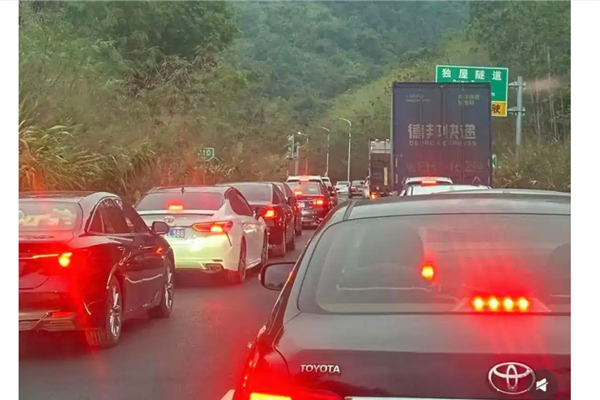
On February 23 (Monday), as the Chinese lunar New Year holiday neared its end, many highways across the country experienced a peak in returning traffic, leading to long-lasting congestion and near standstills in several areas. Multiple self-driving travelers reported that what was originally a journey of over ten hours had stretched to twenty or thirty hours or even longer, with service areas seeing queues extending for kilometers. Netizens commented that the highways had essentially turned into massive parking lots.
Ms. Ai from Suzhou posted on social media that she had set off from Hubei to return to Suzhou in the early hours of the sixth day of the lunar New Year (February 22). Despite choosing to travel at night to avoid peak times, she encountered intermittent congestion throughout the journey. She described the situation as “several kilometers of traffic jams each time, waiting for one to two hours each time, with the car barely moving.” A journey that was originally expected to take just over ten hours ended up taking her more than twenty hours to complete. To minimize restroom stops, she refrained from drinking too much water on the way and felt constantly anxious and exhausted throughout the trip.
Ms. Ai mentioned that once the seventh day of the lunar New Year (February 23) passed, tolls resumed on the highways, prompting many people to rush back in the final two days. She had also planned to travel at night in an attempt to avoid peak times, only to find herself still stuck on the road. She expressed, “I thought about taking the provincial roads, but heard that they were also congested.”
Ms. Xie from Shangrao, Jiangxi, and her family were returning from Changde, Hunan when they encountered severe congestion near Changsha, forcing them to exit the highway and stay overnight. She said, “The service area had queues that stretched for two to three kilometers, making it impossible to enter, so we had to find a place to stay for the night.” The next day when they resumed their journey, their child started feeling carsick, vomiting, and becoming increasingly restless all along the way.
Videos circulating on social media showed vehicles bumper to bumper in many sections, with some drivers shutting off their engines, stepping out of their cars for activities, and even laying out mats at the roadside to rest. One netizen humorously commented, “Everyone is trying to ‘avoid the peak,’ but ended up crashing into the same peak.”
Official data revealed that on February 22 and 23, the national highway traffic flow reached a temporary high. In some areas, combined with rainfall and temperature drops, the slippery road conditions and frequent minor accidents further exacerbated the traffic pressure.
The prolonged delays also left many families physically and mentally exhausted. Some parents expressed, “Children are hungry and feeling carsick again, I dare not even take one more sip of water.” The frustration and helplessness on the return journey became a true reflection of the closing days of the lunar New Year holiday.
Some netizens bluntly stated that traffic jams are not sporadic but rather a systemic problem that “repeats every year.”
Industry experts analyzed that in recent years, the number of private cars has been steadily increasing, while the expansion of major highways has been relatively limited. The combination of holiday toll exemptions and concentrated return trip demands leads to a rapid buildup of traffic on a few specific routes, making way for “tidal congestion.” Additionally, navigation platforms’ route algorithms tend to converge, potentially directing a large number of vehicles towards similar paths, amplifying pressure on specific congested points.
Commenting on these challenges, netizens remarked, “It’s congested every year, yet we keep traveling the same way every year, this is the reality.”