
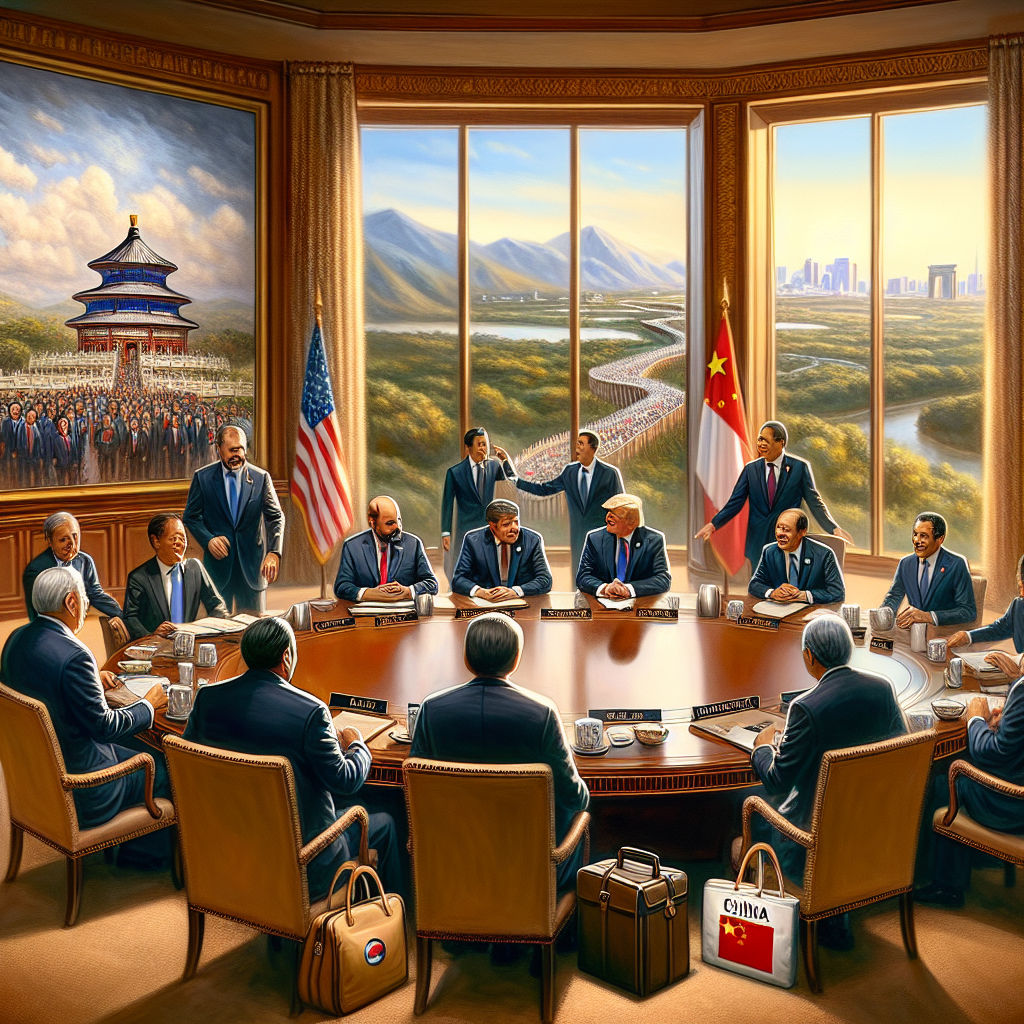
According to media reports, President Trump has invited leaders from Latin American countries to attend a summit on March 7 in Florida. The White House has emphasized concerns about Beijing’s influence in the region. Following this summit, Trump is expected to embark on a visit to China.
The summit for Latin American leaders, as confirmed by a White House representative, will be held at Trump’s Mar-a-Lago estate in Miami. It is expected to bring together presidents from countries such as Argentina, Paraguay, Bolivia, El Salvador, Ecuador, and Honduras, all of whom have close personal relationships with Trump.
Analysts report that Trump is convening this summit to counter China’s expanding influence in Latin America. Washington has increasingly emphasized the geopolitical competition between the US and China in the Western Hemisphere. The upcoming meeting of Latin American leaders is aimed at strengthening coordination and policy coherence between the US and its regional partners.
The Trump administration has made maintaining its dominant position in the Western Hemisphere a top priority. China has been steadily building and expanding its influence in the Latin American region through extensive loans and wide-ranging trade.
General Dan Caine, Chairman of the Joint Chiefs of Staff, convened a meeting this week in Washington with defense ministers and senior military officials from 34 Western Hemisphere countries. During the meeting, Defense Minister Pete Hegseth stated that the Trump administration aims to “achieve lasting peace in this hemisphere.”
On January 3, the US launched a large-scale operation codenamed “Operation Absolute Resolve.” This mission successfully coordinated military strikes, deployment of special forces, and neutralization of air defense systems in Caracas and its surrounding areas.
During a pre-dawn raid, Venezuelan President Nicolás Maduro and his wife Cilia Flores were captured by US forces and subsequently sent to the United States. They will face federal charges, including drug trafficking and drug terrorism.
President Trump declared the success of the operation and described it as a necessary measure against drug crime. He also announced that the US will oversee the political transition process in Venezuela and suggested that US oil companies could participate in restoring and repairing the country’s energy infrastructure.
A few days after Maduro’s arrest, Trump met with oil industry officials at the White House and stated: “One thing everyone needs to know is that if we don’t do this, China or Russia will.” Beijing is the largest buyer of Venezuelan oil and a political ally of Maduro.
Trump also expressed intentions to wrest control of the Panama Canal back from Beijing, emphasizing its vital importance to the US and highlighting that it is operated by China.
Recently, the Supreme Court of Panama annulled contracts for two ports operated by CK Hutchison, a Hong Kong-based company, on the canal.
Additionally, the Trump administration expressed concerns this week over Chinese control of critical infrastructure in Peru. A court ruling in Peru previously limited local regulatory oversight of the Chancay Deepwater Port built by a Chinese company.
The State Department’s Bureau of Western Hemisphere Affairs voiced support for Peru’s exercise of sovereignty over critical infrastructure within its own territory, cautioning that cheap Chinese funding could undermine sovereignty in the region and globally.