
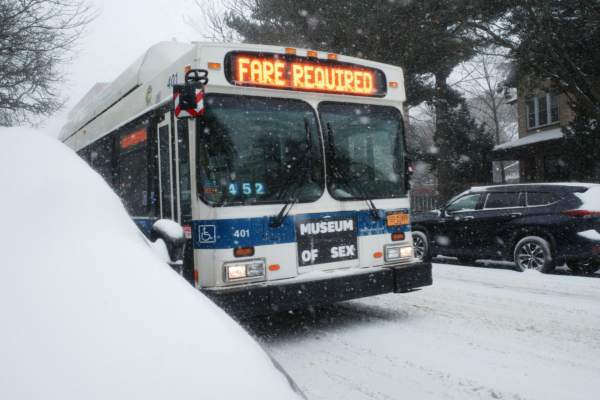
New York City Mayor Mamdani has recently revisited his campaign promises from last year and proposed a five-week “Free Bus” program during the 2026 FIFA World Cup, aiming to test the impact of free public transportation on commuting efficiency, city operation, and the cost of living for residents.
According to reports from multiple English-language media outlets, Mamdani’s envisioned free measures would cover all bus routes across the city and coincide with the period when the FIFA World Cup football matches are held in North America. As one of the important cities for matches and spectators, New York is expected to welcome a large number of domestic and international tourists. The city government hopes that by offering free bus services, they can reduce traffic pressure, encourage people to use public transportation, and alleviate congestion on roads during the event.
Mamdani stated that the free bus service is not only to meet the demands of World Cup tourism but also a part of his policy focus on “reducing the cost of living and expanding public services.” He has long advocated that buses are the most relied upon mode of transportation for many low-income workers, students, and the elderly. By waiving fares during a specific period, families can save expenses, and actual data can be collected to evaluate whether this policy can be expanded or normalized in the future.
However, offering free bus services involves significant operating costs, and coordination is still needed with the state and relevant agencies to arrange financial resources. It remains uncertain whether the city government can obtain state budget subsidies, special project allocations, or rely on the economic benefits related to the World Cup to support this initiative. Supporters believe that the tourism income brought by the World Cup is sufficient to offset the short-term transportation subsidies, while opponents worry whether ending the trial period will create long-term financial pressure and policy expectations mismatch.
Analysts point out that the World Cup period sees a high density of people and a surge in transportation demand, making it a perfect “stress test” for the free bus policy. If the results are significant, it could provide important insights for future public transportation reforms in New York; conversely, operational chaos or cost control issues could become key arguments for the opposition.
Currently, the city government has not released detailed implementation timelines and financial estimation plans. Mayor Mamdani has clearly stated that this five-week trial program will be an important step in fulfilling his campaign promises and showcasing a new direction for public transportation to the voters.