
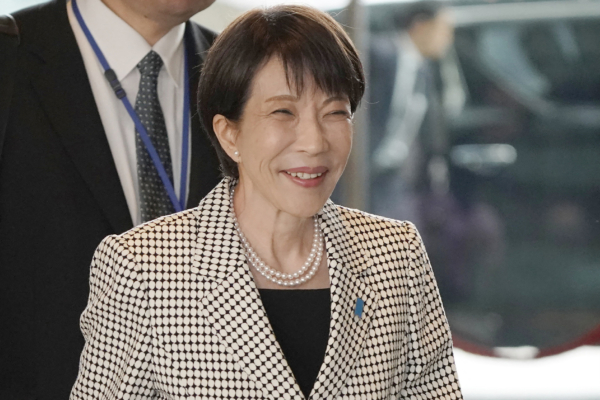
In the Japanese House of Representatives election held on Sunday, February 8, the Liberal Democratic Party (LDP) achieved a historic victory. Several data indicate that the high level of attention on Prime Minister Sanae Takichi on social media during the election campaign may have substantially influenced voters’ behavior, becoming one of the crucial factors affecting the election outcome.
Yomiuri Shimbun’s analysis pointed out that unlike previous elections where party-wide promotion was the main focus, in this election, Takichi’s personal image became the core of discussions on social media. Many voters repeatedly watched her speeches and edited video clips on their smartphones, creating a sense of closeness, ultimately translating this sentiment into support for LDP candidates.
A 25-year-old company employee from the northern district of Tokyo, interviewed, mentioned that he almost daily watched Takichi’s speech videos or edited clips on his phone. The videos depicted her continuing to campaign tirelessly despite being ill, giving a sense of her determination, which led him to vote for the LDP candidate in his constituency.
The voter admitted that he understood social media algorithms would continuously push similar content, but said that “seeing the same person every day naturally creates familiarity and trust.”
In comparison to the previous summer’s House of Councillors election, where he supported the Constitutional Democratic Party due to the abundance of social media content related to “increasing actual income,” it demonstrates that under the social media environment, voters’ attitudes have high fluidity.
According to Yomiuri Shimbun’s analysis using the SNS analysis tool by the Japanese data analysis company User Local, during the campaign, the official social media accounts of party leaders saw growth in followers, but Takichi’s increase was the most significant, with around 35,000 new followers, far exceeding other party leaders.
February 1 became the peak of growth, with a daily increase of approximately 10,300 followers. On that day, Takichi temporarily missed the party leader debate program hosted by the Japan Broadcasting Corporation (NHK) and later explained in a post on her platform that her worsening condition of rheumatoid arthritis in her hands due to injuries from shaking hands with supporters required treatment. After the treatment, according to the original plan, Takichi continued to give street speeches in Gifu, Aichi, and other places.
This incident sparked mixed reactions online. Some netizens criticized her for “avoiding the debate,” but a significant number expressed sympathy, calling her absence the “cost of adhering to on-the-ground politics.” Some posts defending her garnered views in the millions, further boosting her online presence.
In contrast, although the official social media accounts of the LDP also saw growth, the increase was significantly lower compared to Takichi’s personal account, indicating that voters’ focus shifted highly towards Takichi herself in the later stages of the campaign.
On video platforms, the total views of the official videos (including paid advertisements) released by the LDP from a week before the election announcement to the eve of the voting day exceeded 200 million times. Among them, the video ad featuring Takichi with the theme “The future is in your hands” surpassed 150 million views.
Tanihara Nozomi, associate professor of social informatics at the Ritsumeikan University in Japan, pointed out that paid promotions alone cannot guarantee viewership, and Takichi’s personal appeal is a critical factor in significantly amplifying traffic.
Statistics from the election information website “Selection.com” show that between January 27 and February 5, the total views of videos related to the House of Representatives election reached approximately 1.86 billion times, with about 80% generated by third-party creators not affiliated with political parties or candidates. These content mainly consisted of edited videos highlighting Takichi’s assertive moments in debates or demonstrating a strong stance on policies concerning China.
The website’s chief editor Suzuki Kunikazu and analysts believe that many creators aiming to monetize traffic produced a large number of related videos leveraging Takichi’s popularity, further expanding exposure, potentially becoming a crucial driving force for the LDP to achieve an overwhelming victory.
On the day of the vote, an exit poll conducted by Yomiuri Shimbun in conjunction with NHK and Japan TV station series showed that 24% of respondents stated that “SNS and video platforms” were the most significant source of reference when deciding on their voting choice.
Within this group, 35% voted for the LDP in the proportional representation election, significantly higher than the 7% in the House of Councillors election last summer. Conversely, the support for opposition parties like the Constitutional Democratic Party experienced a decline, indicating that voters relying on SNS for information have shifted their support towards the LDP with Takichi as its central figure.