
The Chinese Communist Army, with approximately two million troops, had previously engaged in battles in North Korea. After suffering heavy losses, they only dared to claim a draw against 300,000 American and United Nations troops externally, while internally they falsely declared victory. From the arrogant surprise attack at the beginning to being pinned down at the 38th parallel, the battles of the Korean War still hold real significance today.
Continued:
The Chinese Communist propaganda about the Battle of Shangganling is not at Shangganling—how the Chinese Communist Army was stunned on the Korean battlefield (Part Twenty).
In November 1952, Eisenhower was elected President of the United States and, before taking office, went to the Korean Peninsula to seek possible avenues to end the war. As the former Supreme Commander of the European Allied Forces, he had commanded the Normandy landings and defeated Nazi Germany. Eisenhower announced that he would end the Korean War through “action” rather than “talk.” Subsequently, the U.S. military conducted an amphibious landing exercise, causing panic among the Communist Chinese leadership.
On December 4, Mao Zedong telephoned Deng Hua, stating:
1. “We should affirm that the enemy will have a massive landing of five to seven divisions along the Hanchuan Yalu River line and also air-drops behind our positions, likely in the spring or even earlier. I must reinforce the bunkers and tunnels significantly, deploying five armies in this line, including four experienced ones, marking defense zones, resolutely preventing enemy landings, without any mistakes.”
2. “The second dangerous landing zone is the Tongchuan Wonsan line, and the third is the Jinnampo Hanchuan line.”
3. “Under no circumstances must the enemy be allowed to land on the west coast, especially on the Hanchuan Yalu River line.”
The Chinese Communist Army further increased its troops in Korea to counter potential multiple amphibious landings by the U.S. military and, in late 1952, reignited the conflict.
In December 1952, a fierce battle erupted between the Chinese Communist Army and the South Korean army on the eastern bank of the Imjin River at the Big and Little Nori Hills. The South Korean army held the Little Nori Hill, while the Chinese Communist Army occupied the Big Nori Hill. The Chinese Communists attempted to take the Little Nori Hill, while the South Korean army also counterattacked the Big Nori Hill, the battle was known as the Battle of the Noris.
On December 11, the 140th Division of the 420th Regiment of the 47th Group Army of the Chinese Communists suddenly attacked the South Korean army’s positions on the Little Nori Hill. After three hours of intense fighting, the South Korean army retreated to the 69th Highland 270 meters east of the Little Nori Hill before launching two counterattacks but failed to regain the position. Another South Korean unit replaced them, attacking to the top of the Little Nori Hill.
During the night, the Chinese Communist Army reinforced and launched another attack, causing the South Korean army to retreat once more. Six B-26 bombers from the U.S. dropped over a hundred cluster bombs on the high ground and continuous U.S. artillery fire, resulting in heavy casualties for the Chinese Communist Army. However, the four subsequent counterattacks by the South Korean army the next day were unsuccessful.
On the morning of December 13, the South Korean army recaptured the Little Nori Hill, repelling the Chinese Communist Army’s counterattacks at night. From December 14 onwards, the fighting between both sides reached a stalemate.
The battles at the Big Nori Hill and the Little Nori Hill took place in an area 270 meters wide and 180 meters deep. The United Nations forces fired 120,000 artillery rounds, 31,000 mortar rounds, more than 4,500 tank rounds; aircraft flew 177 sorties. The Chinese Communist Army fired over 18,000 artillery shells and mortar rounds.
The South Korean army suffered approximately 750 casualties, with 237 killed. The Chinese Communist Army estimated casualties between 2,290 to 2,732. An absconder from the 420th Regiment of the Chinese Communist Army later confessed that the regiment suffered heavy casualties during the battle and was withdrawn from the frontline.
In January 1953, the intensity of the fighting in the region decreased, but both sides still occasionally carried out raids. On January 23, the South Korean army broke into the Great Nori Hill position, destroying the Chinese Communist Army’s defenses, and safely withdrew.
This is another battle that the Chinese Communist Party is reluctant to mention, not only because of high casualties and the failure to achieve objectives but also because they were defeated once again by the South Korean army.
During the last three months of 1952, the United Nations forces fired 3,553,518 field artillery shells, and 2,569,941 mortar rounds. The Chinese Communist Army fired 377,782 field artillery shells, and 672,194 mortar rounds, with a firefight ratio of 5.8:1. Facing the intense artillery fire of the United Nations forces, the Chinese Communist Army was clearly at a disadvantage but still employed human wave tactics, disregarding the casualties among their soldiers.
On January 20, 1953, Eisenhower assumed the presidency of the United States, announced plans to expand the war and use nuclear weapons to end the Korean War promptly. However, he did not order reinforcements to the Korean Peninsula but continued to push for ceasefire negotiations.
On February 2, 1953, Eisenhower delivered the State of the Union Address, declaring the neutralization of the Taiwan Strait and persuading countries to collectively support a blockade against the Chinese Communist Party. On February 11, the United States began planning to use tactical nuclear weapons in the vicinity of Kaesong, but the plan was not executed as negotiations progressed.
In 1953, entering the fourth year of the Korean War, the Chinese Communists were still unwilling to agree to a ceasefire, continuing to sacrifice soldiers’ lives and limited resources in a futile, entrenched war.
Meanwhile, ceasefire negotiations proceeded intermittently for two years, with the Chinese Communist Army unwilling to compromise on the issue of repatriating prisoners of war. Many captured Chinese soldiers and even more North Korean soldiers refused to return to mainland China or North Korea. To avoid political embarrassment, China continued the war of attrition.
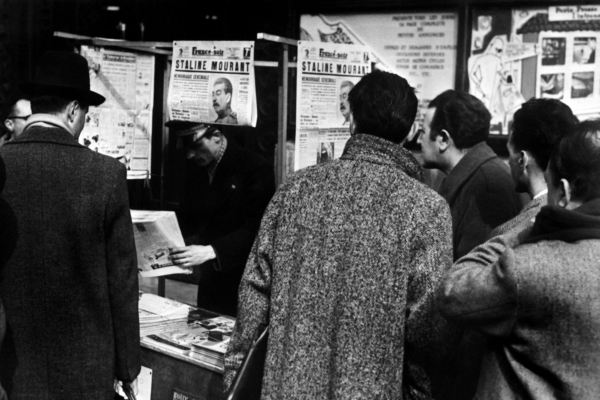
On March 5, 1953, Stalin passed away. The top echelons of the Soviet Communist Party were embroiled in internal power struggles and were no longer willing to support the Chinese Communist Party’s obstinate approach to the Korean War. Instead, they openly called for a ceasefire. In the spring of 1953, the Soviet Air Force withdrew 40% of its deployed fighter planes from Northeast China. Under continuous air raids by the UN forces, Kim Il-sung desired peace, but the Chinese Communists continued to fight.
Under normal circumstances, without Soviet support, the Chinese Communist Army would have found it even more challenging to sustain itself on the Korean battlefield. However, Stalin’s death fueled Mao Zedong’s ambitions once more. Mao believed he could vie for leadership within the communist bloc, viewing the Korean War as a tool to enhance his political prestige.
On March 22, Zhou Enlai informed Mao Zedong that the Soviet side proposed “preparing to compromise on the prisoner of war issue to gain the initiative for peace… those unwilling to return should be temporarily handed over to neutral countries.”
Faced with the Soviet attitude, Mao felt helpless. On March 28, Kim Il-sung and Peng Dehuai corresponded with Clark, proposing to resume negotiations. On March 30, Zhou Enlai issued the “Statement on the Issue of Ceasefire Negotiations,” stating, “Both sides should ensure the immediate repatriation of all prisoners of war they hold after the ceasefire and transfer the remaining prisoners of war to neutral countries.”
Under pressure from the Soviet Union, the Chinese Communist Party had to suddenly make concessions in the ceasefire negotiations. Consequently, the United States did not use tactical nuclear weapons, partly saving the lives of many Chinese Communist soldiers. However, Mao was unwilling to accept this and ordered the Chinese Communist Army to continue the attack.
Vegas was one of the three advanced outposts on the western front of the United Nations, referred to as “Nevada City,” located at an altitude of 300 meters and named for its terrain resembling pork chops. On the night of March 26, the Chinese Communist Army simultaneously attacked the UN’s Vegas, Carson, and Reno outposts and several nearby forward positions. Chinese artillery fire severed the communication lines between the Vegas outpost and the U.S. command center, forcing the U.S. Marine Corps to retreat in the face of the Chinese Communist’s human wave tactics.
The Chinese Communist Army captured the Vegas and Reno outposts. In response, U.S. Marine Corps counterattacked, estimating around 600 Chinese Communist casualties but were ordered to hold the positions persistently.
On March 27, the U.S. Marine Corps reorganized for a counterattack, focusing on attacking the Vegas outpost and successfully securing the hilltop by the afternoon but the Chinese Communist Army continued to occupy the other side of the hill.
On March 28, the U.S. Marine Corps’ 1st Air Wing Squadron dropped approximately 28 tons of bombs in 23 minutes, decimating the remaining Chinese Communist troops. The Marine Corps regained control of the position and repelled the counterattack of a Chinese Communist battalion.
From March 29 to 30, despite casualties, the Chinese Communist Army persistently attacked. After the two regiments suffered losses of around 4,000 men, they were forced to halt.
During this battle, 141 American soldiers were killed in action, 29 later died from severe wounds, 701 were evacuated after being injured, 510 were injured but not evacuated, and 104 went missing. The Chinese Communist Army had 1,351 killed in action, 3,631 wounded, and 4 captured.
The Chinese Communist Army suffered heavy losses in March but failed to achieve its goals. On April 6, both sides held talks on repatriating wounded and sick prisoners of war and reached a full agreement on April 11. As progress was made in ceasefire negotiations, further senseless sacrifice of soldiers should have been unnecessary. However, in mid-April 1953, Mao Zedong telephoned Deng Hua, stating, “strive for a ceasefire, prepare to delay. Military-wise, plan for a delay, just fight, pay no attention to negotiations, do not slack off, continue with the original plan.”
On May 25, the Chinese Communist Army again carried out human wave tactics, attacking the Vegas outpost. After four days of heavy fighting, although U.S. casualties were far fewer than the Chinese Communist troops, the UN command did not want to become entangled in a war of attrition and ordered the complete abandonment of the position.
Chinese Communist propaganda about the Korean War continuously claimed to have forced the Americans to cease fire, when in reality, the opposite was true. The Americans and UN forces always sought a ceasefire. The Chinese Communists, however, refused to stop, continuing to throw a significant number of soldiers into the meat grinder on the battlefield in the final months of the war. The Communist’s distortion of facts in their propaganda was merely to cover up the reckless decisions at the top levels, a practice that persisted even over 70 years later.
Pork Chop Hill, standing at an elevation of 300 meters and named after its terrain, played a critical role in the battles during the Korean War. In April 1953, two large-scale battles erupted on April 16 and July 11. The Chinese Communist Army referred to it as the Battle of the Northern Peak of Shixiandong.
On the night of March 23, 1953, the Chinese Communist Army launched an assault with a regiment on the outpost 266 near Pork Chop Hill under artillery support, capturing the nearby Bald Head Mountain. At that time, one platoon of American soldiers and a platoon of the Columbia Regiment were undergoing rotation; they held the position for two days but, to avoid a war of attrition, the UN command ordered them to abandon the hill. This left Pork Chop Hill vulnerable to attacks from three sides, and the Chinese Communist troops probed nightly.
At that time, ceasefire negotiations were ongoing, and both sides agreed to exchange sick and wounded prisoners on April 20.
Shortly before midnight on April 16, a Chinese Communist regiment launched an attack on Pork Chop Hill under artillery support, forcing the U.S. 31st Infantry Regiment Company E to retreat. In the early hours of April 17, the U.S. soldiers launched a counterattack, retaking Pork Chop Hill after 20 hours of intense fighting.
On the early morning of April 18, the Chinese Communist troops launched another attack with a regiment-level force, but were repelled by the Americans.
In this battle, the UN forces fired over 77,000 artillery shells, and the Chinese Communists also used a similar number of artillery rounds. Both sides engaged in close combat using small arms, grenades, explosives, flamethrowers, and frequent hand-to-hand combat.
The 1959 film “Pork Chop Hill,” based on the book “Pork Chop Hill: American Soldiers in the Korean War, Spring 1953,” depicted the brutality of this battle.
The U.S. casualties in this battle totaled 104 killed in action, 373 wounded. The Chinese Communists did not publicly disclose the casualties of this battle, but given the scale of regiment-level operations against the U.S. platoons, their casualties were likely several times higher.
(To be continued)