
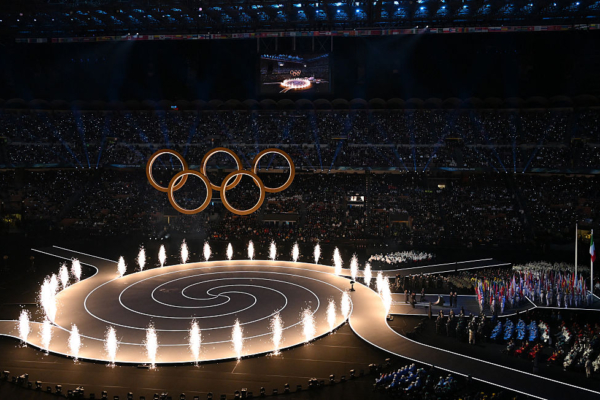
At the age of 99, the legendary San Siro Stadium was illuminated by dazzling lights, transforming the football temple into the world’s largest fashion runway.
As pop diva Mariah Carey appeared in a silver gown singing the timeless classic “Volare,” the Milano Cortina 2026 Winter Olympics officially announced the moment of fusion between sports and Italian aesthetics.
Here are eight highlights not to be missed at this year’s Winter Olympics:
The iconic San Siro Stadium, with 99 years of history, is set to be demolished in 2027. The opening ceremony of this Winter Olympics is not only a celebration but also a brilliant “swan song” before the closure of this football cathedral, leaving countless football fans around the world in tears. The celebration began with a graceful ballet performance at La Scala and paid tribute to the late fashion legend Giorgio Armani who passed away in September last year.
Milan, the world’s fashion capital, was jokingly referred to as a “Fashion Week venue” for this opening ceremony. There were a staggering 1,400 outfits for just the performers and staff, costing nearly 25,000 feet of top-notch fabrics. The host country Italy’s team uniforms were designed by the late Armani himself, featuring the classic “elegant blue,” the iconic star-striped style by Ralph Lauren for the US team, and various national fashion suits including Lululemon for the Canadian delegation, turning the Olympics into a high-fashion show on ice and snow.
The theme of the opening ceremony was “Harmony” (Armonia) and it pushed the limits of technology. During Laura Pausini’s performance of the national anthem in Milan, the Cortina mountain choir, located five hours away and 250 miles apart, provided real-time accompaniment.
Both locations simultaneously lit the Olympic cauldron, a first in Olympic history.
This is not just a arena for top athletes but also a historical stage for the exchange of new and old legends. 21-year-old American speed skating prodigy Jordan Stolz was hailed as a “war machine” by the Dutch media; while 44-year-old Michigan veteran Nick Baumgartner vowed to break the age limit and continue his snowboarding legend.
A new event, Ski Mountaineering (Skimo), was held in Bormio. Athletes had to endure the terrifying cycle of “climbing on skis, hiking with boards on their backs, and skiing down with skins removed” on a course with huge altitude differences.
This sport, known as the “snow marathon,” is the event of this year that best demonstrates the limits of human physical fitness.
Since the 2014 Sochi Winter Olympics, top players from the North American National Hockey League (NHL) have been allowed to participate in the Winter Olympics for the first time. This means that ice hockey will bid farewell to the “amateur era” and return to the world’s highest level of competition. With stars like Connor McDavid all in attendance, tickets have long been in high demand.
Due to the soaring global gold prices, the value of a gold medal at this Olympics is around $2,300 (double that of the 2024 Paris Olympics), while a silver medal is valued at about $1,400.
The medals were meticulously crafted by the Italian Mint, setting historical records in both market value and artistic achievement.
This year’s mascots are two super cute white stoats: Tina and Milo.
Tina, with light fur, represents creativity and endurance, and is the mascot of the Winter Olympics. Milo, with brown fur, represents inclusivity and is the mascot for the Winter Paralympics that will follow. Despite being born without a right foot, Milo learned to walk on his tail, symbolizing the optimistic spirit of “disabled but not defeated” and the courage to overcome obstacles.
The Italian warmth displayed by this sibling pair has received excellent reviews on social media, with surrounding products currently experiencing shortages.
The events of this year are spread over an area of 22,000 square kilometers, with 90% of the facilities being existing or temporary structures. This “no new buildings, no burden left behind” model of hosting events is becoming the new standard for future Olympics.